

Haredi rabbis push English-speakers to dodge IDF draft, worried they might join up
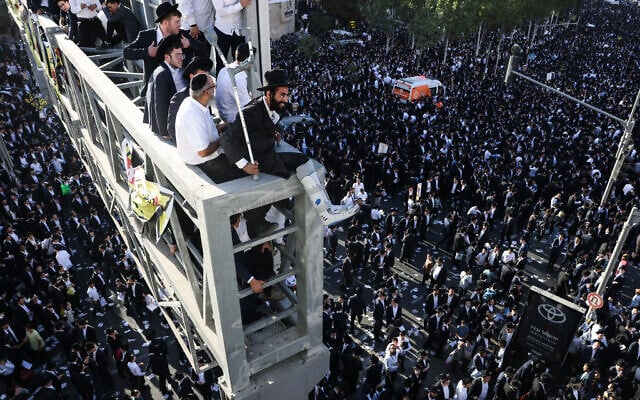
On July 9, hundreds of members of Israel’s ultra-Orthodox community gathered at Jerusalem’s Mount Herzl military cemetery to accompany one of their own to his final resting place.
Two days earlier, Moshe Shmuel Noll, a 21-year-old member of the IDF’s Netzach Yehuda battalion serving in Gaza, had been killed along with four other troops in a roadside bombing.
Speaking at the funeral, Noll’s older sister Gila said her brother had “loved our nation with all your heart, and no matter how dangerous it was, you knew this is what you had to do.”
That “sense of mission,” in her words, stands largely at odds with the overwhelming opposition to military service in the mainstream Israeli Haredi community, whose leadership is currently pushing for legislation exempting full-time yeshiva students from conscription.
But it’s an approach shared by many English-speaking ultra-Orthodox immigrants and their anglophone offspring.
Noll’s parents, ultra-Orthodox Jews affiliated with the Chabad Hasidic movement, had moved to Israel from South Africa over two decades ago. When he was killed, the family was living in Ramat Beit Shemesh A, a bedroom community in the hills west of Jerusalem that is both a major Haredi stronghold and home to a large number of English-speaking families with roots in the US, Canada, UK, Australia or South Africa.
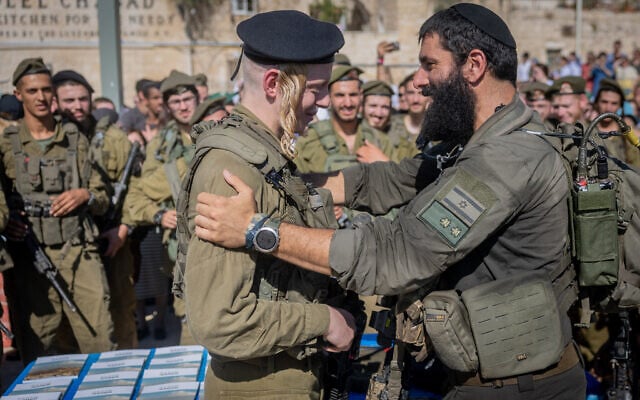
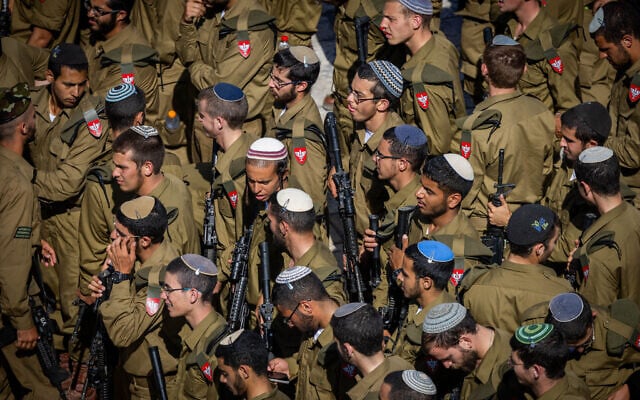
That mix means that, more than many other ultra-Orthodox communities, the sight of uniformed soldiers wearing black velvet kippas is not uncommon in Ramat Beit Shemesh A.
But while some prominent rabbis have embraced enlistment and pushed for the establishment of ultra-Orthodox service tracks, others see the willingness of members of their community to join up as a threat to their shared way of life, which is predicated on successfully separating from mainstream society.
‘Enforced secularization’
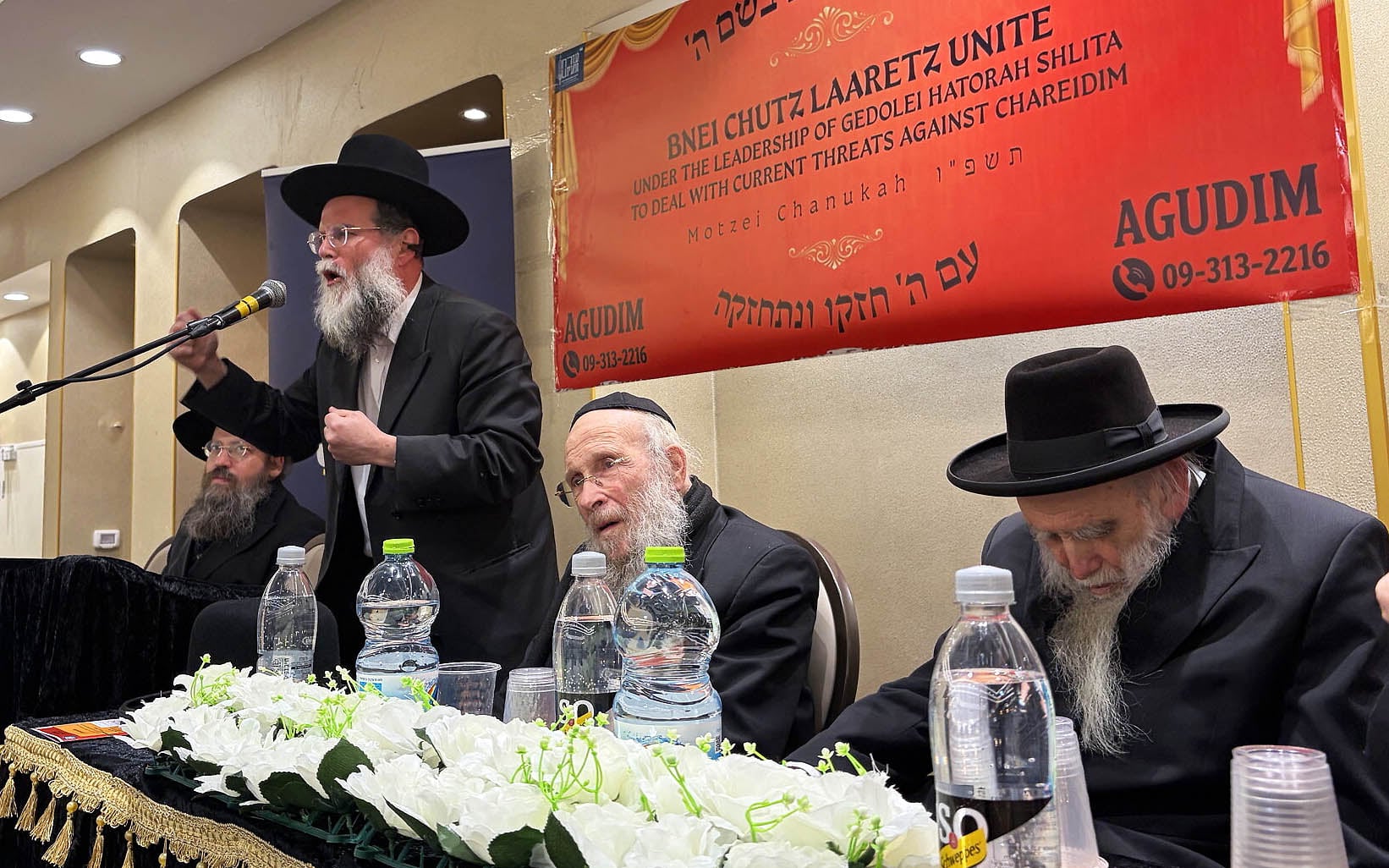
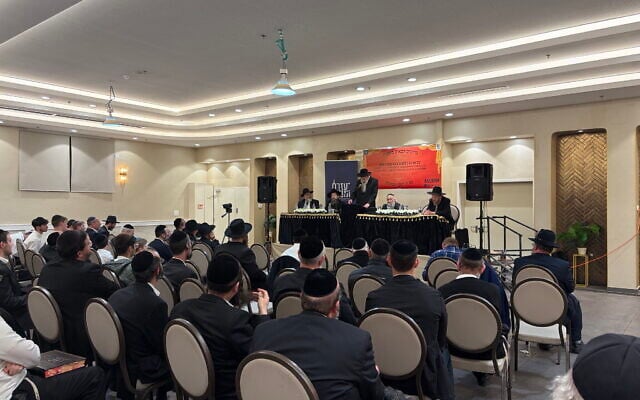
On Tuesday night, not far from where the Noll family’s home is, several of those rabbis took to the stage at an event billed as helping English speakers “to deal with the threats and temptations of the IDF against the Haredim.”
Some 80,000 ultra-Orthodox men aged between 18 and 24 are currently believed to be eligible for military service, but have not enlisted, relying on the continuation of longstanding exemptions afforded the community but deemed illegal by a court ruling last year.
The Israel Defense Forces has long attempted to encourage ultra-Orthodox enlistment, including by creating service tracks for Haredi conscripts such as the Netzach Yehuda battalion that Noll served with, but has met with only middling success.
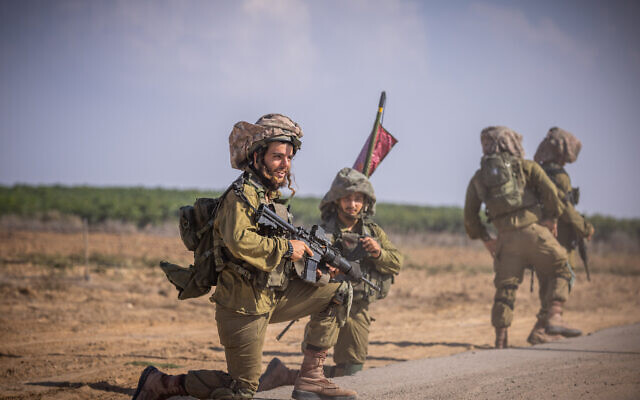
While there is no hard data regarding the enlistment rate among members of the so-called “Anglo” Haredi community, anecdotally, English speakers appear to be over-represented in Netzach Yehuda and other Haredi-focused units.
Lt. Col. (Res.) Yossi Levy, the head of a non-profit which supports the Netzach Yehuda battalion, said Anglos made up a sizable portion of the unit’s draftees. “There’s a lot, he said.”
On Tuesday, as a few members of the city’s national-religious and moderate Haredi populations held a small protest outside, dozens of black clad ultra-Orthodox men streamed into the event hall in the basement of a local synagogue to hear a series of speeches, including by Rabbi Aharon Feldman, the dean of Baltimore’s Yeshivas Ner Yisroel and a member of the Council of Torah Sages for Agudath Israel of America, a leading umbrella group representing the American ultra-Orthodox community.
A table near the entrance contained pamphlets explicitly encouraging draft evasion and claiming that the IDF had repeatedly failed to live up to its promise to provide Haredi recruits with suitable conditions.
Instead, the pamphlets warned, recruits would be subject to “enforced secularization” because those pushing for Haredi enlistment only want “to cancel” the Torah and lead a process of “assimilation” for the entire community.
The event, which was seemingly sponsored by Ezram Vemaginum, an organization that assists those trying to evade enlistment, and a little-known group called Agudim, also featured literature in English explicitly calling on people to skip the draft and providing contact information for several draft evasion hotlines and organizations.
One by one, the rabbinic lineup of speakers inveighed against the draft and encouraged non-compliance with rules mandating enlistment for young men.
Standing in front of a large red banner calling on those from outside Israel to “unite under the leadership of the [great rabbis] to deal with the current threats against Haredim,” the speakers presented Jews as a higher species that must be shielded from outside influences, including the military.
Claiming incorrectly that only Israel and North Korea conscript women, Rabbi Yehoshua Eichenstein, the American-born dean of Jerusalem’s Yad Aharon yeshiva, argued that efforts to reach “equality of the burden” of military service were part of a “progressive” effort to turn Israelis into “goyim.”
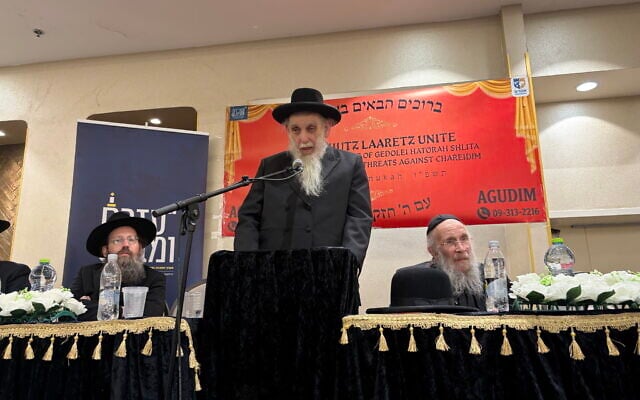
Eichenstein also denigrated national-religious hesder yeshivas (which combine military service and Talmud study) and claimed that conscripts, including 80 percent of those in Netzach Yehuda “do not remain observant.”
Asked by The Times of Israel about the claim, Lt. Col. (Res.) Yossi Levy, the head of a non-profit which supports the Netzach Yehuda battalion, said data that he had collected showed that those who served in the unit had “either maintained their identity or grew on a spiritual level.”
“More than 85% emerged as observant of Torah and mitzvot,” he claimed.
Though heated, much of the rhetoric employed at the event was standard for the ultra-Orthodox mainstream, which has objected to the draft by claiming that joining the military will lead to cultural assimilation, drawing adherents away from the community, and placing them in situations in which they will be unable to adhere to strict religious rules dictating dietary laws and gender separation.
They have also argued that yeshiva students contribute to the country’s defenses by invoking divine assistance.
Feldman emphatically declared that secular and ultra-Orthodox Jews “can never join with each other” and that forcing Haredim to serve together with their non-religious counterparts for three years is “undemocratic” and “a violation of human rights.”
Secular Zionists are “headed for oblivion” while Haredim are “guaranteeing the survival of the Jewish people,” he continued. “Therefore, we cannot permit our children to lose their Jewishness, we cannot permit them to go to the army as it is constituted now” where “50% at least, and probably more come out not religious.”
In fact, there is evidence that most who enter the army as “ultra-Orthodox” have already left the community. The army’s standard, currently under debate, is to classify any recruit who studied in a Haredi high school for two years as ultra-Orthodox, regardless of whether they are still observant when they join up.
According to a report released by the Israel Democracy Institute on Sunday, 55% of Haredi recruits serve in non-Haredi tracks, an indication that the “majority of those counted as ultra-Orthodox in the IDF are not ultra-Orthodox or have since left the Haredi community.”
Researchers say that evidence of growing numbers of young people dropping out of the community is unrelated to the military draft.
“The claim that most religious people who enlist in the army become secular is certainly not true,” Ariel Finkelstein, a researcher at the Israel Democracy Institute who focuses on issues of religion and state, told The Times of Israel.
“This isn’t really connected to the army because there are cases of secularization among women too, because most religious women do not enlist and there’s almost no difference between men and women in most studies.”
During the Tuesday event, Eichenstein was challenged by several modern Orthodox men in the crowd, several of whom have children who serve. Eichenstein shouted back that they should not be “naive.”
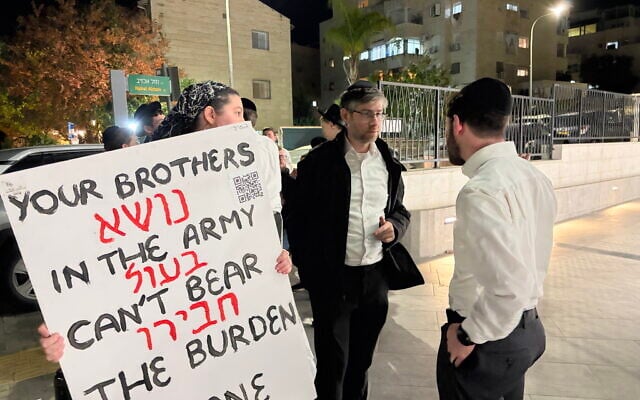
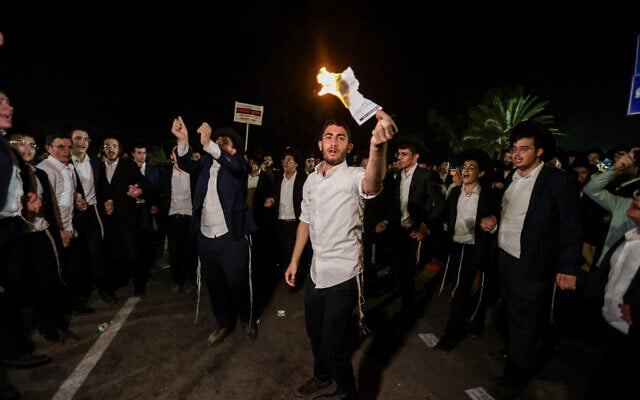
Outside as well, protesters angrily rallied against exemptions for the ultra-Orthodox, leaving the burden of military service to much of the rest of the country.
According to the army, some 12,000 soldiers are needed to make up for acute staffing shortages due to the war in Gaza and other engagements over the last two years, which has stretched the reserve corps to its limit.
“We came because I have three boys who have each served over 300 days since October 7” and while they are proud of their contribution, the extended deployments are taking a toll, said local resident Marc Tobin.
“It’s a disgusting thing when people who are obviously able-bodied don’t serve. My sons are all B’nei Torah [scholars] and learned in yeshiva,” he declared, condemning the Haredi community’s “warped sense of entitlement at the expense of my children.”
‘I don’t know whether I was listening to Al Sharpton or Adolf Hitler.’
Inside, both Eichenstein and Feldman acknowledged criticisms of the demand for exemptions, but justified it by arguing that faith trumps military service or national responsibility.
“What about the fact that other people are dying [and] we’re not dying for the army, for the country,” Feldman asked during his remarks. “It’s a very, very serious question. It bothers me very, very much.”
“But…I’m not obligated to save someone else’s life and give up my Judaism,” he added. “I can’t give up my children to save lives.”
While some ultra-Orthodox members of the crowd agreed with the rabbis, others dismissed their rhetoric as exaggerations and lies.
“Many of the things that they said were reasonable but they put inside them things that were completely not true, not factual,” said Rabbi Brian Tau.
Eliezer, an older ultra-Orthodox man with a long, bushy beard, was particularly incensed over comments from Rabbi Shlomo Miller, who had told the audience that they were ill-equipped to understand the issues and so should let “the great rabbis decide for us.”
“I don’t know whether I was listening to Al Sharpton or Adolf Hitler,” he remarked. “The idea that people in this country don’t know what we’re doing here, don’t know why we are here, those of us who came from abroad don’t know why we came? It’s an insult to everybody.”
