

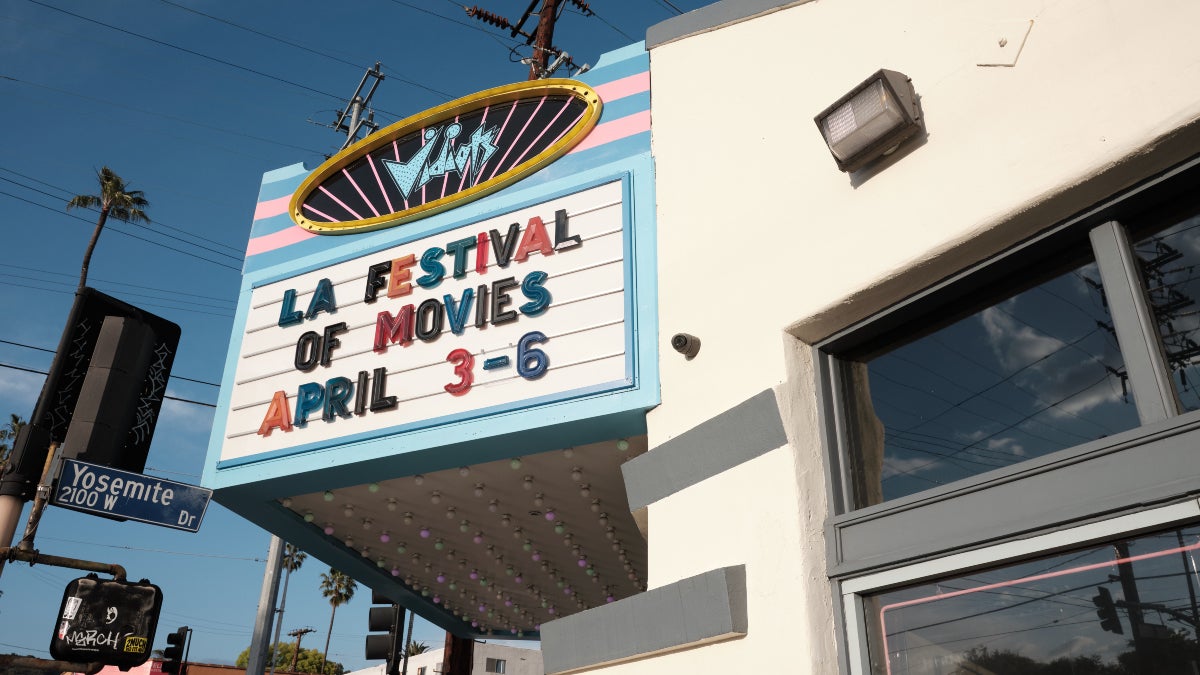
Micah Gottlieb and Sarah Winshall saw a gap in the Los Angeles film festival scene.
To the outside observer, that might sound a bit silly. Between AFI Fest, Beyond Fest, Animation Is Film Festival and many, many more, there are seemingly no shortage of cinematic celebrations hosted in Hollywood.
Yet while festivals like these court genre pictures, awards contenders and other big-ticket items, the Los Angeles Festival of Movies (LAFM) sets its sights on films decidedly smaller. Now in its third year, LAFM (running April 9 to April 12) seeks to provide an annual space for indie film fans in L.A., platforming films that may have a harder time reaching audiences outside of the festival circuit.
“It felt to me like L.A. could use a spring platform for films by both up-and-coming and established filmmakers that to some extent wouldn’t fit into either of those rubrics,” Gottlieb told TheWrap, “or didn’t even have the resources to mount an awards campaign, but that really just wanted to find an audience that would appreciate their films.”
Winshall concurred, but the two didn’t always feel this way. The gap they saw was once filled by the L.A. Film Festival, which brought indie cinema to the city starting in 1995. Non-profit arts organization Film Independent (which also runs the Independent Spirit Awards) took over the film festival in 2001, and later shuttered it in 2018.
“While we are very proud of what we’ve accomplished with the LA Film Festival over the past 18 years, the truth is that it has struggled to thrive, and the time has come for us to try something new,” said the late Film Independent president Josh Welsh in a statement at the time.
The space left behind by LAFF went unoccupied for some time, with the COVID pandemic coming less than two years after Film Independent’s announcement. It wasn’t until 2024 that Gottlieb, artistic director for the film non-profit Mezzanine, and Winshall, a producer at indie production company Smudge Films, cooked up their own haven for LA’s independent film fans.
Two years and one sponsorship shake-up later, LAFM returns Thursday through Sunday for its third edition, opening with John Early’s film “Maddie’s Secret” at Vidiots — and creating that community they sought to find.

“Even if they’re made with a larger studio — something like ‘I Saw the TV Glow,’ for example, from A24 — we’re still looking at these incredibly personal, intimate stories or that they’re trying something very new in their storytelling methods,” Winshall said. “Trying to focus on how the movies are choosing to tell their stories and making sure that they’re truly unique, cinematic and personal are the three tentpoles for us.”

“A healthy balance”
LAFM doesn’t have the same sprawling film list you can find at much larger festivals. Across four days, festivalgoers can screen 11 features, three shorts programs, two artist conversations and a panel on “Parenthood & Filmmaking” moderated by Winshall.
“We really try our best to have a healthy balance of international arthouse cinema and regional American independent film,” Gottlieb said.
It’s a sizable lineup, though far from the overwhelming schedules you can find at bigger fests like Sundance and Cannes. Yet what LAFM lacks in sheer volume, it makes up for in variety.
“Our features program is really, really dynamic,” Winshall said. “We have some hybrid documentary pieces. We have comedies. We have some experimental work. We have what I might call traditional highbrow arthouse film — a little bit of everything, but a lot of stuff that I think will be major discoveries for our audiences.”
Gottlieb noted that they intentionally place LAFM after festivals like Sundance, Berlinale and SXSW to see what films come through. They also fold movies from the previous year’s festivals into their programming, such as “Maddie’s Secret,” which premiered at TIFF.
“I think a lot of these movies, if or when they get U.S. distribution, if they come to LA, there just isn’t the kind of press attention or platform around them that there might have once been, that there might be in cities like New York,” he said.
In years past, LAFM has screened such movies as “I Saw the TV Glow,” “Dead Lover,” “Friendship” and the world premiere of “Rap World.” This year, it will feature such films as “With Hasan in Gaza,” “In the Glow of Darkness” and “Blue Heron.”

Due to the limited slate, LAFM doesn’t take submissions like many other festivals. Winshall, Gottlieb and their crew carefully curate the fest’s lineup through relationships they’ve developed with distributors and other festival programmers, as well as general knowledge of the cinematic landscape from their own staff.
“The staff that we’ve been working with on the festival has been pretty consistent since day one,” Winshall said. “It began as a staff of volunteers, people who were coming to Mezzanine events, people who I knew through independent film producing, but now it’s developed into this really strong group with a really clear point of view of ‘I know what an LAFM movie looks like.’”
That staff is made up of 15 members, with the festival employing around 80 additional volunteers to keep things operational. In 2025, these volunteers keep the festival operational as it saw 1,231 unique attendees, an increase of 30% from LAFM’s first year. 88% of screenings sold out last year, with 160 or more audience members in attendance at each.
“We have an incredible volunteer base,” Winshall said. “We would be totally lost without them.”

When LAFM launched in 2024, the festival had two presenting sponsors. One, Gottlieb’s Mezzanine, remains on to this day.
The other was Mubi, the British streaming service, production and distribution company known well by fans of small and independent cinema. Mubi seemed like a natural fit for LAFM’s mission, championing the same underseen and auteur-driven films integral to the burgeoning festival’s mission.
Mubi would continue to grow in the cinema space, landing a Best Picture nomination in 2025 after picking up distribution rights for the body horror phenomenon “The Substance.” It was a massive moment for the film brand, just months before it would become a $1 billion company, according to the Financial Times.
But that valuation came with some ties. The $100 million donation that put Mubi across the threshold in May 2025 came from Sequoia Capital, betting on an interest in art films like it once bet on tech companies like Google and Apple in their early days.
This caused controversy for Mubi, as Sequoia also has financial ties to the Israeli military through significant investments to the defense tech firm Kela. Soon after, filmmakers such as Radu Jude, Joshua Oppenheimer, Carson Lund and Sarah Friedland signed an open letter titled “Say No To Genocide” expressing “serious concern” over the financial ties.

“Following the investment from Sequoia, some have suggested that we are complicit in the events occurring in Gaza. These accusations are fundamentally at odds with the values we hold as individuals and as a company,” Mubi CEO Efe Cakarel said in his own open letter in August 2025.
In September, LAFM made the decision that it would part ways with Mubi, looking for a new partner to sponsor the festival.
“With Mubi, we were able to work with a marketing team that understood our mission of bold curation, and supported us in cultivating dynamic spaces for cutting-edge arthouse and independent cinema,” LAFM said on Instagram. “We are now actively seeking sponsors and donors who share those values.”
It was a tough decision for Winshall, Gottlieb and their entire team, severing one of their festival’s biggest partnerships as they were looking ahead to only their third year in operation.
“I think we felt an obligation to our community to have the landscape of how our festival is supported reflect the values of how our festival is supported in other ways. Having a presenting sponsor that isn’t reflective of the values of our members, of our filmmakers, of our alumni, of our board, felt at odds,” Winshall told TheWrap. “It’s a financial risk to do something like that, but we also felt like it was a risk to not.”
It wasn’t until late February that LAFM announced its new sponsoring partner: Kino Film Collection. The streaming service, operated by distribution company Kino Lorber, only started in 2023, making it a good match for the indie film fest on the grow.
“They’re trying to make sure that new audiences know about this new streaming platform that Kino is launching, the Film Collection, and our audiences are really the people that I think will enjoy that platform,” Winshall said. “It just made a lot of sense, and it was really fortunate. We’re very, very happy that that came up the way it did.”

An indie haven
Thursday night, LAFM 2026 opens with John Early’s film “Maddie’s Secret,” a comedy written, directed by and starring Early as a food influencer named Maddie who struggles with an eating disorder. Vidiots will host the sold out screening at its Eagle Theatre, featuring a Q&A with stars such as Kate Berlant and Vanessa Bayer.
It’s hard to imagine a better opening night venue than Vidiots, a non-profit video store and indie/repertory theater betting on the idea that L.A. film fans will still flock to “third places” where they can convene and celebrate cinema. It’s a space that, tragically, feels out of time, ripped from another generation.
“We’re really trying to create an environment, a space where you can be before, during and after seeing movies so you can talk about them,” Winshall said. “You don’t have to feel like you have to scurry off and move your car.”

While Vidiots will host the opening and closing screenings (the latter being Sophy Romvari’s “Blue Heron”), Gottlieb called 2220 Arts + Archives the “festival hub.” Previously known as the Bootleg Theater, the cultural center relaunched with a new name after the pandemic, hosting independent film screenings (including Mezzanine’s), live music performances and a slew of literary events. For LAFM, it will host events, screenings and an all-new vendor market (with a bar) for festivalgoers to mingle.
“It’s really, for me, the kind of interdisciplinary art space I always dreamed of there being in L.A. that I would maybe find in New York but now finally exists here,” Gottlieb said.
A few other arts venues throughout the city will house various parts of LAFM. Now Instant Image Hall in Chinatown will host an avant garde shorts program, while the Philosophical Research Society will host a conversation between Josephine Decker and Lisa Hanawalt, as well as a conversation between Melissa Anderson and William E. Jones — both about the current state of moviegoing.
“That’s where we host our artist talks, which are always an important part of our festival as far as trying to highlight conversations that are less about the industry and the craft of cinema and are more about ideas and passions, whether it’s related to art or cinema in general,” Gottlieb said.
And if you’re a cinephile with children, worry not. Gottlieb noted that LAFM will be the first film festival in the U.S. with subsidized childcare, working with the organization Cinecamp to give volunteers and audiences alike relief from babysitter bills.
“Everything at our festival is carefully curated,” Gottlieb said. “We try to have every aspect of it feel intentional and to hopefully have our audiences trust us, whether they decide to see one movie or the majority of movies or all of them, that they’ll have a great time and also have a really holistic experience of what contemporary independent film is.”

