

In the Knesset, Modi says India stands firmly with Israel ‘in this moment and beyond’
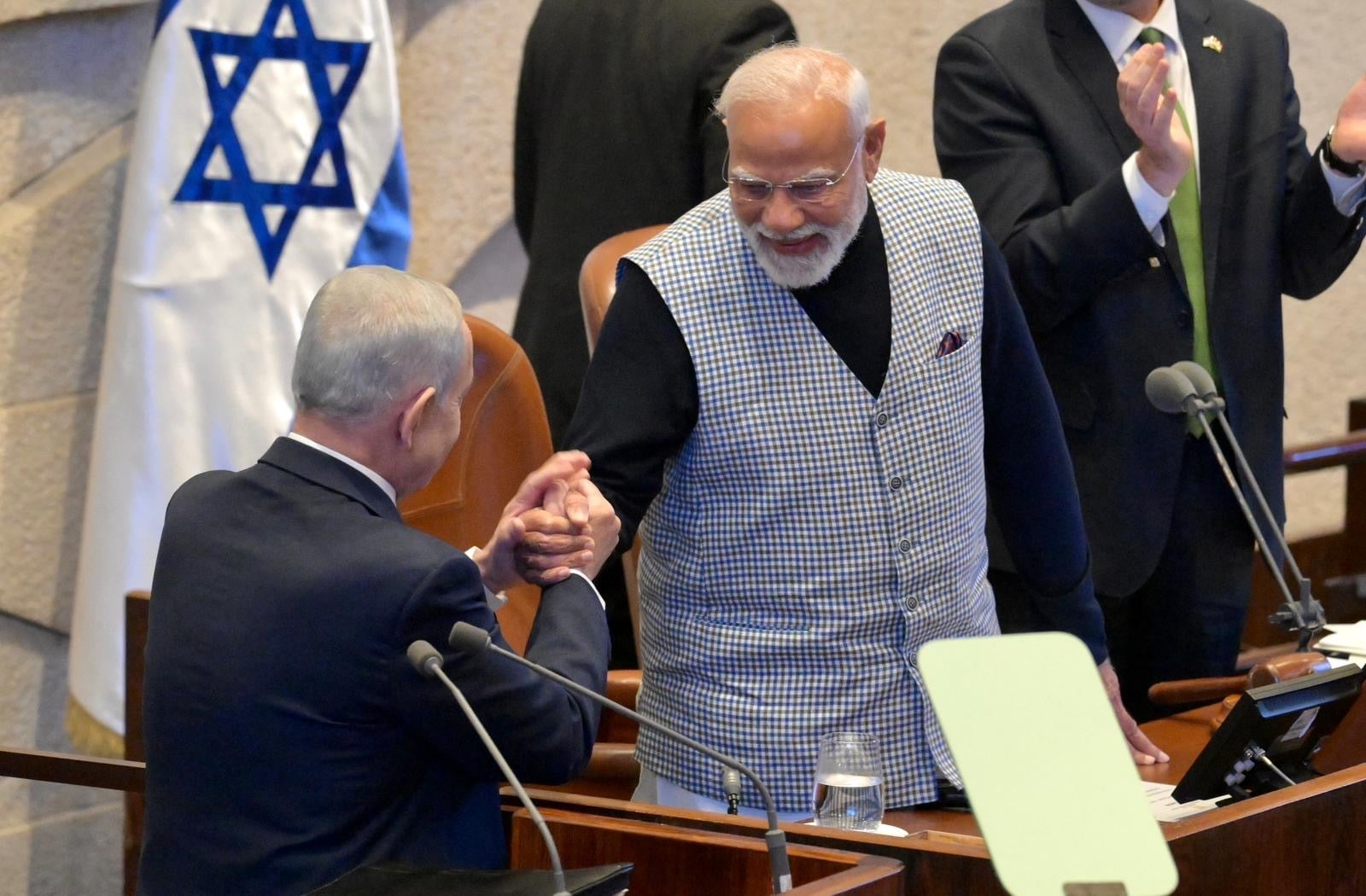
In a clear message to the region emphasizing the strength of their alliance, Indian Prime Minister Narendra Modi and Prime Minister Benjamin Netanyahu pledged on Wednesday to work in lockstep to confront Islamist terrorism, with the Indian leader telling the Knesset in a historic address that his nation stands “firmly” with the Jewish state.
“India stands with Israel firmly with full conviction in this moment and beyond,” Modi told lawmakers during a special session in the Knesset honoring the Indian premier, the first time an Indian leader has addressed Israel’s parliament.
The two long-serving leaders have developed a famously close personal relationship — occasionally uncomfortably so — reflecting a strategic relationship that has been expanding steadily for decades.
India and Israel will build an “iron alliance” of countries “in the face of extremist Islam,” said Netanyahu, speaking ahead of Modi, who is in Israel for a two-day visit.
Netanyahu added that the two countries are together developing the IMEC initiative, a US-backed transport project that aims to connect India to Europe via the Middle East by sea and rail. “This maritime-land corridor can exist and flourish only if it passes through stable and secure countries. And there are no stronger and more secure countries on this axis than India and Israel,” he said.
The idea of creating a new regional alliance has been a recurring theme for Netanyahu of late. On Tuesday, he told the Shin Bet domestic intelligence agency that Israel is working to create its own regional alliance to oppose Iranian and Muslim Brotherhood axes. “I am talking about an entire circle that encompasses the Middle East,” he told the intelligence officials.
In the Knesset on Wednesday, Modi called Israel “a protective wall against barbarism,” echoing language that Netanyahu has used when speaking to Western audiences.
I carry with me the deepest condolences of the people of India for every life lost and for every family whose world was shattered in the barbaric terrorist attack by Hamas on October 7
“The massacre of October 7 made it absolutely clear: either the jihadist axis of evil will break us, or we will break it,” Modi continued, referring to the Hamas invasion of southern Israel in 2023 that sparked a regional war between Israel and Iran along with its armed proxies. “And we are breaking it — and will break it.”
Modi also told his hosts that “I… carry with me the deepest condolences of the people of India for every life lost and for every family whose world was shattered in the barbaric terrorist attack by Hamas on October 7.”

Netanyahu thanked Modi for his support in the aftermath of the Hamas invasion, saying, “After this murderous attack, you stood in such a clear way, so moral, so sharp… We will never forget this.”
In a world where antisemitism is rising, India stands out — a civilization where Jews were never persecuted by the state, only welcomed. We don’t forget that
He also praised India’s tolerance toward its ancient Jewish communities: “In a world where antisemitism is rising, India stands out — a civilization where Jews were never persecuted by the state, only welcomed. We don’t forget that, too. Thank you, India.”
Modi stressed India’s approval of US President Donald Trump administration’s comprehensive Gaza peace plan, saying “that it holds the promise of a just and durable peace for all the people of the region, including by addressing the Palestine issue.”
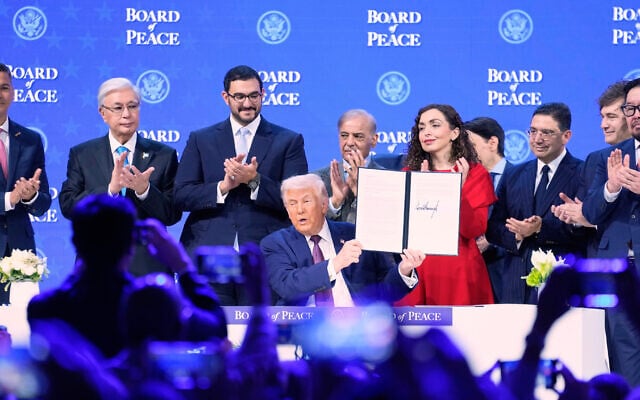
Trump’s Gaza ceasefire is in its second phase, which foresees the demilitarization of Gaza, including the disarmament of Hamas, along with a gradual withdrawal of Israeli forces from the Strip.
However, implementation of the plan has remained unclear, with Israeli officials increasingly believing that stripping Hamas of its weapons will be impossible without the Israel Defense Forces taking action.
Modi concluded his Knesset speech by invoking respective national rallying cries “Am Yisrael Chai” — Hebrew for “The people of Israel live” — and “Jai Hind” meaning “Long live India,” drawing resounding applause and chants of “Modi! Modi!” from the packed plenum.
Preventing a Knesset ‘circus’
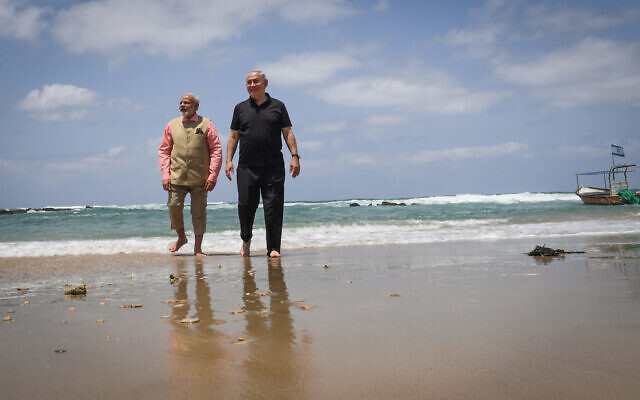
Modi became the first Indian leader to visit Israel in 2017. During that trip, he and Netanyahu waded barefoot together into the Mediterranean surf, the waves gently lapping at the hems of their pants as they talked. The two then sipped drinks and took a drive in a water desalination dune buggy.
To make sure his close friend didn’t forget the experience, Netanyahu later presented Modi with a photograph of their stroll on the beach.
“I say our partnership is a match made in heaven and consecrated on earth,” said Netanyahu when he visited India early the next year.
Netanyahu used similarly effusive language in his Knesset speech on Wednesday.
“Narendra, my dear friend, I am deeply, deeply moved by your visit here today,” Netanyahu said. “Because I have to be diplomatic, I will not rank it. I’ll get into trouble. But I’ve never been more moved than by your visit here with us, a great friend of Israel, a great champion of the Indian-Israeli alliance, and a great leader on the world stage.”
“I would almost venture to say [you are] more than a friend, a brother,” Netanyahu said, praising the technological cooperation between the countries in recent years. “We’ve doubled our trade, tripled our cooperation, quadrupled our understanding in ways that I cannot begin to describe. In some ways, probably shouldn’t describe.”
Netanyahu and his wife Sara met Modi at Ben Gurion Airport early Wednesday afternoon.
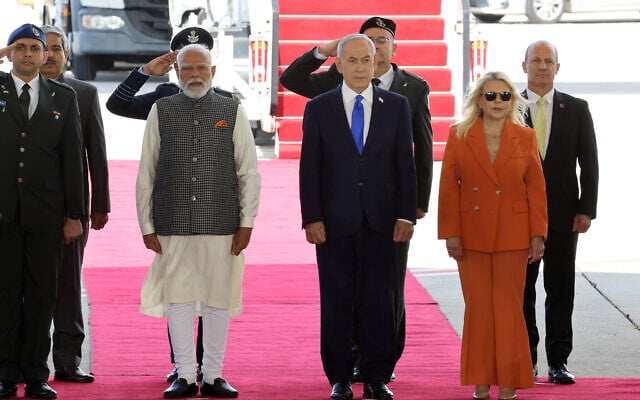
“Welcome, my friend,” Netanyahu said as the three embraced on a huge red carpet while trumpets blasted in the background.
Netanyahu and Modi then sat down for a private meeting at the airport, ahead of Modi’s Knesset address.
“This is a bond, a real friendship,” Netanyahu cheerfully told his Indian counterpart, in footage shared by Netanyahu’s office.
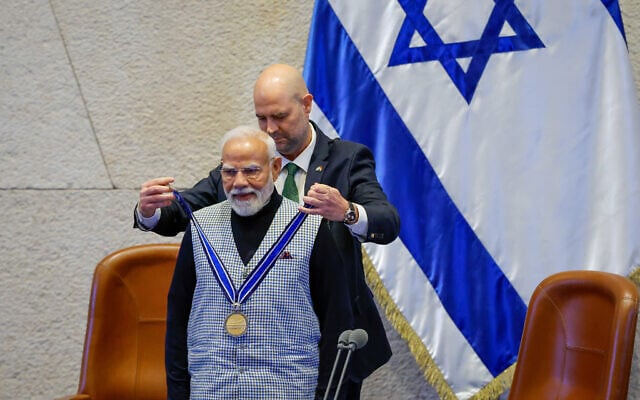
But the warm personal feelings were almost overshadowed by domestic political drama.
Opposition MKs left the plenum during Knesset Speaker Amir Ohana’s and Netanyahu’s speeches to protest the exclusion of High Court president Isaac Amit from the special Knesset session. However, they returned for Modi’s speech to emphasize that the boycott was not meant to disrespect the Indian leader.
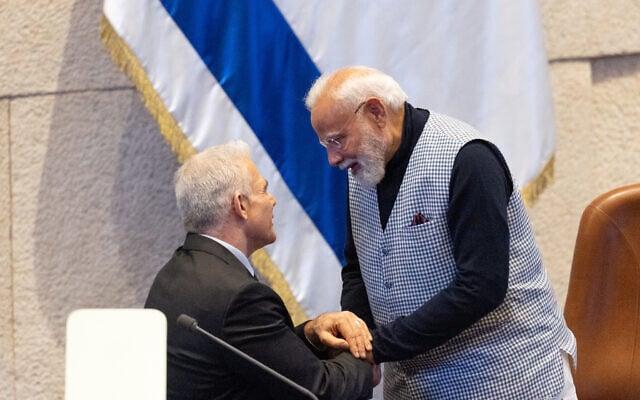
Reentering the Knesset after Netanyahu’s speech, Opposition Leader Yair Lapid shook Modi’s hand and welcomed him to the Knesset.
Lapid assured Modi that the opposition walkout had “nothing to do with you,” drawing boos from coalition lawmakers, to which he replied: “Let’s try not make things worse.”
“The entire State of Israel is filled with admiration for your leadership, for your friendship, for the fact that you were here for us in our time of trouble, and for the alliance, the eternal alliance between our two states,” Lapid said. “So thank you very much for being here. And we are all, both sides of the aisle, looking forward to hearing your speech.”
Free trade strains
Bilateral relations between India and Israel have strengthened in recent years, leading to cooperation in military cooperation, agriculture, science, health, IT and telecommunications. Both Israel and India have been expressing interest in cooperation in additional areas, such as water, fintech, construction and infrastructure.
India is the most populous country and the fifth-largest economy in the world. The $3.9 trillion economy is Israel’s second-largest trading partner in Asia, after China. In 2024, bilateral trade volume between Israel and India reached about $5 billion, which included $2.5 billion in Israeli exports, $1 billion in diamond trade and $1.5 billion in imports from India to Israel.
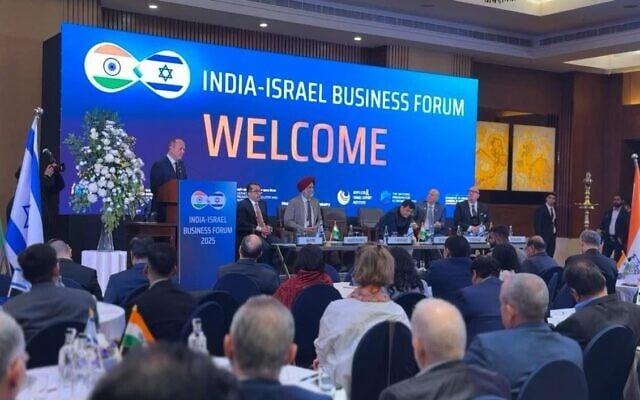
Israel is the fourth largest supplier of military hardware to India.
Last year, a series of Israeli ministers visited India, including Tourism Minister Haim Katz and Agriculture Minister Avi Dichter. In July, Defense Ministry Director General Amir Baram made his first working visit to India, aiming to deepen industrial cooperation with defense firms in the country.
In September, Finance Minister Bezalel Smotrich was in the country to sign a bilateral agreement to facilitate mutual investment flows and encourage economic cooperation and trade between the two countries.
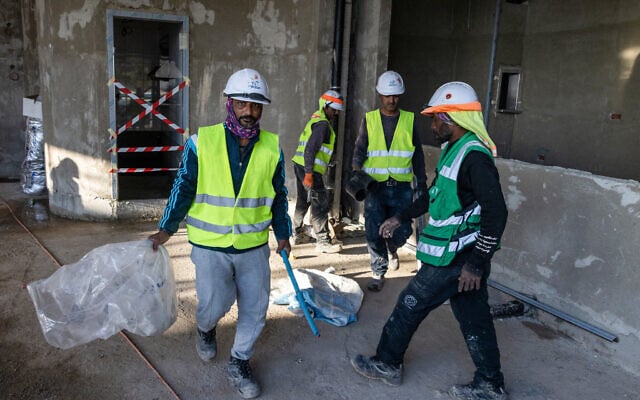
The agreement is seen as preparing a common ground for advancing the ongoing negotiations for a future free trade agreement between Israel and India. In 2025, Economy Minister Nir Barkat led a large business delegation to New Delhi to make progress on the long-touted FTA pact.
According to an Israeli official, Modi and his team are pushing hard for the free trade agreement, but Israel is holding it up. India wants to have foreign workers included in the FTA, but Israel is opposed, but out of fear that it would not be able to control the number of Indian workers coming in, and because of the influence on the Likud party of Israeli middlemen who arrange for the workers to enter the country.
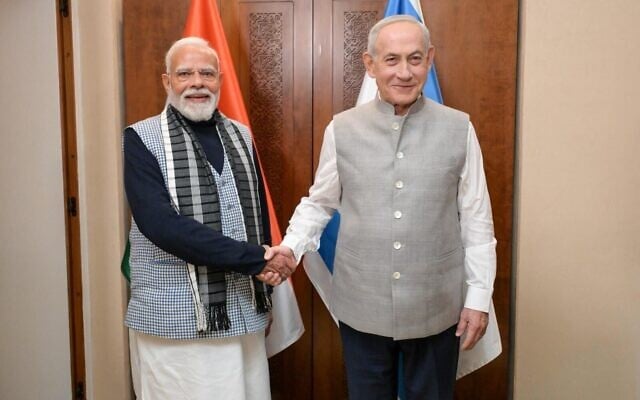
Still, the two leaders weren’t about to let any disagreements over free trade or domestic politics get in the way of the expanding personal and strategic relationship.
हम साथ आगे बढ़ रहे हैं-और तकनीक व नवाचार में भारत-इज़राइल साझेदारी को और मजबूत बना रहे हैं। ???????????????? https://t.co/xP5SrAYNe4
— Benjamin Netanyahu – בנימין נתניהו (@netanyahu) February 25, 2026
Both men posted on X in the other’s language as they headed off in a limousine together for an innovation event.
