

You can never truly know someone, but what happens when their death reveals how little you knew them at all? When they’ve left behind an endless rabbit hole of multiple identities, debts and unanswered questions, can you retrace their steps and piece them back together? How do you deal with all the resentment you’ve built up towards them now that you no longer have the catharsis of confronting them? And how do you contend with the people whose lives they transformed for the better when all they did was leave you worse off?
Black Mirror
These questions are at the heart of Invention, one of several films and shows this year that hone in on a reliance on technology as a means of coping with one’s grief, either to cathartic or calamitous ends. When Carrie’s (Callie Hernandez) conspiracy-obsessed father dies, she inherits his patent for an “electromagnetic healing device,” a machine recalled by the FDA — implying a certain below-par standard — but one that will come to do exactly what it claims to. As Callie sets out to find out more about this machine from her elusive dad’s friends and professional collaborators, it eventually becomes a way for her to work through her grief and, ultimately, heal. The machine works, just not in the way she expected. “Do you think we could get [it] back on the market?” she sobs by the end, an outpouring of emotion that’s less about what the gadget can do than what it’s done for her
Along the way, however, an earnest believer in the late doctor’s ‘healing’ methods suggests he might not have died a natural death, but was actually killed to impede the seismic potential of his inventions. Conspiracy and grief are often intertwined, the film gently suggests, both an endless search to make sense of that which can never rationally be resolved. In splicing outtakes and behind-the-scenes footage into the film, Invention prompts audiences too to question everything they’re seeing.
A similar paranoia infuses body horror drama The Shrouds. While some still occupy the house their former spouse designed, businessman Karsh (Vincent Cassel) had the “visceral urge” to make a home for himself in his late wife’s casket, right alongside her, he explains. He channeled this all-consuming drive into his “ShroudCam” technology, through which the bereaved can view their loved ones decomposing in their coffins in real-time. Headstones, in which an epitaph concisely encapsulates someone’s life, now double up as screens, offering high-definition 3D images of their bodies after death. Gradually, however, Karsh notices strange growths on his late wife Becca’s (Diane Kruger) bones that his sister-in-law suspects of being tracking devices. Then Becca’s doctor goes missing, her grave is among those vandalized and Karsh gets locked out of ShroudCam. For someone who devised an app to illuminate what’s otherwise inaccessible, Karsh now finds himself completely in the dark. Was Becca having an affair with her doctor? Was she being experimented upon?
Writer-director David Cronenberg crafts a world not too far off from our own, one of self-driving cars and AI assistants, technology that eases one’s workload but simultaneously frees up the mind to fixate even more. Karsh’s own invention, initially a source of comfort, now begins to torment him — when he later attempts to access Becca’s plot, visuals of her former lover laying in the gravesite next to hers pop up. The mystery intensifies but there are no easy answers, or any at all by the end of the film; grief, like conspiracy, isn’t neatly reconciled.
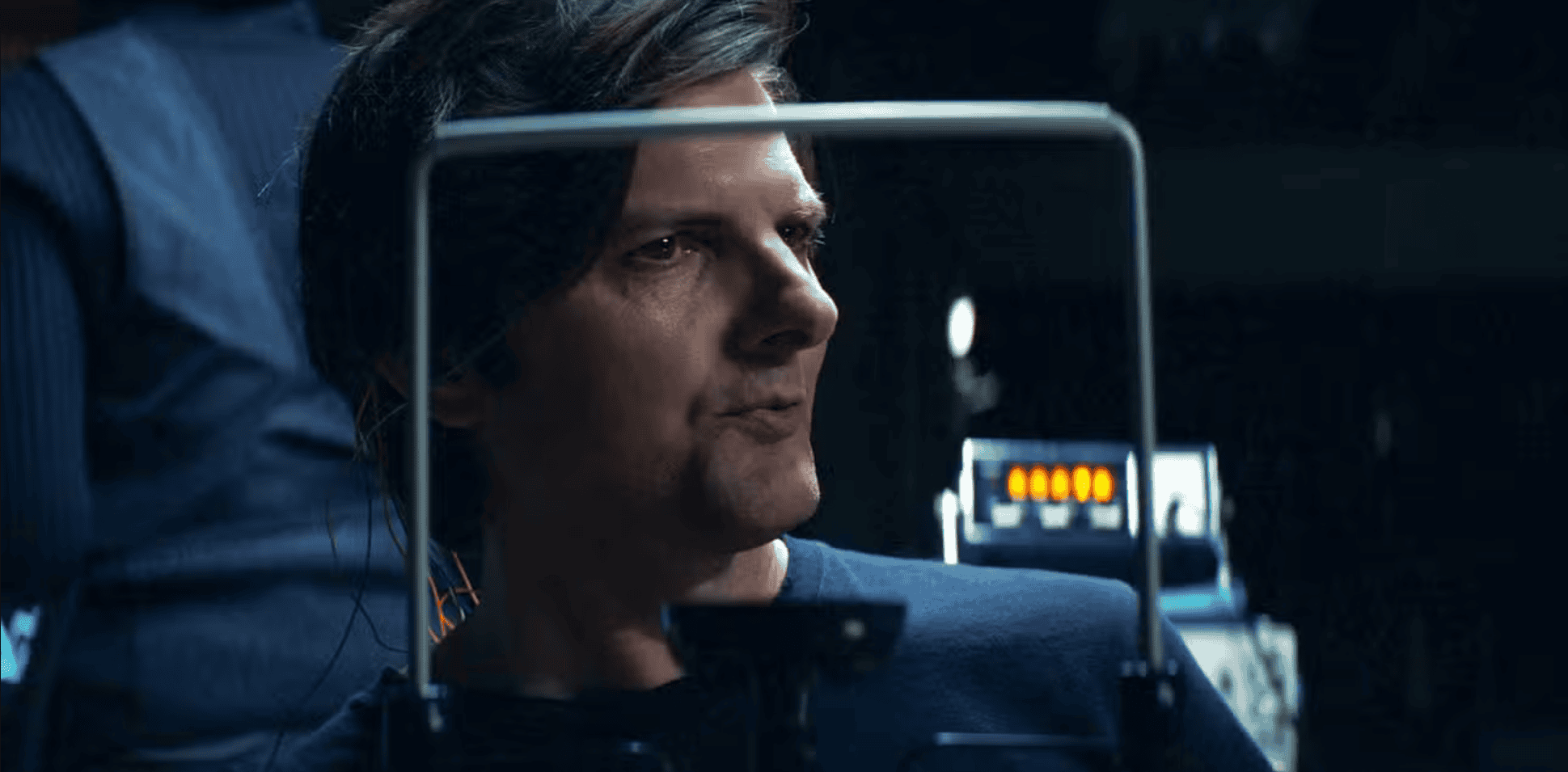
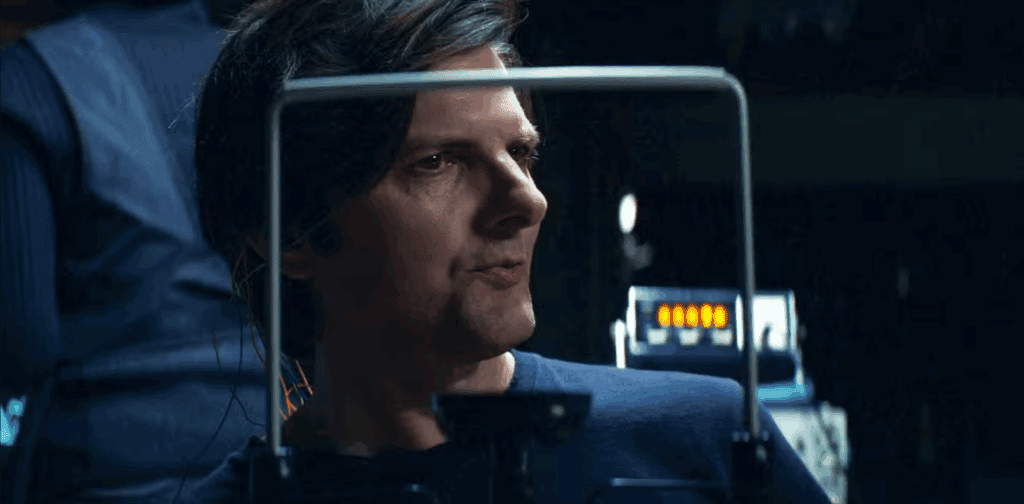
Like The Shrouds, in which Karsh’s GraveTech expands into Iceland and courts a Budapest backer, grief is also big business in the sci-fi series Severance, season 2 of which aired earlier this year, and the documentary Eternal You. Overwhelmed by the pain of his wife’s death, Severance’s protagonist, Mark Scout (Adam Scott), hopes that a nightmarish procedure peddled by biotech firm Lumon Industries might help him regain some semblance of normalcy. A chip implanted in his brain bifurcates his consciousness — at work, he’s just one of many Lumon employees who can’t remember who they are on the outside, and likewise. His work self or ‘innie’ remains effectively trapped at the office, in a tedious job, deprived of rest or revelry, but at least the memory of Gemma’s (Dichen Lachman) loss being suppressed offers him some respite from his outie’s anguish? Not quite. “You carry the hurt with you,” says a friend and co-worker. “You feel it down there too.” Of course, the chip is really to Lumon’s advantage — a company that treats its employees cruelly, with suffocating policies and ‘break room’ punishments, benefits from not having them remember any of it the moment they leave for the day.
Severance
If Karsh’s grief appears as an extension of his control — he expresses jealousy at Becca’s doctor having “had her body,” which now, in death, is for his eyes only — then Lumon’s control over Mark comes from manipulating his grief. Gemma is not only still alive, as he gradually discovers, but is the company’s hostage, subject to painful experiments. His innie has met hers in a professional setting several times, but neither grasped what they meant to each other personally. If Karsh wanted to see, Mark wanted to forget. Having chosen repression, he’s now compelled to look for answers. As he and a group of trusted co-workers attempt to untangle Lumon’s mysteries, their efforts are mirrored by viewers, themselves feverishly crafting and debunking theories around the show.
While Mark, stuck in the bargaining stage of grief, once let himself dwell on all the things he would do just for the chance to have Gemma back — “drink less, listen more” — those in Eternal You resolve their own set of what ifs. The documentary follows bereaved people around the world who opt to ‘resurrect’ their late loved ones in the form of digital avatars that are eerily capable of replicating their tone or texting style. Conversations with the AI simulation then enable them to say everything they wish they had while these people were still alive.
Is this outlet freeing or fixation-enabling? Is the tech ghoulish or soothing? The documentary contrasts lofty philosophical ideas of death and digital ‘rebirth’ against the cynical truth that there’s great money to be made from such reckless exploitation of vulnerable people. Some users find the comforting familiarity of their family members replicated, others discover the unpredictability of generative AI — the avatar of one woman’s late father begins to verbally abuse her, while another woman’s late boyfriend inexplicably announces that he’s in hell, rattling her.
At the core of this artificial construct’s appeal is a kernel of truth: No one can ever be prepared for death, whether a sudden loss or one that’s concluded a long bout of illness. It’s hard to let go. In one of the documentary’s most wrenching scenes, a Korean woman participates in a virtual reality simulation so she can say goodbye to the young daughter she lost. She’s moved to tears, but when she goes to wrap her arms around the child, there’s only an empty space. For all the marvels of this new-age tech, the ache of grief is ultimately more tangible than a hologram. If Severance is a poignant examination of acknowledging one’s grief, rather than attempting to block it out — in employing technology to forget Gemma, Mark is tragically obstructed from regaining a life with her as a consequence — perhaps the idea here, according to psychologist Sherry Turkle, is to learn “how to lose [people] better, not how to pretend they’re still here.”
Unlike Eternal You’s grief-stricken subjects, however, the protagonist of Black Mirror season 7 episode 5 isn’t pretending his former girlfriend is still around. Instead, the wounded Phillip (Paul Giamatti) has gone to extreme lengths to destroy all tangible reminders of her. It took him 15 years to pull himself out of despair, he reveals, after Carol wordlessly walked out on his proposal, and they never reconnected. But like one of Eternal You’s subjects, he too finds bittersweet closure to their abrupt parting through a digital simulation.
A tech company has reached out with news of Carol’s death, asking Phillip for help creating an “immersive memorial” for her by sifting through his memories. By placing a disk on his temple, he can ‘enter’ old photos, sharpening the details of these three-dimensional worlds by attempting to recall them. It’s an episode of the sci-fi anthology series that’s relatively light on gadgetry, instead weighted with lingering regret and unresolved pain. As Phillip retraces their relationship history, fresh revelations emerge. For a show about futuristic technology and its boundless capacity for destruction, the focus here is on large-hearted, vulnerable emotion. In rage, Phillip had once blacked out all photos of Carol, as if attempting to erase her very presence (much like Severance’s Mark). He succeeded, unable to recall what she even looked like anymore. By the end, however, as her face comes into view in the digital world, it’s a treasured, precious sight. Phillip’s episode offers the rarest of Black Mirror pleasures: catharsis.
Could films about the relationship between technology and grief also offer their makers a measure of comfort? Invention blurs the lines between reel and real, fiction film and documentary — VHS recordings of actor Callie Hernandez’s dad, an MD-turned-alternative doctor, stand in for her character’s. In some scenes, she breaks the fourth wall through voiceovers recalling autobiographical details. With The Shrouds, it’s hard not to read into similarities between Cronenberg and his protagonist, with their identical poofy silver hair and T-shirt-and-blazer wardrobes. Cronenberg’s wife and partner of 43 years, editor Carolyn Zeifman, died of cancer in 2017. Had GriefTech existed, he said, he would’ve used it. In its absence, he made this movie instead. His verdict, however, is definitive. “Art is not therapy,” he said in an interview. “And there is no catharsis.”
Source link
