

Chundale, a quiet, picturesque tea estate tucked away up in the Western Ghats of Wayanad, Kerala, is about as far away from New Delhi as one can get. Nothing ever happens here save the placid tranquillity of daily routine. So, the inauguration of a tiny research institute for traditional medicine at Chundale this week wouldn’t attract the slightest attention from even the local papers (it didn’t).
And yet, the inauguration of this research centre is actually a metaphor for a silent, paradigmatic transformation in the area of traditional medical systems that is sweeping the subcontinent: pulled from above by the central government’s Ayush Ministry, and pushed from below by practitioners of natural medicine bearing thousands of years of information. It is a story worth telling.
Shivanandan Vaidyar is a short, dapper man in his early sixties, with white beard and hair that contrasts his dark skin. He hails from an old family of practitioners. He is full of humour, cutting witty jokes with his family and colleagues, as they race to get the institute ready for the inauguration. In between, he pauses to explain his work.
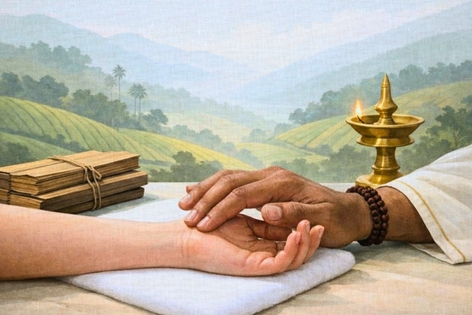
The Vaidyar, a respectful honorific meaning physician, informs that the diagnostic core of his practice is Nadi Vigyan, or pulse analysis. Every pulse pattern, at each stage of a person’s life, represents a specific set of irregularities or ailments in that body. As he expounds, you realise with a start that this is peak empiricism; patterns collated over millennia can be slotted into precise categories of medical issues with a high degree of probability.
“We never try to cure a problem, per se,” he clarifies. “Rather, we only seek to remove that debilitating, intrusive matter which hampers the correct functioning of a body.” That may be anything ranging from cancer to kidney ailments to gut issues to diabetes, and beyond.
He tells a story of a small town in Goa where 16 dialysis machines were in constant operation, such was the prevalence of patients. But within a few years of establishing a centre there, the number of dialysis machines required dropped to just one. Perhaps it is as a testament to such success that he decided to locate his primary centre there.
For good measure, a contributing editor of Swarajya is given an examination by the Vaidyar and his deputies. It is preceded by a stern warning: “Don’t tell us if you have any medical issues.”
Silence. The pulse pattern is read using three fingers on the wrist. For redundancy, a junior does the same. Both confer in code. Then, the Vaidyar’s pronouncement is told: “Muscular pain in both shoulder joints. Mild gut issues. Some numbness in the soles of the feet. Rest okay. Prescribing medicines.” And the prescription is written out… in English.
Correct diagnosis. Actually, spot on. All three niggling issues have been bothersome companions for over a decade.
Later though, outside, because sceptic is as sceptic will, this writer makes the cardinal error of whispering to a friend that the Vaidyar made no comment about his diabetes. “Because it is under control, you dolt!” the friend barks back under his breath. Yes, well, there is that.
Chikitsa, or treatment, consists of powders, potions, oils, and targeted massages. The bulk of the production happens in Gujarat, from where medicines are shipped to the Vaidyar’s centres in other parts of the country. Volumes are a challenge, he admits, because of farmers’ tendency to enhance output by adding fertilisers (a strict “no no”), and because some ingredients can only be sourced physically from selected forests at selected times of the year.
And that is where the research centre comes in. “We know that we can treat specific illnesses by prescribing specific medicines, but we simply don’t know how the chemical treatment process works,” the Vaidyar candidly admits. To compound the issue, there are a number of families, each with their own procedures of diagnosis, protocols of treatment, and medicines.
Thus, it will be the function of the research centre to act as a bridge between various schools of traditional medicine operating in North Kerala, and research labs in other parts of the country which will start analysing the chemical composition and reactivity of natural medicines. In effect, it is a monumental effort to first scientifically define a vast corpus of knowledge, and then to get these medicines into clinical trials just like allopathic pharmaceuticals.
The need to formalise traditional schools of medicine in a systematic, scientific manner is dire because, even today, two thirds of Indians still depend on traditional medical systems for a cure.
“Of course, pulse analysis and treatment are only one part of our practice. There is also a parallel effort on to revive, popularise, and scientifically formalise the traditional means of studying bodily fluids so as to enhance diagnostic skills,” he says casually.
What? Your voice rises in excitement. Ancient Bharata was doing pathological tests ages before street corner path labs and blood tests became a central feature of our modern age?
“Yes,” the Vaidyar replies phlegmatically. “We study faeces, urine, blood, saliva, pus. Sometimes we add potions to the samples to see what reactions take place. Assists us in our medical examinations.” This is empirical chemistry of the very highest degree.
“It will take a century at the very least to decode this knowledge,” the Vaidyar admits. “The amount of data is that massive. And it is not just Kerala. It’s everywhere.”
True. You pause to gather yourself at what you’ve just learnt. You try to somehow put it into perspective. You fail. A peek into the ignorance of modern science is a humbling thing, just as the opportunities of scientific discovery are equally exhilarating.
And the knowledge: where is that stored? The Vaidyar points to a large bundle of palm leaf manuscripts placed reverentially before a photo of Sage Agasthya. How do they read? The Vaidyar chuckles and recites an example.
You gawp in amazement: the foundational medical texts for diagnosis, treatment, and the manufacture of potions are written in terse riddles, in Malayalam, with a liberal sprinkling of tribal words. Only those who have learnt the unlock keys can read the stanzas right. And various families have their own texts.
Is this forest medicine, or Siddha, or Ayurveda? “Neither!” the Vaidyar replies sharply. “It is wrong to differentiate between Yoga, or Ayurveda, or Siddha, or what have you, since they were all born of Shiva’s cosmic dance, the Tandava Nrittam. Perhaps you may call it Bharatiya Vaidya if you wish, because it is that alone: Indian knowledge.”
And there you have it: one more powerful ancient strand connecting this sacred land into an eternal, civilisational whole.
On a policy front, the Vaidyar says that the establishment of an Ayush ministry has greatly aided his ilk of natural medical practitioners. Be it permits to practice, or to make their medicines, clear policy guidelines now in place ensure that they receive their official approvals swiftly; a sea change from the old days when they had to run the gauntlet of sarkari offices up and down the bureaucratic ladder for the pettiest of permits.
But it doesn’t stop there. Unravelling the science behind Bharatiya Vaidya is only one aspect. Complementing this colossal effort is the dissemination of traditional knowledge systems. For this, the likes of Shivanandan Vaidyar are periodically deputed to various institutes in the country as visiting faculty, to share their wisdom, and to professionally train a brand-new generation of Bharatiya Vaidyars.
It is the work of ages. And the most remarkable thing about this silent revolution is that as research into traditional medical systems progresses, it is entirely probable that, in the next decade or so, scientists will discover new proteins and enzymes which force a radical advancement in medicine.
Watch this space.
Source link
