

MINNEAPOLIS (RNS) — As she stood at the pulpit at Westminster Presbyterian Church on Thursday (Jan. 22), the Rev. Rebecca Voelkel, a United Church of Christ minister, looked out at the packed sanctuary with tears in her eyes.
Far from the typical flock of Presbyterian worshippers who frequent the church on Sundays, the more than 600 people who filled the pews represented a wide range of faiths — Christians of all kinds as well as Buddhists, Jews, Muslims and Indigenous practitioners, among others.
All were religious leaders who had traveled to Minnesota on short notice, spurred by their faith to oppose President Donald Trump’s mass deportation campaign in the city.
“In the face of all the pain and suffering in our cities and our country, you are a beautiful, beautiful sight,” Voelkel said.
Beneath her, on the pulpit, sat a sign that referenced Scripture from the biblical book of Micah, but added a decidedly timely twist.
“Do justice. Love kindness. Abolish ICE.”
Hundreds of clergy convene at Westminster Presbyterian Church, Thursday, Jan. 22, 2026, in downtown Minneapolis, Minn. (RNS photo/Jack Jenkins)
The moment marked the beginning of a remarkable two-day religious gathering in Minneapolis this week, taking place amid the Trump administration’s aggressive immigration enforcement campaign. Constructed as a mix of activist trainings, spiritual revival and direct-action protests, Minnesota faith leaders who have been actively resisting Immigration and Customs Enforcement agents used the assembly as an opportunity to pass along lessons to clergy from other parts of the country. And amid the prayers, songs and protest chants, the gathering heralded the emergence of a vast, faith-based network set on resisting the administration’s mass deportation effort.
Religion News Service was one of only three outlets given access to the conference, which was largely organized by the local religious advocacy group Multifaith Antiracism, Change and Healing, commonly known as MARCH. The size of the event was striking, in part because of how quickly it came together: The public invitation to clergy across the country was published on MARCH’s website only a week before the event began, and organizers said so many clergy wanted to take part that they eventually had to halt applications due to logistical concerns.
Many of the participants wore shirts and buttons with the slogan “Abolish ICE,” and attendees proudly displayed liberal leanings. The event was promoted as overtly “pro-queer,” and attendees wore rainbow stoles and other symbols of LGBTQ+ inclusion. Some of the roughly 100 rabbis in the crowd wore yarmulkes designed to resemble watermelons — a symbol of support for Palestinians.
But while attendees — many of whom had flown in from as far away as Massachusetts, California, Tennessee and Alaska — were deeply critical of ICE, most had yet to encounter Department of Homeland Security agents in their cities. They were eager to learn from faith leaders in Minneapolis, where a massive influx of roughly 3,000 federal agents has sparked a sprawling organized resistance among locals.
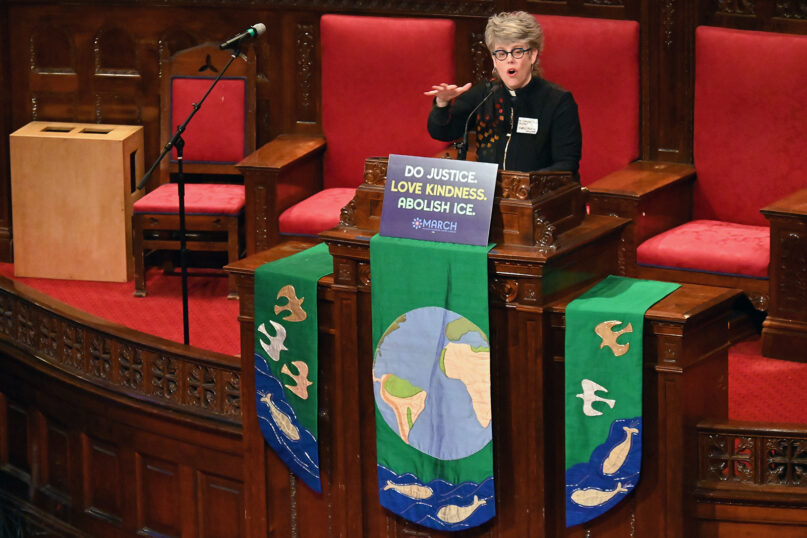
The Rev. Rebecca Voelkel speaks to clergy at Westminster Presbyterian Church, Thursday, Jan. 22, 2026, in downtown Minneapolis, Minn. (RNS photo/Jack Jenkins)
At the opening session in the Westminster sanctuary, attendees belted out an opening song with the refrain “No one is getting left behind this time.” That was followed by remarks from Junauda Juanita Petrus-Nasah, the poet laureate of Minneapolis, and Jim Bear Jacobs, an Indigenous leader who said ICE has also detained people from his community.
“Y’all, we kind of have some opinions about all this conversation about who’s illegally occupying who,” Jacobs said to laughter and applause.
Rev. Voelkel then laid out a goal for the gathering: local faith leaders had learned from clergy in other cities that DHS has targeted for immigration enforcement efforts — and hoped to pay that sentiment forward.
“We have learned so much from our religious kindred in Chicago and LA and Portland,” Voelkel told the crowd. “And we want to share with you what we are learning from our experience.”
That approach resonated with the Rev. Elizabeth Haralam Shuba, who had traveled from Lancaster, Pennsylvania, for the event. One of more than 100 Unitarian Universalist ministers to make the trip, she spoke to RNS while sitting in the back of a bus along with roughly 200 other clergy who were deploying to the streets of Minneapolis.
“We have no doubt that there will be plenty of opportunity for ICE to show up in our community soon,” she said. “Part of why I answered the call was that there was a significant element of training to take back into our own communities.”
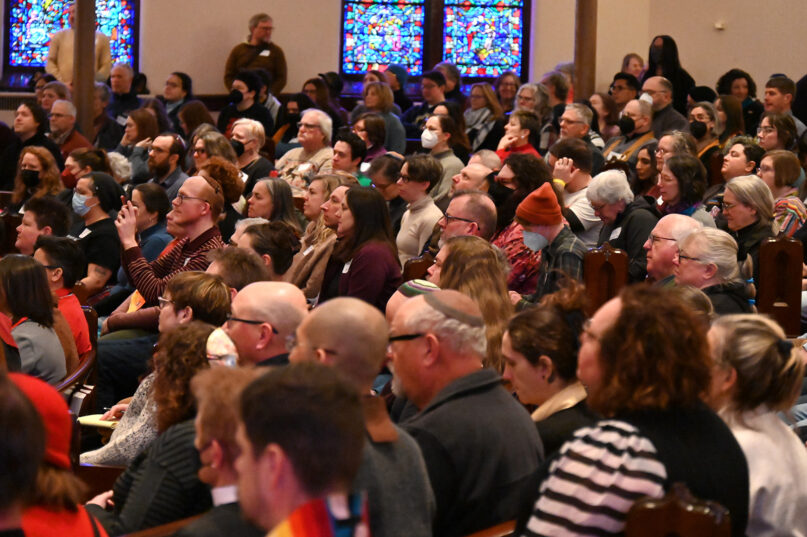
Hundreds of clergy convene at Westminster Presbyterian Church, Thursday, Jan. 22, 2026, in downtown Minneapolis, Minn. (RNS photo/Jack Jenkins)
Becky Silverstein stood on an icy street corner in Minneapolis, looking for ICE agents while explaining that the trainings would be useful for the communities he serves back in Boston. New England has also seen an uptick in ICE activity, he said, and local faith leaders have staged regular vigils at a DHS facility in the region.
“What’s happening here is a testing ground for what’s gonna happen in the rest of the country,” Silverstein said.
The experience of observing DHS agents up close appeared to have a profound effect on some of the attendees. The Rev. James Galasinski, who leads a Unitarian Universalist congregation in Canton, New York, was one of several clergy who saw federal agents confront a woman in front of a strip mall and demand she provide them with citizenship papers.
“I’m becoming radicalized,” Galasinski told RNS later that day. “I mean, demanding papers? I never thought I would live in a country like this.”
Haralam Shuba and others noted that MARCH’s call to clergy invoked the historic Civil Rights protest in Selma, Alabama, where at least two Unitarian Universalists — one pastor and one layperson — were among those killed by racists in the days surrounding the march.
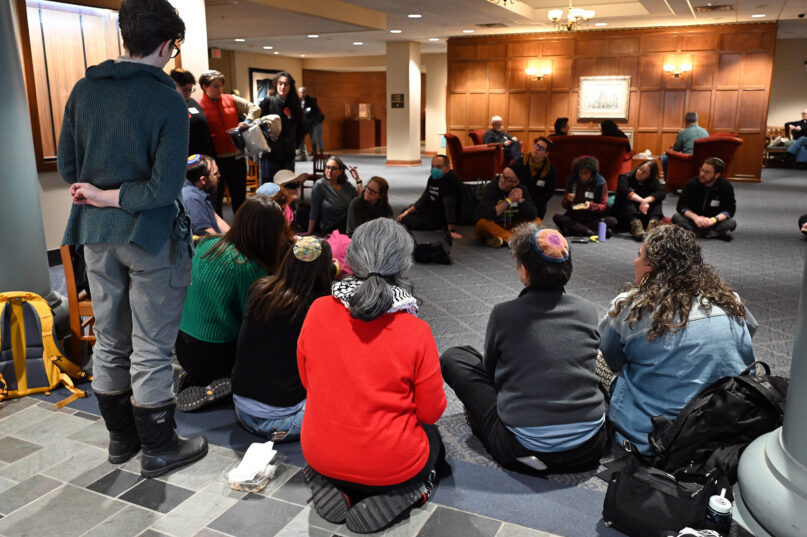
Clergy members meet at Westminster Presbyterian Church, Thursday, Jan. 22, 2026, in downtown Minneapolis, Minn. (RNS photo/Jack Jenkins)
During the opening assembly, an organizer listed a series of major recent protest movements and asked attendees to raise their hands if they had been a part of them. Hundreds of hands were raised when the organizer mentioned Standing Rock, an Indigenous rights protest, or the activism that followed the murder of George Floyd by a police officer. Finally, when the organizer mentioned the famous Selma march, one participant’s arm slowly went up. The sanctuary exploded into applause.
Selma inspired others at the convening as well, albeit less directly. Two of the participants in the gathering — the Rev. Becca Girrell, a United Methodist pastor in Vermont, and Rabbi David Fainsilber, who traveled from Vermont — said they had both participated in a civil rights tour last November. The pair made a pact together to help “dismantle racism together” while standing on the Edmund Pettus Bridge in Selma, Girrell said.
Girrell noted that she also identifies as queer, and that Renee Good — the 37-year-old mother who was killed by an ICE agent in Minneapolis earlier this month — was married to a woman.
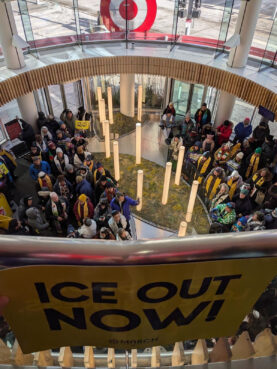
Protesters against Federal law enforcement agents gather at Target, Friday, Jan. 23, 2026, in Minneapolis. (Photo by Jennifer Hosler)
“If we’re keeping track, we’ve already come for Jewish people, we’ve already come for people of color, and now we’re coming for white, queer and nonbinary people,” Girrell said, riffing on a famed poem by German pastor Martin Niemöller. “There’s no one left to come when it’s your turn.”
In addition to learning how to observe and document ICE agents, attendees flocked to a wide range of breakout sessions throughout the day on Thursday. One focused on training for legal observers. Another on maintaining spiritual care amid sustained periods of protest. Down the hall, four-part harmonies drifted out of a room labeled “Skills for sit-ins and song leading.”
Roaming about the halls at Westminster were prominent religious leaders such as the Rev. Dr. Sofía Betancourt, president of the Unitarian Universalist Association, as well as the Episcopal bishop of Washington, the Rt. Rev. Mariann Budde, who led a press conference with local faith leaders decrying DHS’ mass deportation efforts and pointing out that Washington, D.C., had also seen an influx of federal agents.
Standing in the back of the sanctuary during the opening symposium, donned in a clerical collar and overalls, was the Rev. David Black. The Presbyterian Church (USA) minister made headlines last year after footage emerged of him being shot in the head with pepper balls by a federal agent as the pastor prayed outside of a Department of Homeland Security facility.
On the second day of the event, clergy trekked to Dios Habla Hoy, where they assisted with the church’s massive efforts to provide food to local immigrants who are refusing to leave their homes out of fear of ICE. Others participated in a singing protest at the headquarters of corporations such as Target; the store chain has sparked anger from activists who say DHS agents often stage out of its parking lots.
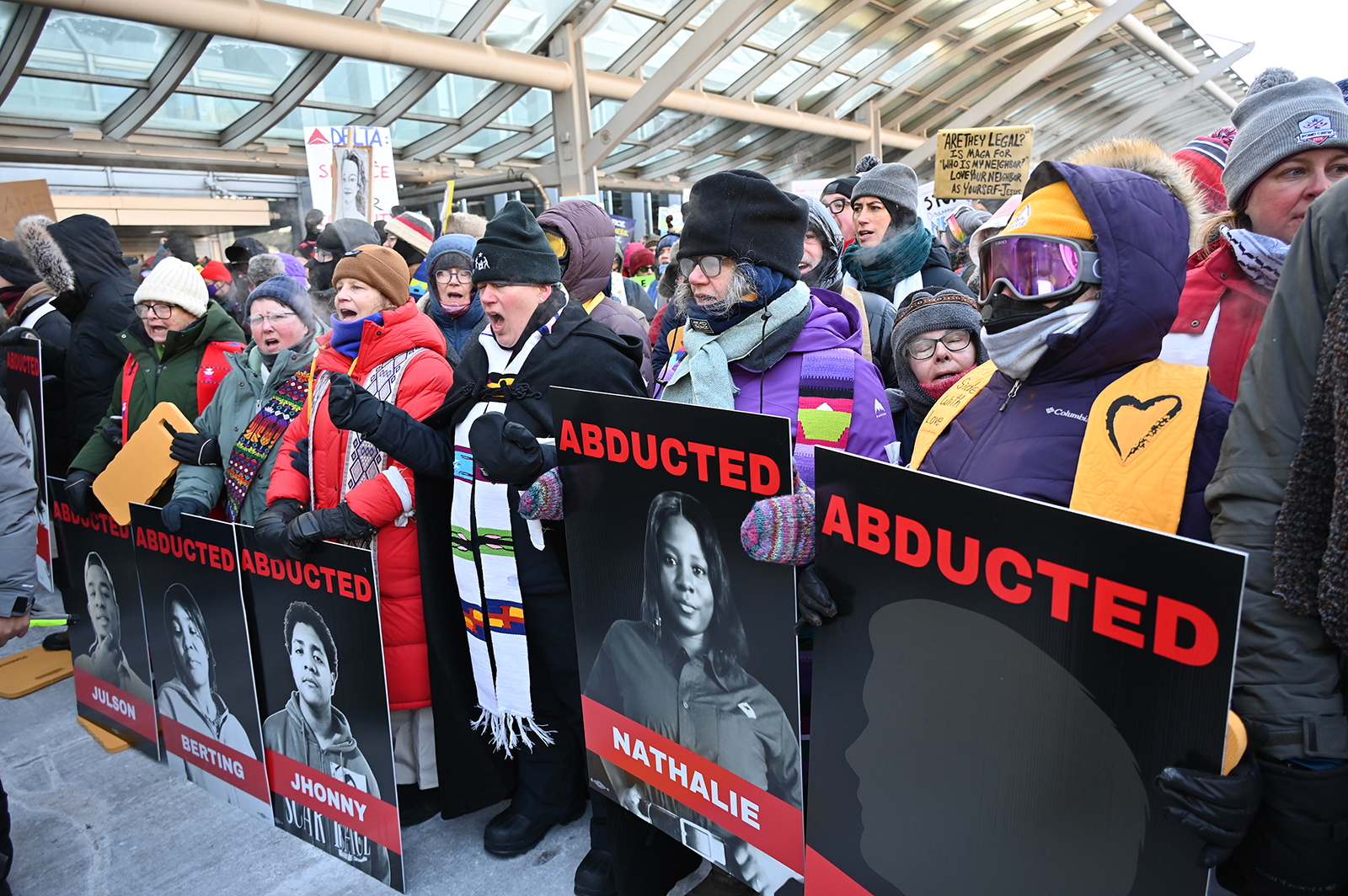
The largest protest by far was a boisterous demonstration at the Minneapolis-Saint Paul International Airport. Hundreds of faith leaders staged a protest just outside one of the terminals, decrying ICE activity at the airport that has resulted in the detention of some workers. Despite an extreme weather warning in effect and temperatures dropping well below zero, hundreds briefly took over the street in front of the terminal.
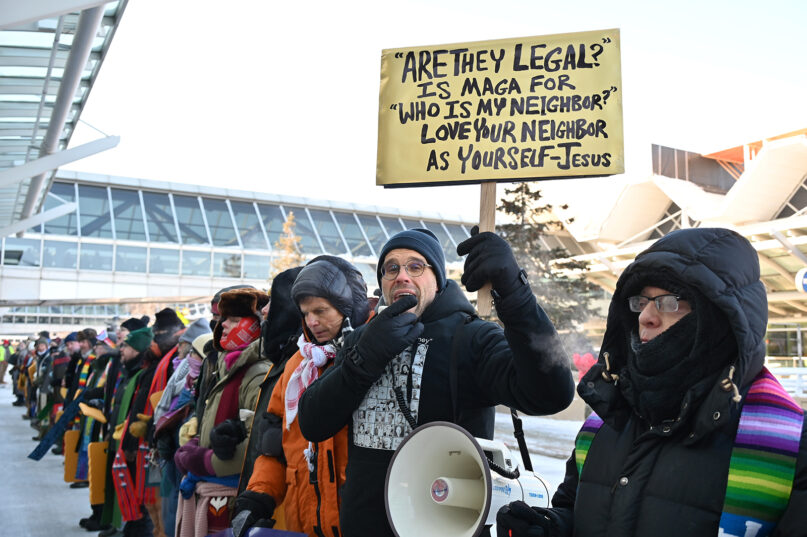
Faith leaders demonstrate against ICE tactics, in the departures area of Terminal 1 of the Minneapolis–Saint Paul International Airport, Friday, Jan. 23, 2026, in St. Paul, Minn. (RNS photo/Jack Jenkins)
Most of the out-of-town clergy returned to the sidewalk, but a line of primarily local faith leaders remained in the road, singing and praying.
The Rev. Karen Larson, who said she worships at Hennepin Avenue United Methodist Church in Minneapolis, spoke to RNS as she knelt on the ground in prayer, cheered on by hundreds of others on the sidewalk who sang songs such as “Down to the River to Pray.”
As local police began to calmly arrest clergy down the line from her — the airport police department confirmed that around 100 were arrested in all — Larson said her role as a faith leader compelled her to resist ICE.
“We cannot stand silent and stand aside as people are being attacked and separated from their families and disappeared,” she said. “They’re beloved children of God, and we are with them — that is our call.”
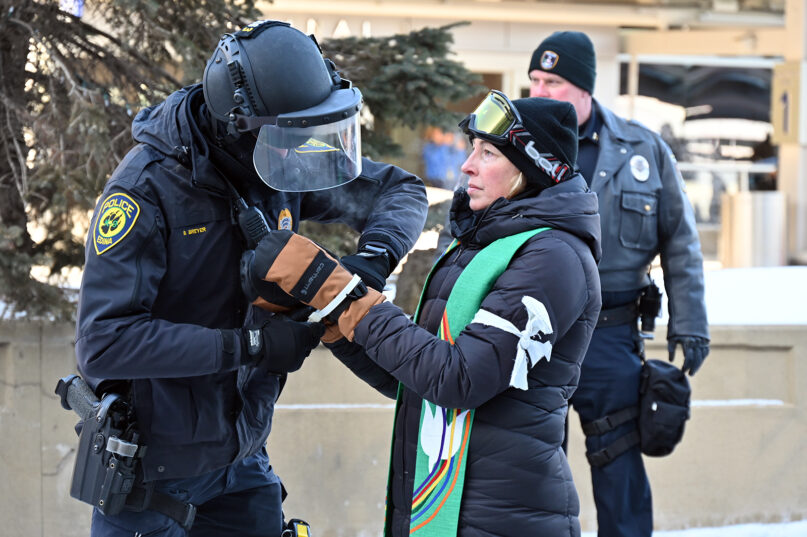
Police arrest the Rev. Ingrid Rasmussen outside of the Minneapolis–Saint Paul International Airport, Friday, Jan. 23, 2026, in St. Paul, Minn. (RNS photo/Jack Jenkins)
If Friday’s protest is any indication — and if the Trump administration continues to expand its mass deportation effort — it’s a defiant spiritual message that is likely to show up in other cities across the country.
As Larson and faith leaders were led away by police, their stoles and other religious vestments flapping in the brisk wind, a roar went up among the crowd. After a pause, the masses — most trained as religious leader and, now, as activists primed to mount righteous resistance against ICE — burst into a new chant.
They shouted: “Let them pray. Let them pray. Let them pray.”
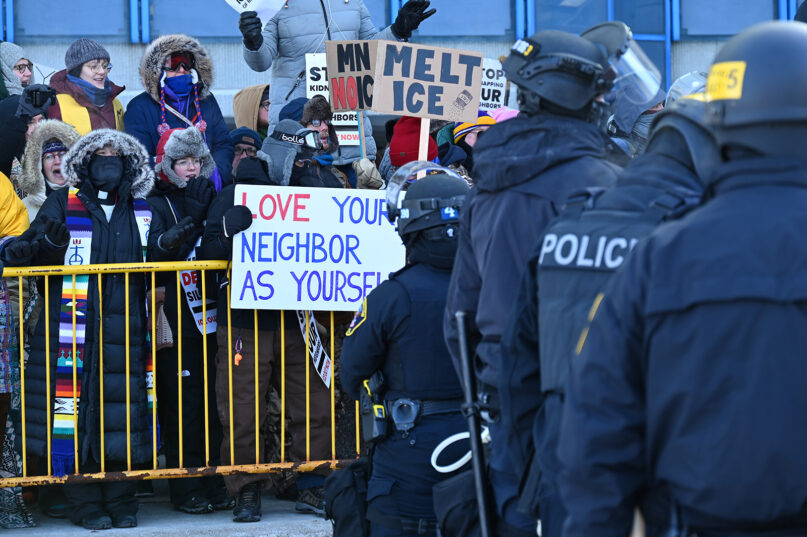
Faith leaders demonstrate against ICE tactics, in the departures area of Terminal 1 of the Minneapolis–Saint Paul International Airport, Friday, Jan. 23, 2026, in St. Paul, Minn. (RNS photo/Jack Jenkins)
Source link
