

I’ve been photographing wildlife for 4 years: here’s what happened when the Google Pixel 10 Pro XL went toe-to-toe with my mirrorless camera
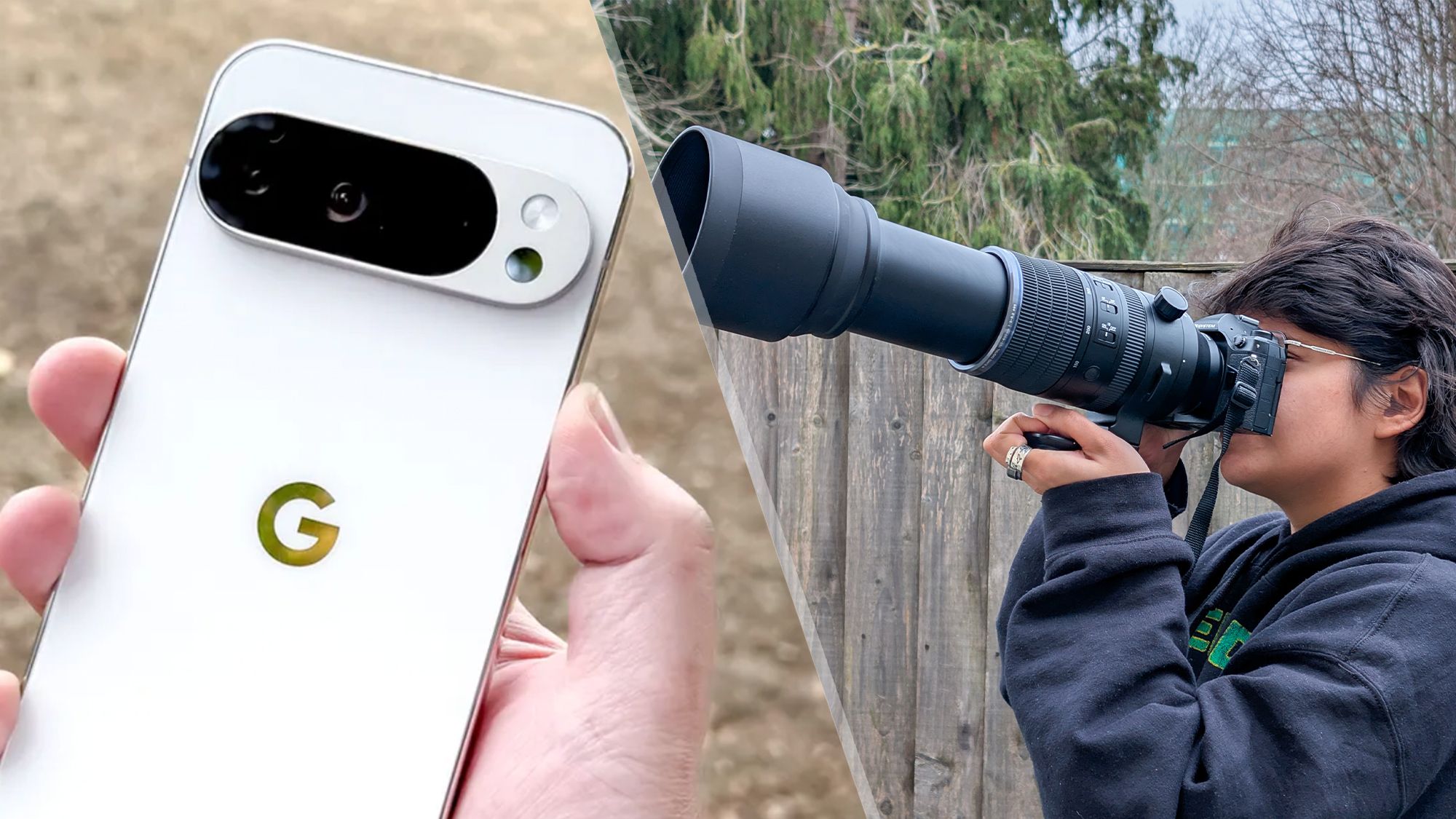
I believe the best camera you have is the one in your hands. Not only do I reviews cameras for a living, I also love photography as a hobby. I consider wildlife photography my niche, as I’ve been taking pictures of animals and birds since I was a young child. But even though the best camera phones have come a long way, can they keep up with mirrorless cameras, especially for wildlife photography? Yes and no.
I’ve spent the last month testing the OM System OM-1 Mark II, which is arguably the best camera for wildlife photography enthusiasts. I’ve also been using my Google Pixel 10 Pro XL for three months now, so naturally, I took photos on both to see if the Pixel could keep up. It would be unfair to say which of the two is better as smartphones can rarely compete directly with cameras when it comes to optics and image quality. I just want to show you the advantages and disadvantages, and that you can still use a smartphone for wildlife — with some compromises.
Nikita Achanta
A quick rundown of specs

First things first, let’s talk about the specs of both the Google Pixel 10 Pro XL and the OM System OM-1 Mark II. We’ll start with the Pixel. The smartphone features 50MP f/1.68 main, 48MP f/1.7 ultra-wide, 48MP f/2.8 5x telephoto, and 42MP f/2.2 selfie cameras. To take photos in 50MP, though, you’ll need to enable it via the ‘Pro’ settings in the camera’s menu. These photos are labelled as ‘hi-res’ and take up more space on your phone.
To get good photos of wildlife, you need to observe them in their natural habitat from a distance, which is why you need decent zoom. The Pixel 10 Pro XL packs a 5x optical zoom and 100x Pro-Res Zoom which uses AI to upscale the image. While it does a solid job, you obviously lose some detail in processing, which I’ll talk about in a second.

Moving on to the OM-1 Mark II. This is a Micro Four Thirds camera, which means it’s sensor size is smaller than that of full frame cameras. Its native resolution tops out at 20.4MP but there are two High-Res Shot modes which let you stack eight to 12 images to get 50MP (handheld) or 80MP (tripod) photos. The OM-1 Mark II captures bright images with popping colors.
Cameras should be paired with long-reaching telephoto lenses so that you get great image quality and capture plenty of detail, and one such lens is the 150-600mm f/5.0-6.3 IS M.Zuiko Digital ED which I used for testing the OM-1 Mark II. Thanks to the crop factor on the camera, you get a full frame equivalent focal length of 300-1200mm, which lets you get up close and personal with animals. No generative AI is involved, unlike on the Pixel — it’s just glass and optics.
The Pixel does a respectable job!
Image 1 of 6


The OM System OM-1 Mark II is a fantastic camera for wildlife but it has a drawback: its 20.4MP native resolution and poor high-ISO performance. This is a limitation of Micro Four Thirds cameras in general, which is why it feels natural to compare the OM-1 Mark II’s image quality to the Google Pixel 10 Pro XL — they feel like they’re on (sort of) level playing ground. On the other hand, comparing the Pixel to the 100MP Fujifilm GFX100RF would not be okay.
This is all to say that the Pixel 10 Pro XL does a respectable job of capturing images, with quite a bit of detail and nice colors, as you can see in the gallery above. I’m surprised by just how sharp the pigeons’ feathers and wings look. Of course, there is some grain in the background and in the birds’ wings, but again, it’s a limitation of the phone camera’s small sensor.
Image 1 of 6


This isn’t to say that the OM-1 Mark II doesn’t capture great photos. The colors in the gallery above are stunning, especially in the photos of the kingfisher and the European robin.
What about autofocus and burst?
Image 1 of 4


Two areas where the OM System OM-1 Mark II, or most other mirrorless cameras, has a leg-up is autofocus and burst shooting. Though image quality on the Google Pixel 10 Pro XL is commendable, the smartphone massively struggles to keep up with birds in flight. But that’s just a limitation of smartphones in general as not all of them feature AF and sequential shooting as advanced as that on mirrorless cameras.
The photos in the gallery above were taken on the Pixel 10 Pro XL. As you can see, a lot of detail has been lost in the action shots, such as the wings of the seagulls and cormorant appearing blurry and undefined. The Pixel 10 Pro XL doesn’t feature a sequential shooting mode, where a camera takes a series of photos with the single press of the shutter button. This is a big disadvantage for wildlife photography, as you’ll want to capture all the action possible.
Image 1 of 5


Check out the photos taken on the OM-1 Mark II, in comparison. The camera features a rapid 120fps drive, as well as slower 10fps to 50fps drives. This means you’re able to capture birds in flight or animals sprinting without missing a beat.
Image 1 of 2


The OM-1 Mark II’s burst performance is further bolstered by a powerful autofocus system, which quickly locks on to even the smallest of wildlife. The Pixel 10 Pro XL doesn’t do this, which results in hit-and-miss photos. Even when subjects are heavily or lightly obscured by tree branches or leaves, the OM-1 Mark II’s autofocus doesn’t fail.
Its autofocus works even better than my own eyes, frankly speaking. I couldn’t actually see the goldfinch before I captured it, because it was right overhead and all I could hear was it chattering away. I pointed the OM-1 Mark II and the camera quickly found it and the 150-600mm focused on it without missing a beat.
And how about the zoom?
Image 1 of 2


The Google Pixel 10 Pro XL has introduced a 100x Pro Res zoom as well as an optical 5x tele zoom, which in theory, should enable you to zoom right in to capture wildlife. But as you zoom in, you encounter a drop in resolution, which is, again, related to the camera’s sensor size. This doesn’t happen when you use a dedicated wildlife camera and a telephoto lens.
Take a look at the two photos in the gallery above. The first image was shot on the Pixel 10 Pro XL, the second on the OM-1 Mark II. There’s a clear difference in the two shots, as the second one is of higher resolution, and you can see the tawny’s owl’s feathers and other features clearly. The first shot, on the other hand, looks muddled up, with all the elements in the scene merging into one.
To summarize…
Image 1 of 2


At the end of the day, a mirrorless camera and a smartphone have different use cases. A smartphone is something you use every day to make calls, keep in touch with friends and family, access social media on, and alongside it all, it can take photos. A mirrorless camera is for when you want to hone your photography, create photos that can be sold as prints, bolster your portfolio, and just capture high-resolution images.
The Google Pixel 10 Pro XL is a great smartphone that takes good images. The OM System OM-1 Mark II is a great camera that takes lovely images, is much easier to handle for when you’re shooting handheld for a long time, and delivers sharper image quality. The added advantage of being able to swap lenses to alter your shooting style is a big advantage. too.
I use my Pixel a lot for photography when I don’t have my camera at hand, and it’s good option if you want on-the-fly photography, but it doesn’t compare to professional equipment. Make sure to check out my full OM System OM-1 Mark II review and our Google Pixel 10 Pro XL review for the complete low-down on image quality.

Follow Digitpatrox on Google News and add us as a preferred source to get our up-to-date news, analysis, and reviews in your feeds.
More from Digitpatrox
Source link
