

Japanese town reeling from year of record bear encounters | Japan
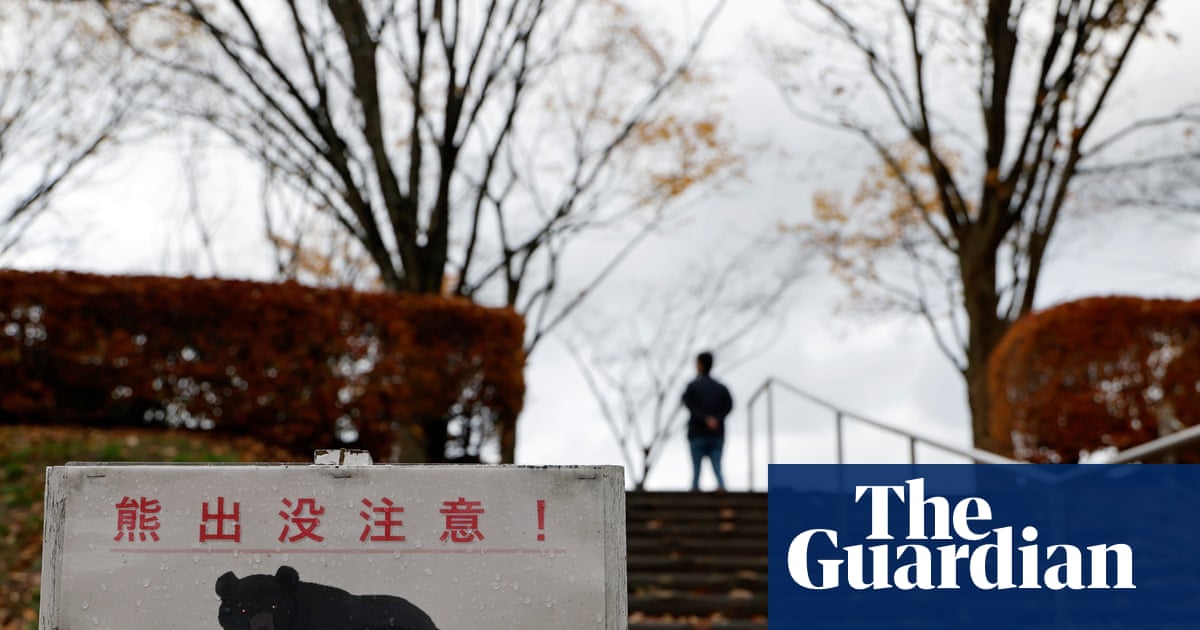
It came as no surprise, least of all to the residents of Osaki, that “bear” was selected as Japan’s kanji character of the year earlier this month.
The north-eastern town of 128,000 people is best known for its Naruko Onsen hot springs, autumn foliage and kokeshi – cylindrical dolls carved from a single piece of wood. But this year it has made the headlines as a bear hotspot, as the country reels from a year of record ursine encounters and deaths, with warnings that winter will not bring immediate respite.
“This year has been particularly bad,” says Kazuhide Otomo, an official in the town’s rural environment development division. “There have always been bears in this region, so people got used to them. But this year is different … it’s the biggest topic of conversation.”
In Naruko Onsen, groups of hikers equipped with suzu bells and repellent spray head into the forest to catch the last of the autumn colours, while posters at the local tourism office warn visitors in multiple languages how to protect themselves.
Tourist numbers are lower than in a typical year, while local ryokan inns say guests are cancelling their reservations.
Satoru Onoma, who runs a coffee shop, admits he is experiencing bear fatigue after months of intense media coverage. “It’s hard to ignore the bear problem because it’s been all over the news,” he said, adding that he had not encountered the animals during his rare trips outside. “But I’ve heard plenty of stories about people spotting bears in the mountains.”
Osaki authorities have reported 400 sightings so far this year, compared with fewer than 100 in 2024. In one incident, a woman in her 70s suffered serious injuries to her face when she was attacked outside her home after picking vegetables. In another, residents saw a bear grab and run off with their dog.
Similar encounters have been reported in regions across Japan, with the northernmost prefectures at the centre of an unprecedented wave of attacks.
A record 13 people died in suspected bear maulings nationwide between April and November, according to the environment ministry, while the number of attacks stood at 197 – another high.
Experts say hungry bears are venturing into residential and built-up areas in search of food after poor crops of acorns and beechnuts in their natural habitat.
Japan’s bear population is growing, with one estimate putting the number of Asian black bears at 44,000 – compared with 15,000 estimated in 2012, although the species is identified as “vulnerable” on the International Union for the Conservation of Nature’s “red list” of threatened species. That figure does not include Hokkaido, thought to be home to about 12,000 Ussuri brown bears, whose population has more than doubled since 1990.
Sightings have been reported on the western tip of the main island of Honshu, fuelling concern that the animals could appear on Kyushu – where they were previously thought to be extinct – which lies 650 metres away across the Kanmon Straits.
The colder weather would once have eased fears, as the animals, fattened up on beechnuts and acorns, disappeared to hibernate until the spring. But their increasingly desperate search for food is forcing them to delay hibernation.
The problem is compounded by a shortage of licensed hunters – many of whom are ageing and have little or no experience of killing bears – and the disappearance of natural satoyama borders that separate forests from villages in ageing farming communities.
As a result, northern prefectures are experiencing a surge in bear sightings even in December and January.
Earlier this month an 80-year-old man – a member of a local hunting club – was found dead near a trapped bear on a mountain, according to police. Another man in his 70s was attacked as he cleared snow from in front of his home.
Toshio Mizoguchi, an expert on bear countermeasures, told broadcaster NHK that between 2019 and 2023 the number of reported sightings in the region in December stood at between 30 to 50. That soared to 284 the following year, and has stayed consistent at 271 sightings so far this year – a phenomenon Mizoguchi attributed to prolonged searches for persimmons as the animals load up on nutrients before hibernating.
“Now black bears have begun invading even Japan’s urban spaces,” Maki Yamamoto, an associate professor at Nagaoka University of Technology who specialises in wildlife management, wrote on the Nippon.com website this month. “We must begin to approach wildlife management as a national policy issue rather than an isolated problem confined to remote mountain communities.”
Authorities in Osaki declared a state of emergency they initially expected to lift at the end of November. The measures, though, will stay in place until the end of the year, as sightings continue. Residents are advised not to go out early in the morning or late at night – when they are more likely to encounter bears – and to strip their trees of persimmons and other fruit that are becoming part of the animals’ changing diet.
“Bears are clever animals,” Otomo said. “If they find something good to eat, like a sweet persimmon, in a particular place they remember and keep going back for more. In the past, bears would often run away when they saw humans, but they are becoming accustomed to people and no longer see them as dangerous.”
Public anxiety prompted the governor of Akita prefecture – where most sightings have been reported – to call in the self-defence forces to trap and dispose of bears, although they are not permitted to shoot them.
The prefecture’s governor, Kenta Suzuki, said he had taken the unprecedented step after four people were killed and 62 others injured in attacks. “One of the characteristics of this year is that these incidents are taking place in urban areas,” he said, adding that the prefecture had culled more than 2,000 bears this year.
“We’re hearing about people opening their front doors to find a bear on their doorstep, or roaming in their garden,” he said. “The fact that this is happening near people’s homes is causing high levels of fear.
“We’ve been criticised for our decision to cull a large number of bears, but we’re not doing this because we want to … it’s because of the damage they are causing in urban areas and to agriculture. It’s unavoidable.”
In Osaki, residents hope 2026 could bring relief, since poor beechnut harvests appear to occur in two-year cycles – a phenomenon some scientists have attributed to the climate crisis and intense summer heat. If the pattern persists, there should be plenty of food, and far fewer hungry bears roaming towns and villages next year.
But it also means that the following year could see a return to more frequent sightings, injuries and deaths.
“It’s about striking a balance between protecting residents and preserving bears’ natural habitats,” Otomo said. “We have to make sure there is a clear division between the bear and human populations. But as long as bears continue to lose their fear of people, the problem won’t go away.”
Source link
