
“The only reason I’m sitting here with you is because the belt broke, because I was holding a little bit of holiday weight.” That’s the explanation Michael Strassner offers for his still being alive, and sure enough, when we meet his semi-autobiographical character in the first scene of Jay Duplass’s The Baltimorons, the comedian is falling from the rafters in a failed suicide-by-hanging attempt. The scene sets the tone for his offbeat Christmas movie, his first film back after a 14-year hiatus from the director’s chair.
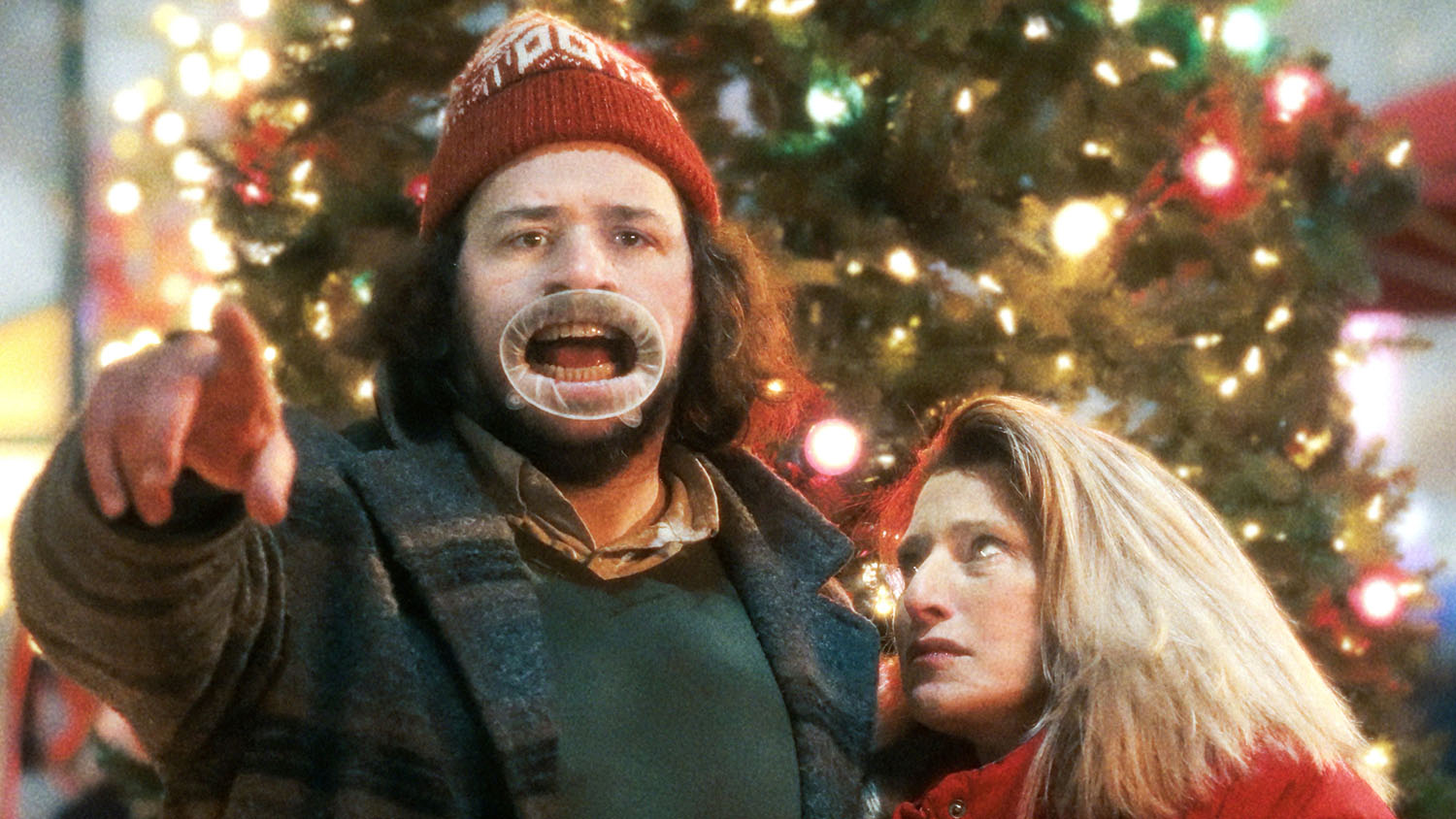
“It was tragedy and comedy, right in that very sentence,” Duplass recalls of the proclamation Strassner offered at their first meeting, arranged through Instagram DMs. “The sweet spot for me is movies that are fun and funny, and that also break your heart.” The pair built on Strassner’s real-life foundation to tell a story of a fictionalized, down-on-his-luck comedian who smacks his head into a doorframe on Christmas Eve. He needs emergency dental surgery and embarks on a hijinks-filled ride around town with the only dentist working the holiday. Between towing lots and wince-worthy holiday parties, Cliff (the injured comedian) and Didi (the dentist, played by Liz Larsen) move past both addiction and midlife lethargy.
The project, which won an Audience Award at South by Southwest last year and is now getting its second wind ahead of the Film Independent Spirit Awards, launched Strassner onto the late-night and indie circuit. It also, seemingly, reignited Duplass’s desire to act as a high-output filmmaker, as he’s quickly following up The Baltimorons with more comedian-focused fare—See You When I See You, which follows a comedy writer battling PTSD—premiering tomorrow at Sundance. Ahead of awards and festival season, Duplass joined CULTURED for a look at how he came back to leading sets (without his brother in tow), and what he plans to do to keep up the momentum.
CULTURED: Can you tell me how The Baltimorons came together? I read that it started by sliding into someone’s DMs.
Jay Duplass: I had not made an original movie myself in like 14 years. It was a really long process of being in partnership with my brother [Mark Duplass], us being sort of like cavemen who make art in a cave together and are just like, Is this anything? We made our last feature film together [in] 2011, and at that time it was quite a struggle to make studio films. We were having some success making tiny little independent movies and selling them, so we were trying to figure out which way to go. Long story short, there was a 14-year period where it really took my brother Mark and me a long time to figure out that he didn’t really want to direct movies and that’s actually everything that I wanted to do. I actually figured it out about seven years in.
We moved into television—it was the collapse of the mini majors at that point in time. I accidentally started acting and that was fun. But then the pandemic happened and then the strikes happened and, honestly, [making] tiny little independent films like The Baltimorons, really handmade pieces of art, wasn’t even an option for a moment there. I turned 50 during the strikes, and I was like, I gotta make a movie, or else I’m gonna die. That’s probably what makes you a director, cause it’s not for the money and the amount of work that you put in is just obscene.
I kind of went back to my roots. Our first movie, The Puffy Chair, was [made with] the available materials. I have a brother who’s an actor, he has a girlfriend who’s an actor, I have a friend who’s an actor. We’re in our 20s, we’re trying to figure out what it means to be in love with somebody. That’s what we were going through. I was like, I need to find somebody who’s going through something. I’ll tell you the origin story of how I found out about Michael “The Body” Strassner.
CULTURED: Is that the nickname that we’re going with?
Duplass: I just came up with that just now. That’s just for CULTURED. If you really examine his body, front to back is incredibly thick, and I’m not talking about belly. There’s a lot of chest there. But, during the pandemic, I eliminated all of my social media to just be nothing but comedy. That’s all I could handle, and Michael’s large body was dancing and prancing across my screen. He just made me happy and I followed him and he DM’d me, but I didn’t know what DMs were because I’m 50 years old. I thought DMs were just for sex, but eventually I saw that he had messaged me, maybe seven months later, and I helped him with a short film he was making and learned about his story.
I met him several years into his sobriety where he’s just loving life and feeling great about it and feeling thrilled to be alive, and I was just like, This is the guy. This is the movie. This is what the world needs right now. The world isn’t saying that it needs a movie about alcoholism and sobriety and suicide and menopause, but it does, and that was made very clear to us in this past year. We won the Audience Award at South by Southwest, we got a distribution deal for a tiny little movie that has no movie stars in it. It restored my faith that if you can make a good piece of art, even if it is a movie—cause movies are kind of like off-Broadway now—people will champion it.
CULTURED: Were you shocked by how well this came together after just running across someone online. Or, when you met, were you like, I’ve got someone really talented here?
Duplass: I knew I had some gold there. I honestly didn’t even know if he could act that well, because I had not seen any acting from him, but he’s a performer for sure. With Liz Larsen, similarly, there was certainly a thought that we could get a famous lady in this movie so it could get noticed more, but we were writing the script for Liz. I didn’t know if Liz could really do straight up vérité acting. I shoot a documentary style—if you’re not 100 percent real, it shows. I sat down with her during the strikes, and I was like, “If these strikes ever end, would you like to come to Baltimore and run around on the streets in the middle of the night?”
CULTURED: Working with a small team, do you find that this is really the kind of project that attracts you?
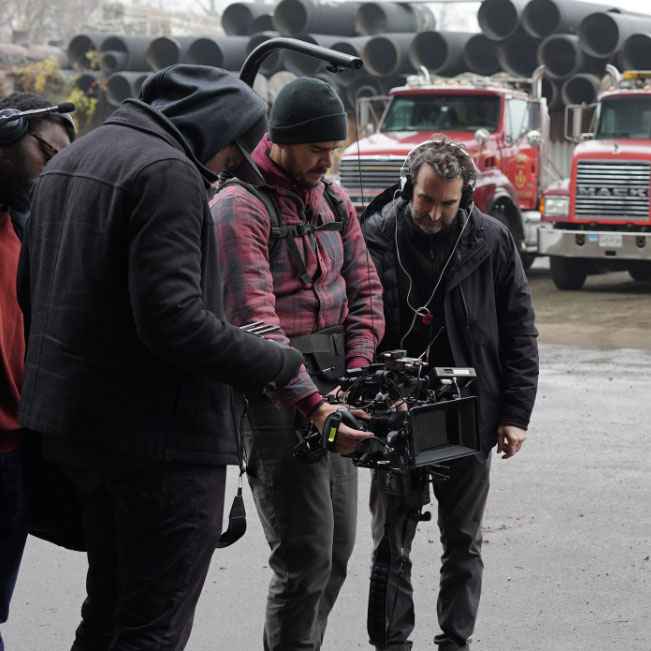
Duplass: Yeah, we had about 12 or 15 people, depending on the day, just kind of roaming around. Baltimore is where I started. It is where my heart is. It’s a hard way to make money, I’ll tell you that. It’s really more of a labor of love—just a weird, mystical push to have a piece of art come through that really wants to be made. A lot of people have all these horror stories and whenever you make a tiny independent film, you’re gonna have horror stories, but I have to say that this movie just wanted to be made. We had crazy obstacles and crazy things happen, but it just was like, “Just keep rolling, just keep shooting. Oh, that place canceled on us. They don’t want us there. How about we just go right around this corner and do it right here. We’ll knock it out in 35 minutes and hopefully nobody shows up in time.” That kind of filmmaking really forces you to constantly think about what exactly your scenes are about and what is absolutely critical about this narrative. I do love it. And I do love making movies with not-famous people. There’s something so much more pure about the experience of seeing those movies where you don’t have that 30-minute period of adjustment or sometimes you never adjust, because we never get over the fact that this is Johnny Depp.
CULTURED: Do you feel like it’s more or less difficult to get people on board with this kind of project these days? Audiences seem to have a little bit more awareness of how the studio structure works and making a concerted effort to support smaller projects, but do you feel like the institutional support has dropped out?
Duplass: It’s definitely just straight up harder to sell a movie. If you wanna have a decent sale for a movie with no stars in it, you’re gonna have to win a major festival and probably win the Audience Award, because that’s the award that actually matters for distributors. TV is so prolific and TikTok is so prolific. We’re not really even competing against TV with movies anymore, we’re competing against TikTok. Audiences are way less likely to watch movies just cause they’re scrolling, but independent filmmaking has always been hard, and my first success came with the first digital filmmaking availability. The first movie I ever made, that nobody’s ever seen, was shot on 16-millimeter, black-and-white film, because back in the day, you needed a 35-millimeter print to exhibit at Sundance. So, the cheapest movie that was showing at Sundance ultimately cost hundreds of thousands of dollars. I find that time to be way harder than this time because now, if you have an iPhone and a laptop and a decent microphone—that’s the most important part, cause you gotta have good sound—you can finish a feature film.
[My brother and I] produced Sean Baker’s Tangerine, which is a $100,000 iPhone movie. Sean’s always made great films, but that’s the movie that put him on the map and set him up to make Florida Project and Anora. It went to Sundance and got massive attention. The truth is, as hard as it is to get your movies seen, that’s really only for movies that are not great. People don’t wanna hear that. It sounds shitty to say it, but you talk to distributors and they’re like, “We’re dying for great movies.” It can’t be just an okay movie. It can’t be just a movie that your friends like. It really needs to break through walls and boundaries, but there’s not a money barrier anymore. The only limit to your success as a filmmaker is your own creativity, ingenuity, and drive. That overcomes all the barriers of financing, and it also overcomes the barrier of experience. I do think it takes several films to make a great one. It took me many, many films before I even made a decent one.
CULTURED: So you went 14 years without doing a film. Now you have one coming out in two weeks as I’m still talking to you about the last film. Do you feel like you’re getting back on a role?
Duplass: I’m back to make movies probably until I die now. I’ve already missed this year, so I don’t think I’m one-a-year, but I would like to be one every two years at minimum. Knock on wood. I don’t know if anybody will be making movies other than computers in five years, but for the kinds of movies that I make and hopefully that people still wanna watch, we’ll need humans to make them. It’s funny because people are talking about A.I. and how shocking it all is, and I’m just like, they’re the big blockbuster studio movies that are made by formula. They are already A.I., in my mind. They are designed as commodities to deliver the widgets that they think people want to consume. That’s a form of A.I.—it just requires a lot of humans still, but it won’t require humans in the near future. VFX is A.I.—it just requires several humans to operate, and pretty soon VFX will only require one human to operate.
I do hope that I can keep making movies and doing it the way that I love to do them, which is getting a bunch of people and going away to camp and trying to make a great piece of art in almost impossible circumstances. I don’t know why I like that so much but I think it comes down to what everybody’s craving right now, which is doing things, being in the world, actual intimacy, actual problem solving, actually putting yourself out there and taking risks and eating breakfast with people on the edge of a cliff in 37 degree weather. That’s actually what life is about and moviemaking is an incredible way to thrust yourself into it.
CULTURED: So my last question then will be are you feeling cynical or optimistic about the future of moviemaking, as you’re off to Sundance?
Duplass: I’m feeling hopeful. I have a pretty positive disposition in general about making stuff, because it took me a good 10 years to figure out how to make something that didn’t suck. I have a little bit of a Taoist approach to it, which is don’t get too upset, don’t get too excited, just make stuff. I do feel that fundamentally, the artists that I know that are working and having success do not focus on the results—they focus on the process. They really want to be in the world making movies. Most people are very fixated on the outcome. Most people don’t even want to be on a cliffside at six o’clock in the morning in 37 degree weather. They actually just wanna be at Sundance receiving an award. I wanna be out in the world making art and the Sundance part of it is actually kind of hard because there’s not that much for me to do at Sundance other than just go to locations and answer questions and sit in an audience full of people desperately hoping that they laugh and cry at the right moments. It is really all about staying focused on making art.
More of our favorite stories from CULTURED
Why Are So Many Contemporary Museums Showing Dead Artists Right Now?
Wolfgang Tillmans Became a Household Name Finding Beauty in the Banal. He’s Ready to Re-Evaluate.
19 Design Experts Answer All Your Burning Interiors Questions
Nia DaCosta and Ryan Coogler Compare Notes on Marvel, Genre-Hopping, and Making Films That Shock
4 Days in Feminist Warsaw: Johanna Fateman on the Art of Abortion and the Return of the All-Women Show
Source link
