

Community mental health services are widely known in Chicago, but access becomes far less clear outside city limits—particularly for people without private, employer-sponsored insurance.
While a network of nonprofit providers offers low-cost or free care, availability varies sharply by geography, funding, and transportation.
In Chicago, care is readily available: organizations like Thresholds, Trilogy, Center on Halsted and Howard Brown Health provide mental health services on a sliding-scale basis for people who are uninsured or covered by Medicaid or Medicare. Sliding-scale models allow patients to receive care at reduced cost based on income, rather than paying full out-of-pocket rates.
For residents in suburban Cook and Lake counties, access often depends on a smaller set of providers. Agencies such as the Josselyn Center in Northfield, Turning Point in Skokie and Evanston, and the Kenneth Young Center in Mount Prospect serve as primary mental health resources for surrounding communities. Similar nonprofit models operate across the Midwest, though coverage remains uneven.
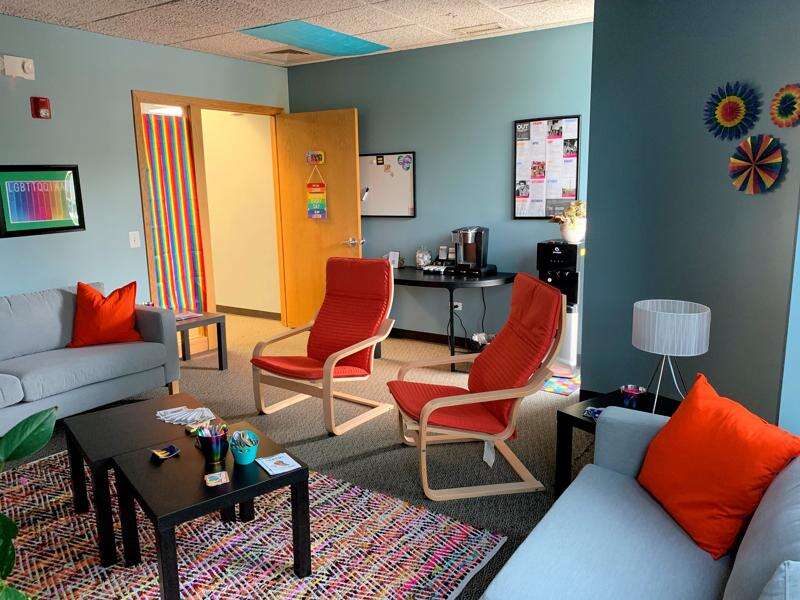
Amid coverage gaps, a new therapeutic model is emerging: crisis support spaces, known as “Living Rooms.” Designed as alternatives to emergency rooms or psychiatric hospitalizations, Living Rooms offer short-term, voluntary support for people experiencing acute mental health distress. Guests meet with recovery support specialists—often individuals with lived experience—who help de-escalate crises and connect visitors to longer-term care.
Unlike clinical settings, Living Rooms are intentionally informal, resembling residential spaces rather than medical facilities. Recovery support specialists are encouraged to share aspects of their own mental health journeys when appropriate, a practice advocates say can build trust and reduce stigma.
“At the Josselyn Center, I can openly say I’ve been there before,” said Latroya Clady, a mental health counselor with years of experience across multiple Chicago facilities and an intern at Josselyn. “It helps guests understand that peer specialists and interns are here because we’ve experienced similar struggles.”
Beyond walk-in crisis support, some agencies also offer mobile crisis response. The Kenneth Young Center operates a 24/7 Mobile Crisis Response team serving Elk Grove Village, Hoffman Estates, Mount Prospect, Schaumburg and surrounding areas. Teams respond in homes or community settings to provide on-site assessments, stabilization, and referrals to ongoing services.
Despite demand, many providers report financial strain. Federal funding reductions have forced agencies like the Kenneth Young Center to “navigate a challenging financial landscape,” said Amanda Gallegos, Vice President of Programs at the center. Advocates warn that instability in funding threatens services that fill gaps left by hospitals, schools and private providers.
Demand is particularly high among adults transitioning out of school-based support systems. As young people graduate from high school or college, they often lose access to school psychologists and counselors, increasing reliance on community-based agencies.
“Transitional care is a significant need,” Gallegos said, citing individuals who age out of parental insurance coverage at 26 while lacking stable housing, employment, or life skills.
According to the Kenneth Young Center, 40 percent of its guests are between 26 and 50 years old, while another 45 percent are between 51 and 65—demographics that reflect gaps in midlife mental health support.
Even students who remain in school face limited access to counselors. “In the city, you might have two or three social workers for 300 students,” Clady said, adding that nonprofit partnerships could help close the gap.
Some suburban districts have expanded mental health programming in recent years. Evanston Township High School offers psychiatry services through its Bridges program, while Stevenson High School has implemented student support teams—initiatives that were rare a decade ago. Still, Clady said access remains insufficient.
“Teaching mental health coping strategies and embedding them into school curricula is critical,” she said. “Mental health is something students deal with every day.”
Insurance disparities further complicate access. Clady noted that patients with public insurance often receive fewer covered treatment days than those with commercial plans, a difference she described as a major barrier to equitable care.
Transportation poses another challenge. While Living Rooms operate around the clock, reaching them can be difficult—especially during overnight hours.
“The Living Room is open 24 hours, but that doesn’t mean people can get here 24 hours,” said Rachel Kelly, a recovery support specialist at Kenneth Young. Ride-share costs, limited public transit and fear of ambulance bills can deter people from seeking help.
The Josselyn Center covers ride-share costs for some guests, but Kenneth Young and Turning Point do not. As a result, proximity plays a significant role in who receives care. At Kenneth Young, 56 percent of guests live in Mount Prospect, where the center is located.
“I wish we had more funding because people need help,” said Seamus Black, a recovery support specialist at Kenneth Young. “Transportation alone can determine whether someone follows through with getting care.”
How to access resources in Chicago and beyond
If you’re looking for mental health support without private insurance, help does exist, though where you live can shape which doors are easiest to open.
Several community-based agencies across Chicago offer free or sliding-scale mental health services for people who are uninsured or underinsured.
Thresholds operates across Chicago, with multiple locations on the North Side and beyond, providing outpatient mental health care and crisis support on a sliding scale.
Trilogy, based primarily on the North Side, offers community mental health services and crisis response for adults living with serious mental illness.
Center on Halsted, located in Lakeview, provides behavioral health services within an LGBTQ+ affirming community space.
Howard Brown Health – Halsted, also in Lakeview, integrates mental health care into broader community health clinic serving LGBTQ+ patients.
GRO Community, based in the South Side, offers mental health and wellness support rooted in community-based care.
For people living outside city limits, suburban agencies often serve as the first– and sometimes only– accessible point of care.
The Josselyn Center, headquartered in Northfield and Northbrook, provides outpatient mental health services and crisis support to residents of the North Shore and surrounding suburbs.
Turning Point, with locations in Skokie and Evanston, offers counseling and operates a crisis “Living Room” where people can walk in during moments of acute distress.
Kenneth Young Center, based in Mount Prospect and Elk Grove Village, serves much of the Northwest Suburbs with therapy, crisis stabilization, and long-term mental health care.
More Reads by TCR
Source link
