

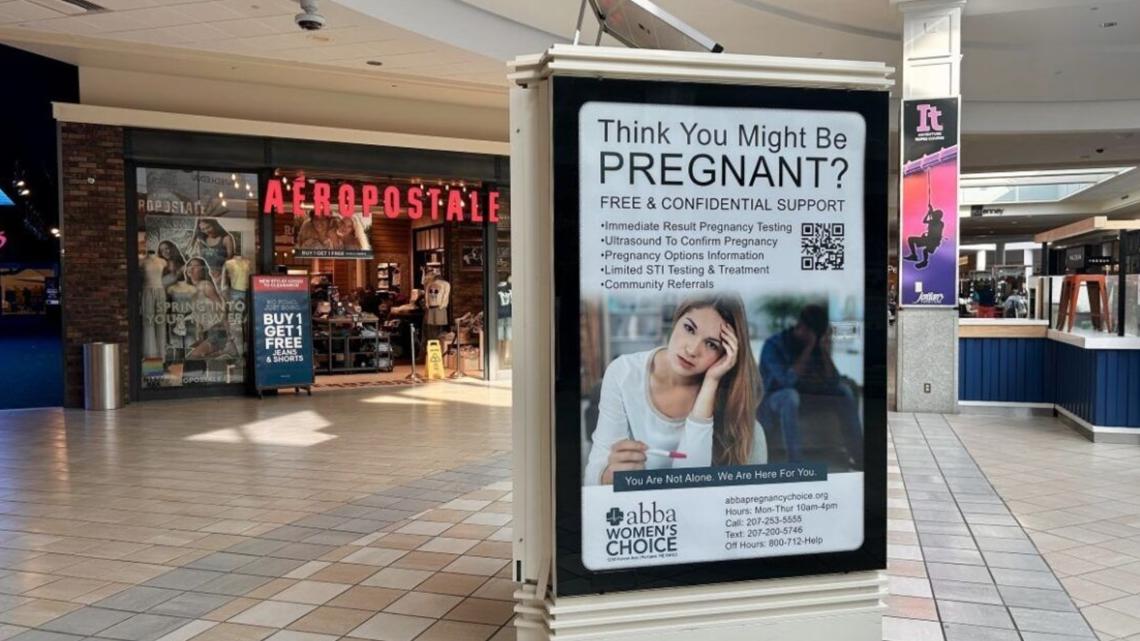
The centers aren’t bound to the same oversight as doctor’s offices and are often connected to religious organizations that oppose abortion.
PORTLAND, Maine — ABBA Women’s Choice in Portland looks like a typical medical office at first glance. On an April afternoon, Executive Director Jenny Pratt opened the door, revealing a modern waiting room with patterned chairs and an array of pamphlets featuring the faces of women. A long hallway led past rooms with exam tables, medical dioramas and sonogram machines.
RELATED: Maine Family Planning ends primary care services due to Medicaid cuts
ABBA’s website describes the center as a “medical certified women’s pregnancy resource center,” and Google Maps describes it as a “women’s health clinic.” Staff provide free pregnancy tests and conduct free ultrasounds, which are read by a doctor licensed in the state of Maine, Pratt said.
When it comes to abortion, ABBA’s website emphasizes making “a fully-informed decision,” presents information about adoption and parenting, and lists six risks of abortion, though it does not note how rare the complications are.
The omission is a nuanced sign that ABBA can operate more loosely than a regular doctor’s office. It is not bound to the same oversight as a primary care office or hospital. It is not licensed as a medical facility by the state of Maine, and it is not beholden to federal privacy requirements that protect patient information.
Rather, ABBA is one of 11 so-called crisis pregnancy centers in Maine. These nonprofit organizations offer a limited range of services directed toward pregnant women and may make claims about abortion that are not supported by medical studies. They are small and largely run by one or two paid staff members, in addition to volunteers.
But they maintain a medical-looking appearance, belying the fact that they are often connected to national or global religious organizations, and do not perform or refer for abortions.
For instance, ABBA’s LinkedIn page states it follows guidelines set by those religious organizations and that its staff are certified by the American Association of Christian Counselors. Another crisis pregnancy center in Rockport, called Zoe, A Women’s Center, wrote on its tax form that it provides “biblical counseling” alongside ultrasounds and other classes.
As abortion providers in Maine face major funding cuts, staff from reproductive rights organizations are concerned that more women may turn to crisis pregnancy centers, unaware of what these facilities are.
Representatives from Reproductive Health and Freedom Watch, Maine Family Planning, and Grandmothers for Reproductive Rights also said they fear there is an opening for the Trump administration to redirect money from regulated medical providers to crisis pregnancy centers in Maine, as it did in California in 2019.
Lisa Newcomb, a spokesperson for Planned Parenthood of Northern New England, said she was not aware of any current conversations to redirect federal government funds to Maine crisis pregnancy centers, but “we are aware of this happening in hostile states.”
In Maine, crisis pregnancy centers play less of a role in reproductive health than in other states, in part because Maine does not fund them. No known federal funds currently flow to them either, according to George Hill, president and CEO of Maine Family Planning, which provides reproductive health care, including abortions.
At least four crisis pregnancy centers in Maine have received federal funding in the past: a total of $31,253 in Paycheck Protection Program funds during the beginning of the pandemic to cover payroll and rent, according to a ProPublica database.
The amount that went to Maine doesn’t appear to have directly funded services and was a small fraction of overall federal awards. Between 2017 and 2023, the federal government gave $429 million from various pools of money to more than 650 crisis pregnancy centers across the country, according to a recent report by the research and consulting firm Health Management Associates.
What’s more, in 2021, Maine was one of only four states with more abortion providers than crisis pregnancy centers, according to a spatial analysis of facilities nationwide, conducted by the University of Georgia College of Public Health. Support for abortion also remains high in Maine, according to surveys.
But the landscape is shifting, even in states such as Maine where abortion remains legal after the 2022 U.S. Supreme Court case that overturned Roe v. Wade. In July, the Trump administration eliminated Medicaid reimbursements for non-abortion health services at certain providers that also perform abortions.
The legislation prevented these providers, such as Planned Parenthood and Maine Family Planning, from billing Medicaid for primary-care services, an important line of revenue. (Federal funds were already prohibited from paying for abortions in most cases.)
In turn, Maine Family Planning announced on Oct. 29 that it would end primary care operations at three of its locations, in Houlton, Ellsworth and Presque Isle. Its decision came as two in five hospital birthing units across the state have closed over the last decade.
Both Hill and Jenifer McKenna, a senior advisor at Reproductive Health and Freedom Watch, said the federal changes will decrease access to Maine’s sexual and reproductive health providers.
“Patients who want to see a provider for comprehensive options counseling may find themselves dealing with a fake clinic that has just one item on its agenda and that is continuing a pregnancy to term,” Hill said.
Patients might be misled because crisis pregnancy centers frequently talk about choice, language typically used by abortion rights advocates. Center directors in Maine pushed back against the assertion that they operate “fake clinics” where staff try to convince women to avoid abortion, instead saying they emphasize options.
“When women come in here, we look at them first. We don’t think, ‘I’m going to save her baby.’
That’s not why we’re here. We’re here to educate her, to let her know that there are options. Yes, abortion is an option. We know that. But there’s adoption, there’s parenting, and there’s all these other options. So that’s our mindset,” Pratt said.
Mary Rose Pray, director of the Brunswick-based crisis pregnancy center, Care Net of Midcoast Maine, echoed Pratt.
“We are not pressuring. This is the thing that gets put out, that you come in here, and we are going to corner you, and if you even mention the ‘a word,’ we’re not letting you out. No, no. It’s a person’s choice. They have to make the choice,” Pray said.
‘Risk to public health’
It was not possible for The Maine Monitor to independently confirm how each center in Maine would respond to a woman facing an unintended pregnancy. Staff from nine of the 11 centers declined to answer questions.
Some centers may provide appropriate information. Nationally, however, many have misinformed women, forced them to sit through religious programming for baby supplies, declined to provide information or referrals for birth control, and used sonograms to attempt to persuade women to avoid abortion, according to national news reports. They have set up near abortion clinics and college campuses to confuse abortion seekers, and have been widely described as central to the anti-abortion movement.
While some crisis pregnancy centers in Maine refuted that they are anti-abortion, at least eight are affiliated with one or more large, anti-abortion advocacy groups that have powerful legal connections and religious missions. Pratt, for instance, said ABBA is affiliated with the National Institute of Family and Life Advocates, based in Virginia. The institute’s website says it “stands up for the most vulnerable among us — the unborn,” and provides legal counsel, education and training to its more than 1,800 members across the country.
ABBA is also affiliated with Care Net and Heartbeat International. Care Net, based in Virginia, describes itself as a “pro abundant life ministry” with a goal to “save babies from abortion” and “ensure that they and their parents have the abundant life that can only be found in Christ.” On its website, Heartbeat International, based in Ohio, says its vision is to make abortion “unthinkable.”
Of the 11 known crisis pregnancy centers in Maine, six are affiliated with Heartbeat International, and eight are affiliated with Care Net, with some centers belonging to both, according to a database compiled by the left-leaning organization Reproaction, which argues that all such centers oppose abortion “whether explicitly or implicitly.”
When asked if Care Net of Midcoast Maine must be anti-abortion based on its affiliations, Pray said, “We’re anti-abortion in the way that we don’t offer the abortion pill, but we have accurate information about the abortion pill and the possible side effects.”
Similarly, Pratt responded, “I would say we talk about all her choices and from a life-affirming place. We don’t do abortions here or refer for abortions, but we talk about abortions from a medical perspective.”
Talk of a medical perspective conflicts with the fact that ABBA and similar facilities are not regulated as doctor’s offices are. While individual crisis pregnancy centers may provide information that meets medical standards, they are exempt from independent oversight that would evaluate their practices.
There is not even consensus on what to call the centers. In conversations with The Monitor, people called them “pregnancy resource centers,” “unregulated pregnancy centers,” “anti-abortion centers” or “pregnancy help centers,” depending on their views of abortion.
Warnings about them come from different corners. Portland city government describes them as “anti-abortion organizations that intentionally mislead pregnant people with scare tactics and lies” and says they are “a risk to public health.”
The American College of Obstetricians and Gynecologists emphasizes that abortion is a safe procedure backed up by decades of data. Despite this, crisis pregnancy centers “use false and misleading information, emotional manipulation, and delays” to prevent pregnant people from getting timely care from licensed medical professionals, the member organization for OB-GYNs states on its website.
It also describes how crisis pregnancy centers may assert false risks of abortion, downplay the impact of pregnancy and childbirth on people’s lives and health, advertise their centers online using keywords that make them appear in searches for abortion clinics, and falsely represent their facilities as legitimate health care clinics.
Reproductive rights advocates in Maine fear misleading practices could result in increased harm to patients’ health, especially if those practices are supported by government funds that are redirected from licensed health care facilities.
Aside from Medicaid cuts, earlier this year the Trump administration also stopped Title X funding from flowing to various health centers across the country, including 63 in Maine, according to KFF, a nonpartisan health policy organization. Title X is the federal family planning program that helps cover services such as birth control, testing and treatment for sexually transmitted infections, pregnancy testing, Pap smears and breast exams for low-income patients. By law the money cannot be used for abortion.
The federal government grants about $2 million each year in Title X funds to Maine Family Planning, which distributes the funds to Planned Parenthood of Northern New England and federally qualified health centers across the state. Last year, Planned Parenthood of Northern New England in Maine served 6,468 Title X patients, or 61 percent of all its patients visiting its health centers in Biddeford, Portland, Sanford and Topsham.
“The issue for us is of course the potential diversion of Title X funds to fake clinics,” wrote Hill of Maine Family Planning. “This would be catastrophic for our patients.”
Both Pratt and Pray said they don’t want federal funds.
“As soon as you start taking government money, the government gets to step in and tell you what to do and what not to do,” said Pray, with Care Net of Midcoast Maine. “The fact that we don’t receive any government funds is actually a good thing.”
Others are not convinced. Nationwide, “the unregulated pregnancy center industry has been proactively, vigorously vying for these funds,” said McKenna, who is also co-author of “Designed to Deceive,” a study of crisis pregnancy centers in nine states. “They’re not in a passive relationship to what’s happening at the federal level. The concern is that they don’t appear to be even close to qualified or equipped to meet the reproductive health care needs of the enormous low or no-income population.”
Others are worried that the lack of privacy protections for women who visit crisis pregnancy centers, especially in states that limit or restrict abortion, could result in their abortion plans being shared with those who would prosecute them.
Heartbeat International — to which six Maine crisis pregnancy centers belong — collects the personal data of people who contact Heartbeat International or local affiliates. That information could include clients’ sexual and reproductive histories, test results and ultrasound photos, according to an investigation by TIME. (Both Pratt and Pray said they don’t use Heartbeat International’s data system.)
Centers may say they keep client information confidential, but they are not subject to the same federal privacy laws — such as the Health Insurance Portability and Accountability Act, or HIPAA — that health care facilities are.
In other words, they are not under any legal obligation to protect personal information or to “keep it out of the hands of abortion bounty hunters,” wrote seven U.S. senators in a 2022 letter to Heartbeat International, outlining their concerns. Heartbeat International responded to say it maintains the same security standards as hospitals.
Unsupported by science
Some crisis pregnancy centers in Maine publish information on their websites, or provide information in-person, that is unsupported by medical studies. For instance, at least three talk about so-called abortion pill reversals, an experimental process aimed at undoing a medication abortion.
A medication abortion involves taking two drugs: mifepristone to stop the pregnancy growth, followed by misoprostol to make the uterus contract to expel the fetus. Claims of abortion pill reversals — where high doses of progesterone are given to pregnant people who have taken the first but not the second drug required for a medication abortion — are “unproven and unethical,” according to the American College of Obstetricians and Gynecologists.
A 2020 clinical study had planned to enroll 40 patients in a double-blind, placebo-controlled, randomized trial to measure the effectiveness of administering progesterone after mifepristone. But it stopped early, with only 12 participants, after three of them were brought to the hospital in ambulances for severe bleeding. Those who start medication abortions with the first drug, but don’t take the second drug, “may be at high risk of significant hemorrhage,” the study concluded.
First Step Pregnancy Resource Center in Bangor does not mention this severe risk. Instead it claims on its website that women just need to act quickly after taking mifepristone “for the abortion pill reversal to be successful.” Its source is not a medical study but an “Abortion Pill Rescue” website made available by Heartbeat International. (First Step did not respond to questions regarding claims that centers distribute misleading information.)
Neither First Step nor Heartbeat International disclose on their websites that the effects of progesterone on “reversing” an abortion remain unproven. In fact, mifepristone alone doesn’t always cause abortion anyway; some women who take only mifepristone have continued their pregnancies, according to a review published in the reproductive health journal Contraception.
The full effect of this misleading information on women in Maine remains unclear. But Mabel Wadsworth Center, a sexual and reproductive health care facility in Bangor that provides abortions, gets “multiple patients” each year who originally visited the nearby crisis pregnancy center, First Step, in pursuit of medical care and walked away with inaccurate information or no actual treatment, said Aspen Ruhlin, community engagement manager at Mabel Wadsworth.
For instance, Ruhlin spoke of two patients who, a couple years ago, initially went to First Step and tested positive for sexually transmitted infections, but were not referred for or offered treatment. (First Step did not respond to a question about this assertion; on its website it says it provides both testing and treatment.)
Ruhlin also said Mabel Wadsworth has cared for patients who originally went to First Step and were told they were too far along to get abortions despite being less than eight weeks into their pregnancies. Maine law allows abortions up to the point of viability, which is when a fetus can survive outside of the uterus — generally around 24 weeks. Physicians may perform abortions after that point when they deem it medically necessary. (First Step did not respond to a question about the assertion that it gave inaccurate information on abortion.)
Ruhlin, along with Cait Vaughan and Elayne Richard of the Maine-based advocacy organization Grandmothers for Reproductive Rights, also said they have heard from people who visited centers in pursuit of free baby supplies and had to sit through religious content before receiving less than one day’s worth of diapers. They did not name which centers.
“They are preying on populations who have less access to traditional health care systems, and maybe less education access around sexual and reproductive health,” said Vaughan, a spokesperson for the group.
As Planned Parenthood and Mabel Wadsworth have faced tightening budgets and recent years of big funding losses, crisis pregnancy centers have largely enjoyed healthy margins, though their budgets are far smaller, according to a review of their tax forms.
Of all the centers, Resolve Life Center in Waterville had the greatest increase in revenue, which nearly tripled between 2019 and 2023. It allowed the center to spend $50,000 in advertising in 2023 — or 19 percent of its expenses. The center does not disclose on its tax forms where its contributions came from.
Doctors help out
Some doctors in Maine assist crisis pregnancy centers, though the public won’t always know their names. No centers currently list the names of their affiliated doctors publicly, such as on their websites or even their recent tax forms, and they aren’t required to.
Pratt and Pray confirmed that ABBA and Care Net of Midcoast Maine each have a medical director, a Maine-licensed physician who reads their ultrasound results, though they both declined to share the names of the doctors.
“I don’t want to. It’s so polarized here in the state, unfortunately, to be pro-life,” said Pratt, with ABBA.
Crisis pregnancy centers are largely unregulated, so it is nearly impossible to get independent information about their operations. But there is one way to sometimes tell which doctors are affiliated with them: the federal Clinical Laboratory Improvement Amendments database.
Any facility, including a crisis pregnancy center, that tests human samples has to get a CLIA certificate. The person who completes the facility’s application for certification is listed as its lab director, said Floyd Salerno who oversees the CLIA program in Maine. The title does not specify the exact nature of the lab director’s role within the crisis pregnancy center, but it indicates the person has helped in some way.
In Maine, three crisis pregnancy centers have CLIA certificates. Two of them list doctors as their lab directors.
One, Dr. Warren Shearer, who works in Pittsfield for Northern Light Health, was listed as the lab director for First Step in Bangor.
Dr. Garth A. Miller was listed as a lab director for Zoe in Rockport. Miller previously worked for Lincoln Medical Partners in Damariscotta, which is now part of Maine Health, but he is no longer employed by the system, a spokesperson confirmed.
Shearer declined to answer questions about the nature of his work with First Step. First Step’s website states it is “licensed” under a doctor, though it does not specify what it means by “licensed.” It also says an obstetrician or radiologist provides final ultrasound reports but does not name them.
A representative from Zoe confirmed that a male doctor oversees the center from offsite and reviews all ultrasounds, but declined to give the doctor’s name. Neither Miller nor a representative from his new medical center, WhidbeyHealth in Washington, responded to requests for comment.
The Hope House crisis pregnancy center in Lewiston listed support from Dr. Michael J. Czerkes on its website in April, but his name was removed following questions by The Monitor. Czerkes’ Maine medical license expired in 2023, according to Maine’s licensing board for doctors, and he currently practices in Michigan, according to a spokesperson for OSF Healthcare. In an email, the spokesperson said Czerkes declined a request for an interview.
The Maine Medical Association said it did not “have a perspective to share at this time” on whether doctors should be helping crisis pregnancy centers.
Mentions of doctors enhance the appearance that crisis pregnancy centers are medical clinics, McKenna said.
“When people think of medical clinics, they think they’re regulated, that they operate under health and safety standards, that they’re covered by medical malpractice insurance,” she said. Clients would “not assume that this is a private nonprofit, incorporated as a religious organization. That’s what they more typically are.”
This story was originally published by The Maine Monitor, a nonprofit and nonpartisan news organization. To get regular coverage from The Monitor, sign up for a free Monitor newsletter here.
news/regional/the-maine-monitor/reproductive-health-pregnancy-crisis-center-abortion-defunding-affordable-care-act/97-47c57a3a-9430-47db-8072-23e009f36468″>Source link
