

Mars Was Once Warm and Wet. NASA’s ESCAPADE Is About to Learn What Went Wrong
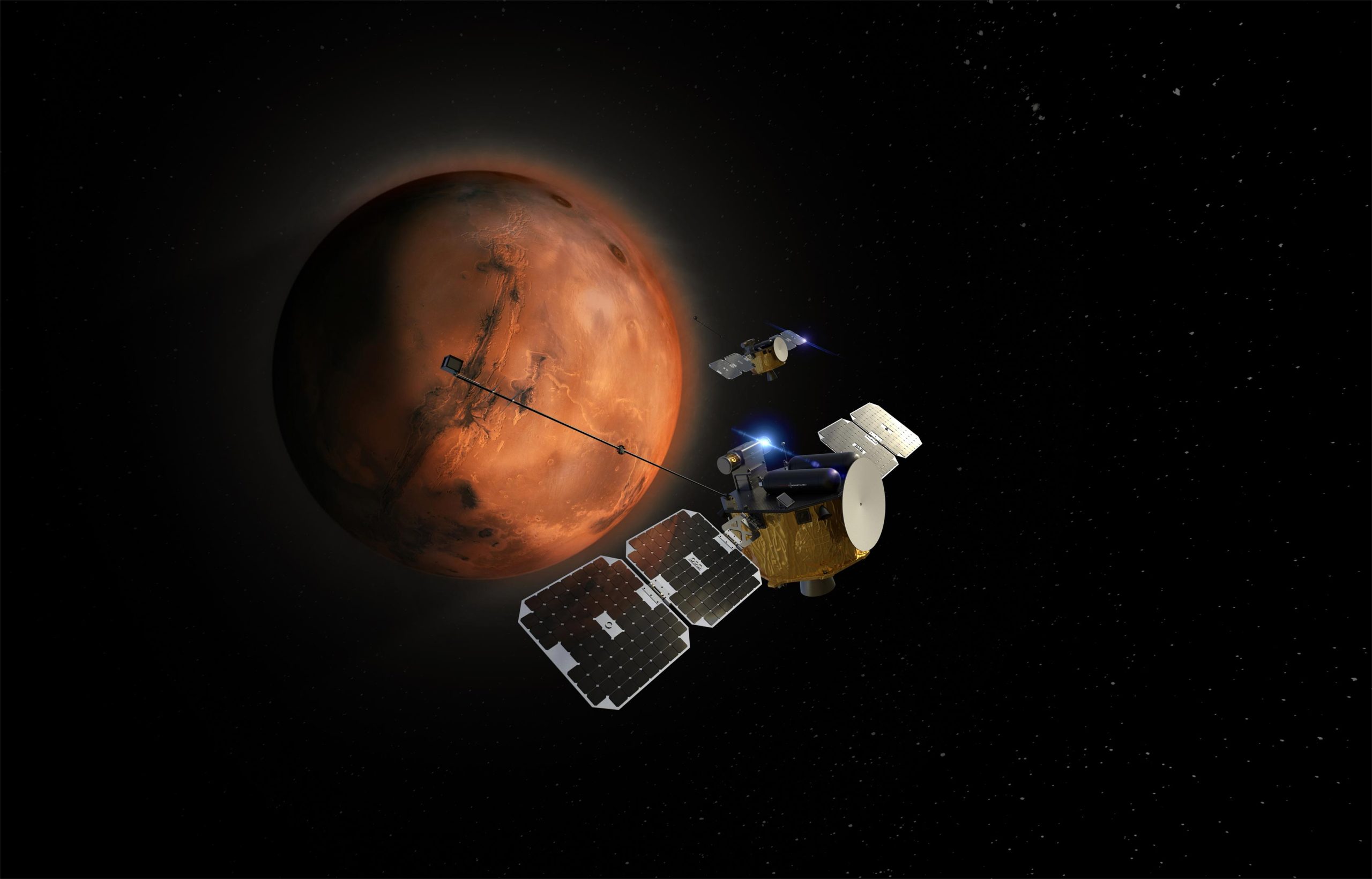
NASA’s twin ESCAPADE spacecraft will uncover how the Sun stripped Mars of its atmosphere.
Mars is a very different world today than it once was. Scientists believe the planet used to have a thicker atmosphere, liquid water on its surface, and a warmer environment. Now it is cold, dry, and surrounded by only a thin layer of gas.
The main force behind this dramatic change is the solar wind, a constant stream of charged particles flowing from the Sun. Over billions of years, this flow has steadily stripped away much of Mars’ atmosphere. As the atmosphere thinned, temperatures dropped and surface water gradually disappeared.
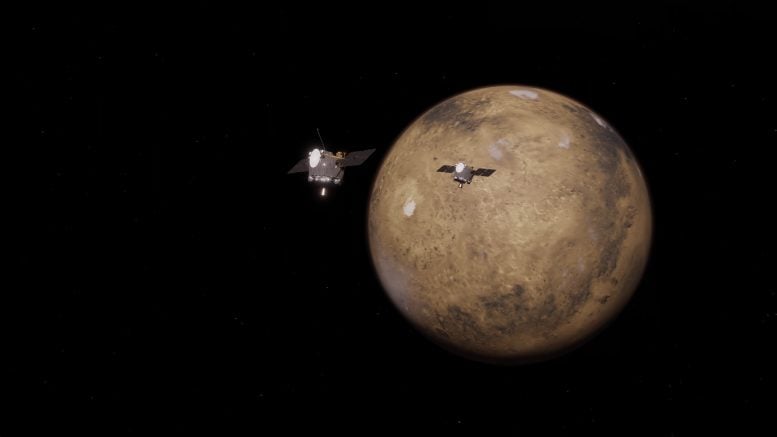
NASA’s ESCAPADE Mission Investigates Mars
To better understand this transformation, NASA launched the ESCAPADE (Escape and Plasma Acceleration and Dynamics Explorers) mission on November 13, 2025. Its scientific instruments were activated and fully operational as of February 25. These tools will study how Mars lost its atmosphere and how solar activity continues to affect the planet today. The mission will also collect new data on space weather near Earth and during the journey to Mars.
Once at Mars, the mission’s results could help NASA prepare for future human exploration by improving understanding of the planet’s harsh environment.
“The pioneering ESCAPADE duo will not only investigate the Sun’s role in transforming Mars into an uninhabitable planet, but also will help inform the development of space weather protocols for solar events directed at Mars during future human missions to the Red Planet,” said Joe Westlake, heliophysics division director at NASA Headquarters in Washington. “By joining the heliophysics fleet of missions across the solar system, ESCAPADE will be another weather station making humans and technology in space safer and more successful.”
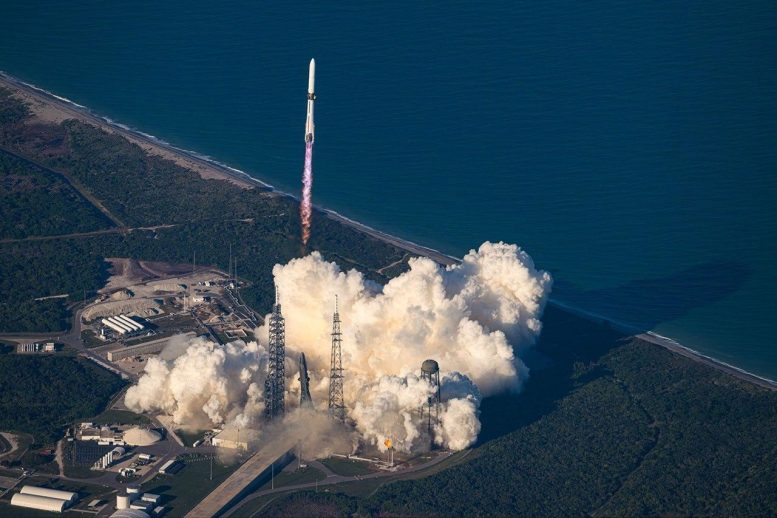
Twin Spacecraft Provide a New View of Mars
ESCAPADE is the first mission designed to operate two spacecraft together in orbit around Mars. This dual setup gives scientists a new way to observe the planet’s magnetosphere, the region influenced by magnetic forces, and track how it changes over short periods of time.
“Having two spacecraft is going to help us understand cause and effect — how the solar wind, when it comes to Mars, interacts with the magnetic field,” said Michele Cash, ESCAPADE program scientist at NASA Headquarters.
Earlier missions have examined Mars’ atmosphere using only one spacecraft. By comparison, ESCAPADE offers a simultaneous view from two positions, allowing scientists to better connect what is happening in different regions.
“The ESCAPADE mission is a game changer,” said Rob Lillis, the mission’s principal investigator at the University of California, Berkeley. “It gives us what you might call a stereo perspective — two different vantage points simultaneously.”
When the spacecraft arrive, they will initially share the same orbit, passing over the same areas at slightly different times. This approach helps pinpoint when and where changes occur.
“When we have two spacecraft crossing those regions in quick succession, we can monitor how those regions vary on timescales as short as two minutes,” Lillis said. “This will allow us to make measurements we could never make before.”
After about six months, the two spacecraft will move into separate orbits. One will stay closer to Mars, while the other travels farther away. This phase, expected to last five months, will allow scientists to observe incoming solar wind and Mars’ response at the same time.
“Prior spacecraft could either be in the upstream solar wind, or they could be close to the planet measuring its magnetosphere,” Lillis said, “but ESCAPADE allows us to be in two places at once and to simultaneously measure the cause and the effect.”
Why Mars Is More Dangerous for Humans
Future astronauts on Mars will face far greater exposure to solar radiation than people on Earth.
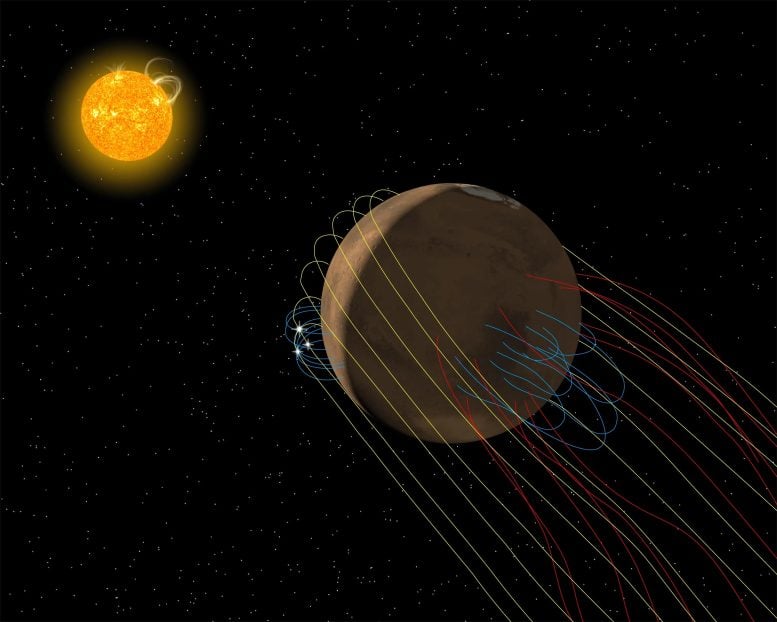
Earth is protected by a strong global magnetic field that shields it from energetic particles coming from the Sun. Mars once had a stronger magnetic field as well, but it weakened long ago. Today, the planet has scattered magnetic regions in its crust along with a constantly shifting magnetic field created by interactions between the solar wind and charged particles in the upper atmosphere.
This combination forms what scientists call a “hybrid” magnetosphere, which offers only limited protection. Along with Mars’ thin atmosphere, this allows solar radiation to reach the surface more easily, posing risks to human explorers.
“Before we send humans to Mars, we need to understand what type of environment these astronauts are going to encounter,” Cash said.
ESCAPADE will also study Mars’ ionosphere, a region of the upper atmosphere that future missions will rely on for communication and navigation signals.
“If we ever want GPS at Mars or long-distance communications, we need to understand the ionosphere,” Lillis said.
A New Path to Mars
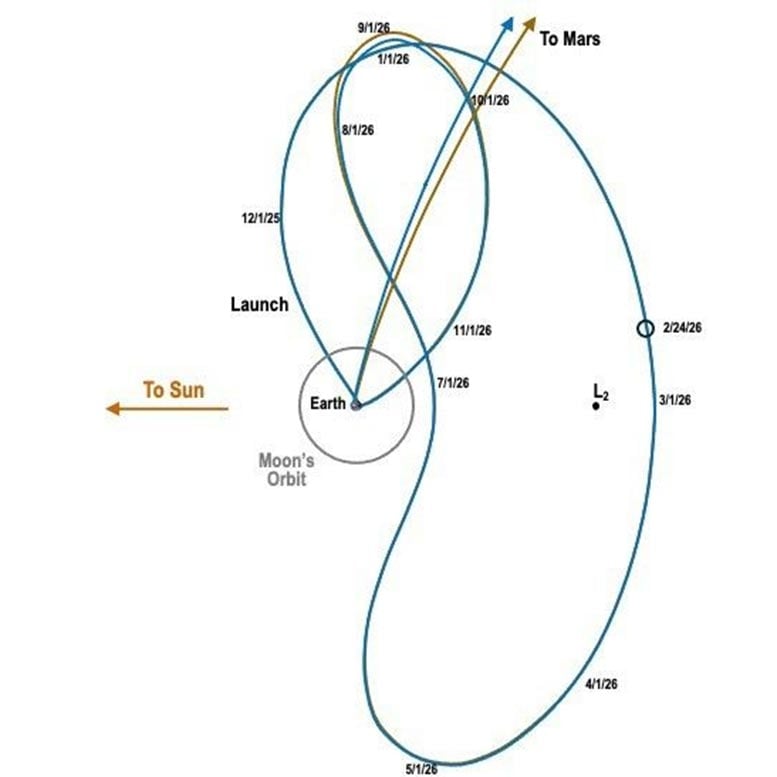
Most Mars missions launch during specific alignment windows that occur about every 26 months. ESCAPADE is testing a different approach that allows greater flexibility in launch timing.
Instead of traveling directly to Mars, the spacecraft are first looping around a point about a million miles from Earth known as Lagrange point 2. When Earth and Mars align again in November 2026, the spacecraft will return toward Earth and use its gravity to accelerate toward Mars, with arrival expected in September 2027.
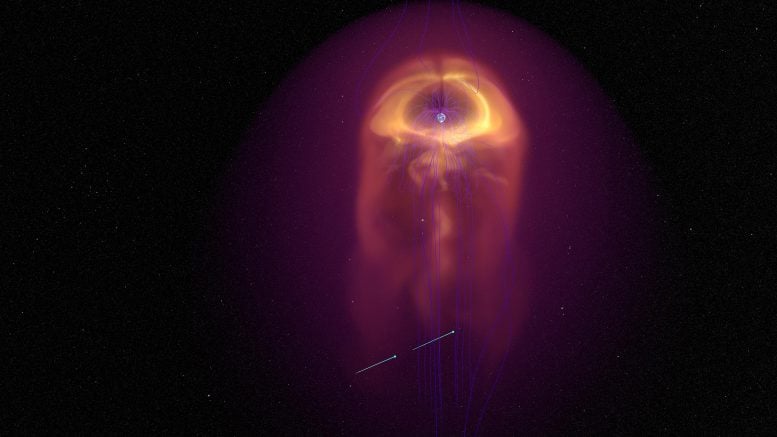
This extended path includes a “loiter” orbit reaching roughly 2 million miles from Earth. During this time, the spacecraft will pass through a previously unexplored region of Earth’s distant magnetotail, the part of Earth’s magnetic environment that stretches away from the Sun.
“We’re going to be doing some discovery science,” Lillis said. “No one has ever measured Earth’s tail this far away.”
During the 10-month journey to Mars, the spacecraft will continue collecting data on the solar wind and the magnetic conditions of interplanetary space, the same environment future astronauts will travel through.
The ESCAPADE mission is funded by NASA’s Heliophysics Division and is part of the NASA Small Innovative Missions for Planetary Exploration program. UC Berkeley’s Space Sciences Laboratory leads the mission with key partners Rocket Lab; NASA’s Goddard Space Flight Center in Greenbelt, Maryland; Embry-Riddle Aeronautical University; Advanced Space; and Blue Origin.
Never miss a breakthrough: Join the SciTechDaily newsletter.
Follow us on Google and Google News.
Source link
