

New Memory Chip Survives 1300°F, Hotter Than Lava
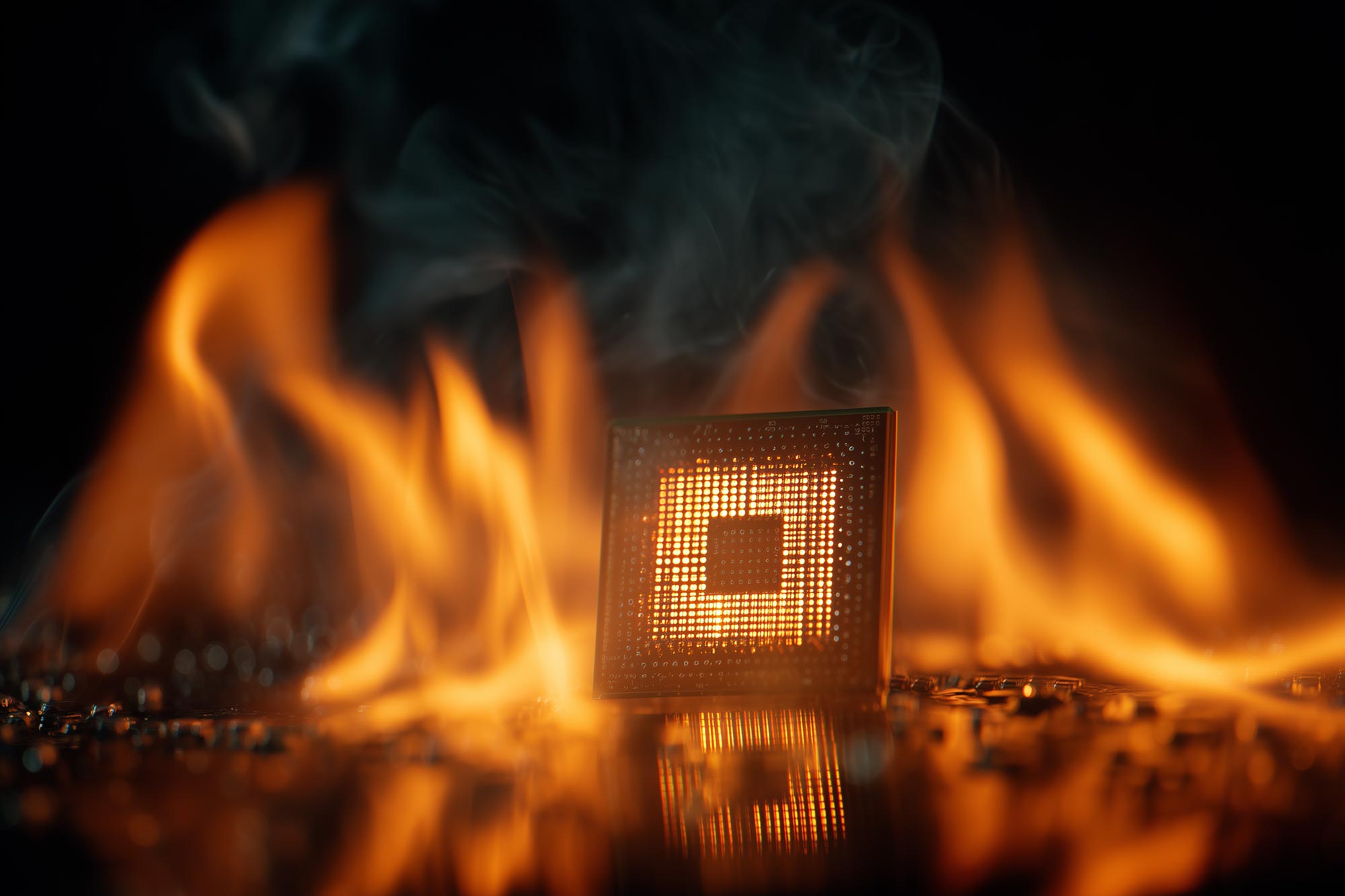
A heat-proof chip that survives 1300°F could revolutionize both extreme-environment tech and AI.
From smartphones to satellites, modern electronics all face the same limitation. Heat. Once temperatures rise above about 200 degrees Celsius, performance begins to degrade, and failure soon follows. Engineers have spent decades trying to push beyond that limit, with little success.
Now, researchers at the University of Southern California believe they have taken a major step forward.
In a study published on March 26, 2026, in Science, a team led by Joshua Yang, Arthur B. Freeman Chair Professor at the Ming Hsieh Department of Electrical and Computer Engineering at the USC Viterbi School of Engineering and the USC School of Advanced Computing, introduced a new memory device that continues to operate at 700 degrees Celsius (around 1300 degrees Fahrenheit. That is hotter than molten lava and far beyond the limits of existing technologies. The device did not show signs of failure during testing. In fact, 700 degrees was simply the highest temperature their equipment could reach.
“You may call it a revolution,” Yang said. “It is the best high-temperature memory ever demonstrated.”
A Heat-Resistant Memristor Design
The new technology is a memristor, a nanoscale component that can both store information and carry out computations. Structurally, it resembles a tiny layered stack, with two electrodes surrounding a thin ceramic layer.
Jian Zhao, the paper’s first author, constructed the device using tungsten as the top electrode, hafnium oxide as the insulating middle layer, and graphene at the bottom. Tungsten is known for having the highest melting point of any metal, while graphene, a one-atom-thick sheet of carbon, is extremely strong and resistant to heat.
This combination produced impressive results. The device retained stored data for more than 50 hours at 700 degrees without needing to be refreshed. It also endured over one billion switching cycles at that temperature and operated at just 1.5 volts with speeds measured in tens of nanoseconds.
A Discovery That Happened by Accident
The breakthrough was not the team’s original goal. They had been working on a different graphene-based design that did not perform as expected. During that process, they came across something unexpected.
“To be honest, it was by accident, as most discoveries are,” Yang said. “If you can predict it, it’s usually not surprising, and probably not significant enough.”
After investigating further, the researchers uncovered the reason for the device’s resilience. In traditional electronics, high temperatures cause metal atoms from the top electrode to slowly drift through the insulating layer. Eventually, they reach the bottom electrode and form a permanent connection, short-circuiting the device and leaving it stuck in the on state.
Graphene prevents this from happening. Its interaction with tungsten is, as Yang described it, similar to oil and water. Tungsten atoms that move toward the graphene surface cannot attach to it. Without a stable point to settle, they move away instead of forming a conductive path. This stops the short circuit from forming and keeps the device functioning even under extreme heat.
Using electron microscopy, spectroscopy, and quantum-level simulations, the team confirmed exactly how this process works at the atomic level. That deeper understanding allows researchers to identify other materials with similar properties, which could make the technology easier to manufacture at scale.
Extreme Environment Applications
Electronics capable of operating above 500 degrees Celsius have long been a goal for space exploration. Venus, for example, has surface temperatures in that range, and previous missions have failed in part because conventional electronics could not survive the heat.
“We are now above 700 degrees, and we suspect it will go higher,” Yang said.
The potential uses extend well beyond space. Geothermal drilling requires electronics that can function deep underground where temperatures are extremely high. Nuclear and fusion systems also expose equipment to intense heat. Even in everyday applications, durability would improve significantly. A chip designed to withstand 700 degrees would be extremely reliable at the roughly 125-degree temperatures often reached inside car electronics.
A New Approach for AI Computing
In addition to storing memory, the device could play an important role in artificial intelligence. Many AI systems rely heavily on matrix multiplication, a core mathematical operation used in tasks such as image recognition and language processing. Conventional computers perform these calculations step by step, consuming large amounts of energy.
Memristors take a different approach. By using Ohm’s Law, where voltage times conductance equals current, the device performs calculations directly as electricity flows through it. The result is obtained instantly by measuring the current.
“Over 92 percent of the computing in AI systems like ChatGPT is nothing but matrix multiplication,” Yang said. “This type of device can perform that in the most efficient way, orders of magnitude faster and at lower energy.”
Yang and three co-authors of the study (Qiangfei Xia, Miao Hu, and Ning Ge) have already co-founded a company called TetraMem, which is working to commercialize memristor-based chips for AI. Their lab is already using functional chips from the company for machine learning tasks. The high-temperature version described in this study could extend those capabilities to environments where traditional electronics cannot operate, allowing devices such as spacecraft or industrial sensors to process data directly where they are deployed.
Challenges Before Real-World Use
Despite the promising results, the technology is still in its early stages. Yang emphasizes that memory alone is not enough to build a complete computing system. High-temperature logic circuits will also need to be developed and integrated. In addition, the current devices were created manually at very small scales in a laboratory, so scaling up production will take time.
“This is the first step,” Yang said. “It’s still a long way to go. But logically, you can see: now it makes it possible. The missing component has been made.”
From a manufacturing standpoint, two of the materials used in the device, tungsten and hafnium oxide, are already widely used in semiconductor production. Graphene is newer, but major companies such as TSMC and Samsung are actively developing it, and it has already been produced at wafer scale in research settings.
A Step Toward Future Exploration
The research was conducted through the CONCRETE Center, short for Center of Neuromorphic Computing under Extreme Environments, a multi-university Center of Excellence led by USC and supported by the Air Force Office of Scientific Research and the Air Force Research Laboratory. Key experimental work was carried out in collaboration with Dr. Sabyasachi Ganguli’s team at the AFRL Materials Lab in Dayton, Ohio. Theoretical analysis involved USC researchers and collaborators at Kumamoto University in Japan.
For Yang, the significance of the work goes beyond a single device.
“Space exploration has never been so real, so close, and at such a large scale,” he said. “This paper represents a critical leap into a much larger, more exciting frontier.”
Reference: “High-temperature memristors enabled by interfacial engineering” by Jian Zhao, Cameron S. Jorgensen, Krishnamurthy Mahalingam, Cynthia Bowers, Wataru Sugimoto, Kai Ito, Seung Ju Kim, Ruoyu Zhao, Yichun Xu, Han-Ting Liao, Rajiv K. Kalia, Aiichiro Nakano, Kohei Shimamura, Fuyuki Shimojo, Priya Vashishta, Ajit K. Roy, Ning Ge, Miao Hu, R. Stanley Williams, Qiangfei Xia, Sabyasachi Ganguli and J. Joshua Yang, 26 March 2026, Science.
DOI: 10.1126/science.aeb9934
Never miss a breakthrough: Join the SciTechDaily newsletter.
Follow us on Google and Google News.
Source link
