

Orbán Will Lose Hungary’s Election in Two Weeks—If It’s Clean
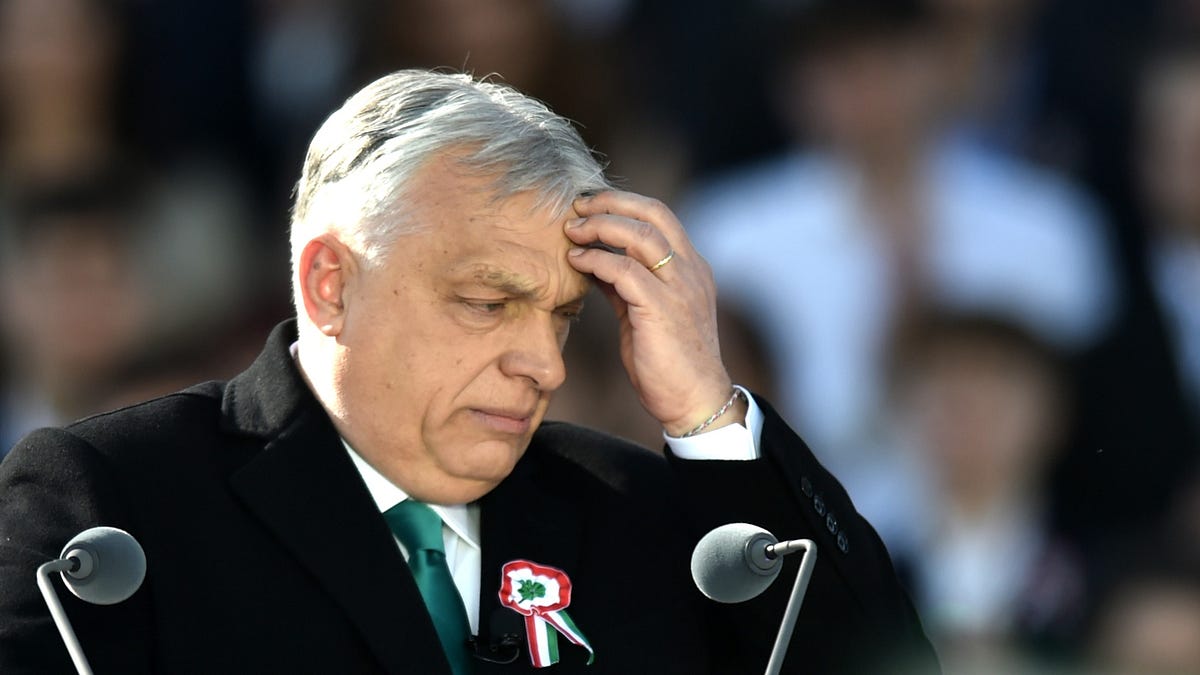
THE NEARLY FOUR-DECADE-LONG political career of Viktor Orbán, culminating in a fifteen-year premiership, may come to a sudden end in two weeks—assuming that Hungary holds clean elections on April 12. All independent polls show Péter Magyar’s Tisza party with a commanding and expanding lead over Orbán’s Fidesz. Although Orbán has retained much of his base, the tide in the country is turning against him, a fact visible in the campaigns. Magyar, amassing enthusiastic crowds everywhere, looks relaxed and confident, and is clearly enjoying himself. Orbán, on the other hand, looks stiff and stern, appearing only before pre-selected crowds, and even then he has to battle hecklers in the back. Were Hungary a functioning democracy, the handwriting foretelling Orbán’s demise would have been on the wall months ago.
But Hungary is hardly a democracy at all. It’s an autocratic, kleptocratic mafia state, where all the levers of power are controlled behind the scenes by a single man. Since returning to power in 2010, Orbán has rewritten the constitution and amended it fifteen times, changed the electoral laws to give his party structural advantages, captured the top layer of the judiciary, occupied the chief prosecutor’s office to protect his cronies and prosecute his enemies, weaponized the tax authority, commandeered the media, installed spy software on the phones of journalists and opposition figures, harassed and restricted the rights of NGOs, revoked the rights of religious communities unwilling to collaborate with his regime, forced the country’s most prestigious university to move to Austria, harassed opposition political parties, denied them resources and spied on them illegally, nationalized and reprivatized banks and businesses to reshape and dominate the economy, steered his country into an alliance with Russia, Hungary’s historic enemy, and enriched his family and friends beyond their wildest dreams.
Given these overwhelming structural advantages, many observers of Hungary—myself included—had concluded that Orbán could never be removed from office through democratic means; that the end of his regime would come through crisis and collapse. The fact that Orbán is not only likely to lose a national election but could easily get creamed is nothing short of utterly amazing.
His kryptonite has proven to be Péter Magyar. A former Fidesz insider, Magyar understands the regime he is fighting against and has proven remarkably adept at anticipating and countering its tactics. Bestowed with seemingly superhuman levels of energy, he has barnstormed the country since he burst on the scene suddenly two years ago, demonstrating that with enough conviction, determination, and will, persuasion is possible even in a soft autocratic regime. And unlike the liberal opposition he replaced, Magyar understands the importance of national symbols and patriotism. This has allowed him to steal Fidesz’s nationalist brand and highlight the regime’s enormous hypocrisy and betrayal of the country.
The contrast between Orbán and Magyar was displayed dramatically this past March 15, a national holiday commemorating Hungary’s failed democratic revolution of 1848. Both politicians delivered major speeches, yet they were so different it seemed as if they were speaking to two different countries.
Orbán’s speech centered on fear. He used it to ramp up wild claims that Ukraine is planning an attack on Hungary; “Do you see Ukrainians? Do you see Zelensky? The Hungarian state has been here for a thousand years. And you think you can scare us with oil blockades, blackmail, and threats against our leaders. . . . You’ve got enough problems on the eastern front, why are you attacking us?” According to Orbán, the European Union is planning to enter the war: “We know not the day nor the hour when Brussels’s first soldier will step on Ukrainian soil. But there’s one thing we know for certain—it will happen. . . . We don’t want this fate for the mothers of our children. . . . Kiev and Brussels need to understand: Our boys will not die for Ukraine.”

Conspicuously absent from the speech was any concrete reference to the events of 1848, much less to the liberal ideals that inspired the revolution for which so many Hungarians gave their lives. Orbán’s words were as detached from Hungarian history as they were from the state of Hungarian society and the contemporary realities in Europe.
Péter Magyar’s speech, by contrast, overflowed with the spirit of 1848 and was brimming with optimistic confidence. The lesson of 1848, Magyar said, is that, “we need to fight for freedom and for national independence again and again. . . . Our ancestors gave their lives and their blood; they fought and died for a free European Hungary. . . . Our nation belongs to the West, our nation belongs to the European community, our nation belongs to NATO.” The question in 1848 was “whether we would be slave or free. . . . whether the government would rule over us or we ourselves would be the government. Whether we would be subjects or citizens. . . . A citizen is one who is respected by his elected leaders, who is not lorded over by them, and whose money is not stolen by them.”
Magyar even took on Russia, a country which has been actively interfering in Hungary’s election at Orbán’s behest. “In 1848–49, in 1956,” Magyar said, “our revolutions were put down [by the Russians]. . . . They suppressed the revolution, but they could never break us . . . and neither will the Orbán government. Even if, like his predecessors, the wannabe emperor, in an act of final desperation, dispatches the tsar’s KGB officers against freedom-loving Hungarian citizens exactly like in 1849 and 1956. . . . But I have some bad news for them. . . . The Hungarian people have never allowed others to take away their freedom. And that’s why on April 12 we will deliver a victory so impressive it will be visible not just from the moon, but from the Kremlin.”
Interlaced through Magyar’s speech were verses by the poet Sándor Petőfi, which the crowd of over 100,000 would recite in unison. At other times the crowd broke out into chants of “The Tisza is flooding,” a line from one of Petőfi’s poems about the river from which Magyar’s party takes its name. One wonders if any political campaign anywhere has ever been as stamped by poetry as Péter Magyar’s. The effect is uplifting. It imparts the sense that one is part of something bigger, an actor in Hungarian history, writing the next chapter in the national story. No wonder, then, that Magyar’s crowd was nearly three times the size of Orbán’s.
DESPITE MAGYAR’S IMPRESSIVE ACHIEVEMENTS, Orbán could still manage to cling to power, depending on what unfolds over the next two weeks.
One cannot rule out the possibility that Orbán will attempt something drastic. The Washington Post recently reported that the Russians had proposed to the Hungarians staging an assassination attempt against Orbán to alter the dynamic of his losing campaign. The Hungarian government denies this, but the course of the campaign over the last month lends credibility to the report. Orbán has been working hard to escalate tensions with Ukraine. As part of that effort he posted a video on Facebook where he is talking with his daughter on the phone about an alleged Ukrainian threat against her safety. Ostensibly the call is in response to threats issued against Orbán and his family by a marginal Ukrainian political figure, in a video circulated by Russian and pro-Orbán media outlets. Analysis of the video suggests, however, that it was edited and altered by AI. And, of course, the fact that Orbán would just so happen to discuss this dubious video with his daughter in front of a camera to share on Facebook is both laughable and suspicious. In light of the Washington Post article, one easily imagines the entire maneuver was preparation for a staged assassination attempt.
That, of course, is speculation, and the very fact that the possibility of a false-flag operation is being discussed extensively in Hungary makes the event less likely. Nevertheless, indications that Orbán has considered taking such a step might be seen as a sign that he’s grown desperate.
If Orbán can’t avoid the election, then it’s all but certain that he plans to cheat. At a conference of mayors and other representatives of local government held earlier this year, Orbán told the assembled, “You need to win this election. . . . We have the votes, we have the majority, but you need to mobilize them on election day.” The implicit message, according to critics, was that mayors of small villages should bribe and threaten economically vulnerable inhabitants to vote for Fidesz. This kind of “mobilization” has happened before, although on what scale is unclear. According to an investigation released as a documentary film a few days ago, the government has been ramping up its voter-intimidation scheme. Here is how it would work: People dependent on state social services are told to take a photo of their marked ballots, which they need to show late to a local official. If the photo shows they voted for the wrong candidate, they might be punished in some way—denied work or social benefits, or even have their children taken away as wards of the state. The filmmakers suggest that the government hopes to secure as many as 500,000 votes this way.
Yet, the success of this strategy depends in part on the perception that a Fidesz victory is inevitable. If Fidesz doesn’t win, local officials can’t follow through on their threats. Uncertainty about the electoral outcome may work to undermine voter intimidation tactics. Here Magyar’s barnstorming could make a difference. He has visited virtually every town and hamlet in the country. They know about Tisza in the villages and rural districts. They’ve heard Magyar speak, assuring them that they need not be afraid. They’ve sized up Magyar and judged he’s got a good chance of winning. That means the local officials threatening them may soon have a new boss. Indeed, any official who contemplates intimidating voters needs to consider the possibility that if Fidesz loses, he or she could face legal prosecution.
Even an elaborate cheating scheme won’t be enough to deliver Orbán victory if the polls are correct. But it might be enough to keep things close. The closer the race between Tisza and Fidesz, the greater the chance that a third party, Mi Hazánk—Our Homeland Movement—makes it into Parliament. One might say that Our Homeland is a far-right party, except that it’s no further right than Fidesz. It’s more like a protest party, drawing a segment of support from disaffected Fidesz voters. If Tisza wins narrowly, it might lack the seats necessary to form a government. In that scenario, Fidesz could form a coalition with Our Homeland to stay in power.
If Tisza wins narrowly, with enough seats to form a government, Magyar will confront an extraordinarily difficult set of circumstances. His party and ministers, lacking any experience in government, will need to address economic challenges, compounded by impacts from the war in Iran, almost immediately. Meanwhile, the constitutional system Orbán has constructed would allow the defeated prime minister to retain influence over most public institutions, sabotaging the new government’s efforts at crisis management. Protracted instability would then afford Orbán an opportunity to mount a comeback.
This may be the most likely scenario for Hungary after April 12—assuming the election happens cleanly—but it’s not the only one. There is also a real chance Magyar wins in a landslide and secures the constitutional supermajority he needs to dismantle the entire Orbán regime.
Despite most polls showing Tisza with a 10-point lead, one of Hungary’s most respected research firms, Medián, has now released two polls showing Tisza up by more than 20 points. Its most recent poll projects Tisza winning two-thirds of the seats in parliament. Although the poll is an outlier, the prestige Medián enjoys recommends against dismissing it summarily. One might dare to say that the latest Medián polls sit well the “mood” in the country and the “vibe” of the campaign. Admittedly, this is a subjective evaluation. But if animals can sense an impending storm through a drop in barometric pressure and other changes to the air, perhaps in politics people can feel a tidal wave when it is approaching.
Hungary is a small country of 9.5 million, a place where—Hungarians sometimes say—everybody knows everybody. This isn’t literally true, of course, but Hungarians do tend to have extended networks of friends and family that can exert influence on each other. As people within those networks begin to speak out more openly in favor of Tisza, this might work to create a late wave toward Tisza. According to Medián, more Hungarians now believe that it is Tisza, not Fidesz, that will win the election. This is the first poll since Orbán came to power in 2010 that has shown people expecting Fidesz to lose a national election. The battle for perception matters. If people start really believing that Orbán is going to lose, they will look more frankly at his government and acknowledge what they already know: that his whole illiberal, Christian nationalist regime is built on cronyism, corruption, and control. And, turning their backs on it, they may bring it down.
Source link
