

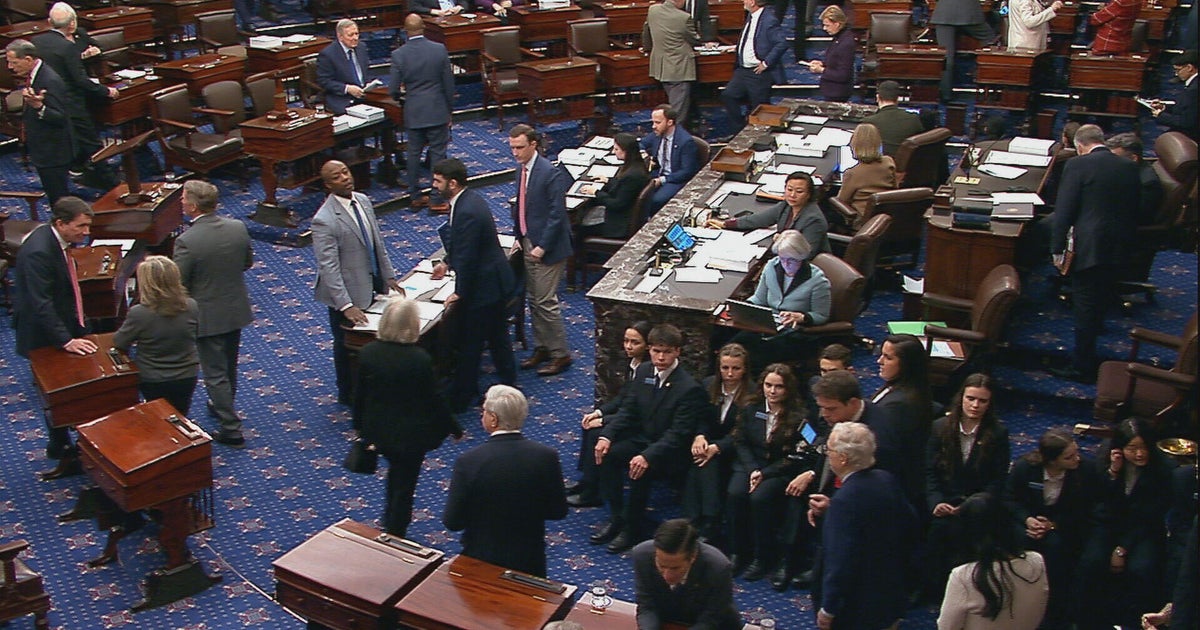
Partial government shutdown begins
Funding for the Pentagon, the State Department, the Treasury and many other agencies has officially lapsed, triggering a partial government shutdown.
The shutdown could be short-lived and have few tangible effects if the House swiftly approves a funding deal that was passed by the Senate on Friday. The lower chamber returns to Washington on Monday.
Some other agencies will be unaffected by the shutdown because Congress has already approved funding for them, including the Justice Department, the Department of Veterans’ Affairs, the Food and Drug Administration and the Environmental Protection Agency.
Read more here.
Jeffries won’t say whether House Democrats will support the Senate-passed funding package
House Minority Leader Hakeem Jeffries won’t say whether Democrats in the lower chamber will back the Senate-passed funding legislation.
In a statement, Jeffries said House Democrats “will evaluate the spending legislation passed by the Senate on its merits and then decide how to proceed legislatively.”
“The Trump administration must set forth an ironclad path that dramatically reforms ICE and other DHS agencies that the American people know have become lawless and heavy-handed. It is in the best interest of the country that this is done before the Congress reconvenes on Monday evening and legislation is brought to the House floor,” he said.
OMB tells affected agencies to begin executing plans for shutdown
In a memo to department heads on Friday, the director of the Office of Management and Budget directed affected agencies whose funding will lapse at midnight to begin preparing for a shutdown.
Those include the departments of Defense, Homeland Security, State, Treasury, Labor, Health and Human Services, Education, Transportation and Housing and Urban Development, among others.
“As it is now clear that Congress will not complete its work before the expiration of appropriations, affected agencies should now execute plans for an orderly shutdown. Employees should report to work for their next regularly scheduled tour of duty to undertake orderly shutdown activities,” the letter from Russ Vought said.
“The Administration will continue working with the Congress to address recently raised concerns to complete appropriations for Fiscal Year 2026. It is our hope that this lapse will be short,” Vought said.
Thune on DHS negotiations: “It’s going to be really, really hard to get anything done”
Senate Majority Leader John Thune expects it will be a heavy lift to reach a bipartisan agreement on DHS funding in the next two weeks.
“I wish they’d given us more time,” the South Dakota Republican told reporters. “I just think it’s going to be really, really hard to get anything done and then actually execute on the procedures and process we have in the Senate, even if there’s an agreement.”
“There are some pretty significant differences of opinion,” Thune added.
Schumer vows Democrats will stand united against long-term DHS funding without ICE reforms
Senate Majority Leader Chuck Schumer said there will have to be “strong, common-sense legislation that reins in ICE” in order for Democrats to support long-term funding for DHS.
“If our colleagues are not willing to enact real change, they should not expect Democratic votes,” the New York Democrat told reporters at a news conference after passage of the funding deal.
The reforms sought by Democrats include requiring federal officers to wear body cameras, banning officers from wearing masks and mandating judicial warrants for arrests, as well as ending roving patrols.
Schumer said Democrats intend to negotiate with Senate Majority Leader John Thune, not President Trump, to find a path to 60 votes — the threshold needed for passage in the upper chamber. He also said public opinion is in Democrats’ favor on the issue given recent events in Minnesota.
“I’m going to talk to Thune. Whatever he wants to say to Trump … if Trump can be constructive, great. But right now Trump is being destructive,” Schumer said. “Thune and I are the two leads on the negotiation.”
Sen. Patty Murray of Washington, the top Democrat on the Senate Appropriations Committee, said over the next few days Senate Democrats “will be focused on negotiating real restraints to put an end to the chaos we’re seeing on our streets.”
Senate approves funding package in 71 to 29 vote, sending it to the House
The Senate approved the funding package in a 71 to 29 bipartisan vote hours ahead of the deadline to fund the government.
Funding is still set to lapse at midnight, since the House must approve the legislation. The lower chamber is set to return to Washington on Monday. The impact of the funding lapse could be minimal if the House is able to quickly approve the legislation and get it to the president for his signature.
Senate now voting on final passage
The Senate is now voting on final passage of the funding package.
As part of the funding deal, senators agreed to substitute the DHS funding bill in the package for a two-week extension of funding for the department at current levels. The move comes as part of the agreement sought by Democrats to negotiate immigration enforcement reforms within the funding measure for DHS, which oversees Immigration and Customs Enforcement and Customs and Border Patrol.
Senate rejects Merkley amendment
In a 52 to 47 vote, the Senate rejected Democratic Sen. Jeff Merkley of Oregon’s amendment.
Senate rejects Sanders amendment, now voting on Merkley’s proposal to bar rescissions
The Senate rejected independent Sen. Bernie Sanders’ amendment on ICE funding in a 49 to 51 vote.
His amendment would have repealed the $75 billion funding increase that ICE received as part of the One Big Beautiful Bill Act and redirect those funds to Medicaid.
Two Republicans, Sen. Susan Collins of Maine and Sen. Lisa Murkowski of Alaska, voted with Democrats in favor of the amendment.
Merkley also introduced an amendment that would bar the clawback of funds already approved by Congress within 90 days of their expiration, which the Senate is now voting on.
Last year, Congress passed legislation at the request of the president to rescind $9 billion in foreign aid and public broadcasting funding, angering Democrats and some Republicans. In August, Mr. Trump moved to rescind almost $5 billion in foreign aid funds through a rarely used maneuver known as a pocket rescission, aiming to withhold funds unilaterally.
Senate tables Lee’s third amendment, moves to Sanders amendment on ICE funds
The Senate tabled Republican Sen. Mike Lee’s third amendment in a 58 to 42 vote. The amendment aimed to defund the United States African Development Foundation, citing allegations of corruption against one of its leaders.
Senators are now voting on an amendment from Sanders on ICE funding.
“When you give ICE that huge amount of money, you are not talking about an agency for immigration and customs enforcement, you are talking about a domestic army,” Sanders said. “We don’t need a domestic army in America to terrorize people, we need to guarantee healthcare to all Americans.”
Unlike the other amendments in this vote series, 60 votes are needed for adoption.
Senate blocks another Lee amendment, takes up third proposal
In a 58 to 42 vote, the Senate blocked a second amendment from Lee that would strike an earmark for a community and training center for a New York nonprofit that serves immigrants.
Senate blocks Lee amendment, takes up proposal to end earmark on immigration training
Senators blocked an amendment from Lee to remove earmarks from the funding package, in a 67 to 33 vote.
The upper chamber is moving on to a second amendment from Lee.
Schmitt amendment falls short, Senate takes up Lee earmarks proposal
The Senate rejected an amendment from GOP Sen. Eric Schmitt of Missouri by voice vote. The amendment was related to the National Endowment for Democracy, which Schmitt said had drifted from its intended purpose to support democratic institutions around the world.
The chamber is now considering an amendment from Lee to remove earmarks from the funding package. Sen. Susan Collins, the top GOP appropriator who negotiated the funding package, spoke in opposition to the amendment, stressing that “members of Congress understand the needs of our constituents far better than any well-intentioned federal employee located here in Washington.”
Senate voting on Rand Paul amendment on Minnesota fraud
The Senate is voting on the first amendment in the series of seven.
Sen. Rand Paul, a Kentucky Republican, advocated for his amendment concerning fraud in Minnesota welfare programs on the Senate floor ahead of vote.
Paul said his amendment would dictate “no more welfare for refugees until a nationwide investigation of the level of this fraud,” and until “Congress balances the budget.”
“America can’t be the world’s sugar daddy when we can’t even afford the welfare for our own citizens,” Paul said.
Sen. Tammy Baldwin, a Wisconsin Democrat, spoke in opposition to the amendment, calling it “ill-advised” and urging senators to oppose it.
Graham says he will lift his hold and vote for funding package
After stalling votes earlier, Graham said he secured an agreement from Thune to vote on legislation to crackdown on sanctuary cities and to allow broader lawsuits stemming from special counsel Jack Smith’s investigation into the 2020 election.
“He just informed me that he is supportive of my efforts to have a vote on my bill to end sanctuary city policies once and for all, by making it a federal crime for state and local officials to willfully violate federal immigration laws,” Graham said in a statement. “Leader Thune also supports, at a time to be determined, a vote on creating the ability for groups and private citizens, not members of Congress, that may have been harmed by Jack Smith and the Biden DOJ to have their day in court.”
“I will lift my hold and vote for the package,” he said.
The votes on Graham’s proposals are expected at a later date.
Thune locks in time agreement, allowing votes on funding deal to move forward
Thune locked in a time agreement for votes on the funding package, with votes on seven amendments.
The majority leader told reporters heading into the Senate chamber that votes would begin “soon.”
Thune: “We’re getting closer”
Senate Majority Leader John Thune told reporters at the Capitol that leaders are “still working on a couple things” as they look to address member opposition and set up the votes on the funding plan.
“We’re getting closer,” Thune added
GOP Sen. Thom Tillis: “If we have a shutdown, we own it”
Sen. Thom Tillis, a North Carolina Republican, took to the Senate floor to criticize GOP holdups, encouraging his colleagues to move ahead with the plan to fund the government.
“We’re going to shut down the government because some Republicans refuse to take a win,” Tillis said.
Tillis said Mr. Trump “agrees with what we can do to avoid a shutdown,” citing his endorsement of the deal with Senate Democrats on Thursday night.
“If we have a shutdown, we own it,” Tillis added.
The North Carolina Republican argued it’s “wrong for us to shut down the government to make a point.” And he said the vast majority of Republicans are “ready to go.”
“If we shut the government down today, we created the problem — and we need to fix it,” he said.
House GOP conference call pushed back
A House GOP conference call has been pushed back a few hours, according to a source familiar with the plans, as the lower chamber waits for the Senate to pass a funding package. The call was originally planned for 11 a.m., but is now scheduled for 4:30 p.m.
Graham on House repealing lawsuit provision: “You jammed me”
Graham addressed a move by the House to repeal a law that allows senators whose phone records were seized by the Justice Department during the Biden administration to sue for $500,000. The provision was heavily criticized by House lawmakers, who voted unanimously to repeal it when they passed the funding package last week.
Graham was one of the senators whose phone records were searched, and previously said he intended to sue under the new law. He criticized the House for repealing the law in full, including a portion that requires senators to be notified if their records are seized and they are not the target of an investigation.
“You could have called me about the 500,000 — I’d be glad to work with you. You jammed me,” Graham said. “Speaker Johnson, I won’t forget this. I got a lot of good friends in the House. If you think I’m going to give up on this, you really don’t know me.”
Graham said he would demand a vote on an amendment to extend the ability to sue to Republican groups who may have been improperly targeted by federal investigators, and restore the provision about notifying lawmakers’ offices.
“Everybody says, ‘Well, it passed unanimously in the House.’ I could care less. What you did, I think, is wrong. You overreacted,” he said. “We’ll fix the 500,000, but you took the notification out. I’m not going to give up on that.”
Graham lays out demands to lift hold on funding deal
In a floor speech, Graham said he would not allow the funding deal to move forward unless he gets votes on legislation to crackdown on sanctuary cities and another on giving more people the ability to sue over special counsel Jack Smith’s investigation.
“I will not lift my hold on this bill until I get guaranteed a vote on my legislation that would criminalize the conduct going forward,” the South Carolina Republican said. “What conduct am I talking about? State and local officials openly defying federal law that’s been on the books for decades, incentivizing more illegal immigration, massive taxpayer ripoff and a breakdown of law and order. To these 12 states: you’re screwing it up for the rest of us. You need to change your policies and comply with the law that’s been on the books for decades, and this should be a punishment. To me, what you’re doing is you’re inciting chaos.”
Graham said he could not remember ever putting a hold on an appropriations bill, but said it was necessary because “what happened in Minnesota has to be addressed.”
“There are things being done on the ICE side that a lot of Americans are uncomfortable with. I get that,” Graham said. “If you want to have more accountability, count me in. But your rhetoric, count me out.”
Graham said lawmakers can be “unnerved” by the actions of immigration enforcement in Minnesota, but argued the solutions being offered are insufficient.
“The problem is, you want Band-Aid solutions,” Graham said.
Schumer says members “working on moving forward” to fund government
Senate Minority Leader Chuck Schumer said he hopes the upper chamber “can get voting quickly” on a funding package after movement stalled last night.
“Members are working on moving forward on a deal to fund the government and working on legislation desperately needed to rein in ICE’s abuses,” Schumer said on the Senate floor.
Jeffries says 2-week funding extension for DHS emphasizes “urgency” in addressing issue
House Minority Leader Hakeem Jeffries said the proposed two-week extension on DHS funding underscores the “urgency” in addressing concerns about immigration enforcement officials’ conduct.
“We have to deal with the issue of reining ICE and the Department of Homeland Security in with the fierce urgency of now,” Jeffries told reporters. “A two-week window will evaluate whether that’s sufficient time, but there’s urgency to dealing with this issue, because ICE, as we’ve seen, is out of control.”
Jeffries reiterated the demands of Democrats to reform ICE — including requiring officers to wear body cameras, judicial warrants for arrests, banning officers from wearing masks and others.
Still, Jeffries would not explicitly say whether he supports the deal reached between Senate Democrats and the White House.
“[The] Senate has to do its thing before we have anything to evaluate, but I’m going to remain in close contact with Leader Schumer, and hopefully they’ll get something done today,” he said.
Senate to return at 11 a.m., with no votes currently scheduled
The Senate will reconvene at 11 a.m., according to a notice from Majority Whip John Barrasso’s office, and will resume consideration of the motion to proceed to the six-bill funding package.
No votes are currently scheduled, but the next step in finalizing the plan will likely be a vote on cloture on the motion to proceed. That would require 60 votes to succeed. Doing so would allow the chamber to amend the current version of the funding package to strip out DHS funding, with the goal of extending DHS funding at current levels for two weeks instead.
Senators could bypass formal votes with unanimous consent at any step of the process, if all 100 members agree to fast-track passage.
Graham on funding agreement: “This is a bad deal”
Late Thursday, Graham told reporters he was opposed to the agreement. After leaving a meeting in Senate Majority Leader John Thune’s office, Graham pointed to heated criticism of federal immigration agents as Democrats push for changes to enforcement practices, saying: “I’ve never been more offended than I am right now of what’s being said about these folks.”
Graham’s opposition could prevent Senate leadership from quickly moving forward through unanimous consent.
“This is a bad deal,” Graham said.
Lawmakers left the Capitol without voting Thursday. Senate Minority Leader Chuck Schumer told reporters the bill was held up by Graham, saying Senate Republicans “need to get their act together.”
Asked about Graham’s concerns, Thune said: “I hope we can get these issues resolved. Right now, we’ve got snags on both sides, but tomorrow’s another day.”
Why a funding lapse likely won’t lead to a prolonged shutdown
While funding will almost certainly lapse at midnight, the actual work of shutting down the government is a process that each relevant agency undertakes to determine what activities are essential, which workers will be furloughed and which will continue to work. The White House Office of Management and Budget coordinates each agency’s procedures and tells them when they should begin implementing them.
That process typically wouldn’t begin until Monday, and might not happen at all if the White House determines that funding is close to being approved. Lawmakers often intentionally craft funding bills to expire on Fridays to give themselves some breathing space to finalize a deal before the start of the work week.
If the Senate successfully passes its spending plan on Friday, the focus would then turn to the House. Speaker Mike Johnson has said that the chamber would approve it on Monday, and the president would sign it soon after, ending the funding lapse.
Trump backs spending deal, urges bipartisan support
President Trump threw his support behind the deal with Democrats in a post on Truth Social on Thursday evening, urging members of both parties to support the agreement.
“The only thing that can slow our Country down is another long and damaging Government Shutdown,” he wrote.
The president said: “Hopefully, both Republicans and Democrats will give a very much needed Bipartisan ‘YES’ Vote.”
Source link
