

Physicists Reveal the Big Bang’s “Primordial Soup” Really Flowed Like a Liquid
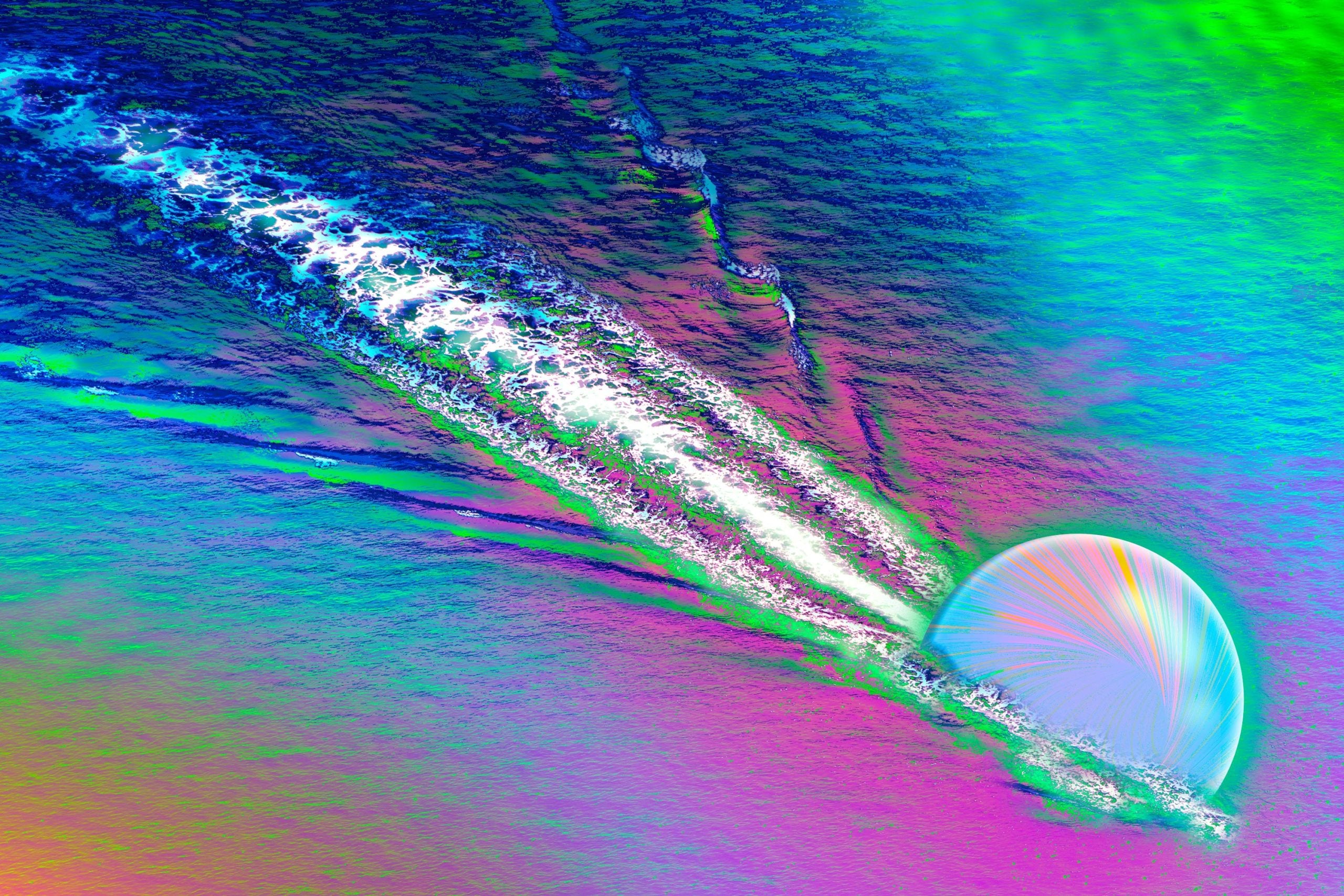
Scientists studying particle collisions at CERN have captured new evidence of how quarks move through the early universe’s primordial plasma.
In the first instants after the Big Bang, the universe was not filled with atoms, stars, or even protons. It was a searing, trillion-degree mix of quarks and gluons moving at nearly the speed of light. Together, they formed a state known as quark-gluon plasma, a short-lived phase that lasted only a few millionths of a second before cooling enough for quarks and gluons to lock together into protons, neutrons, and the other particles that still shape the cosmos today.
Scientists at CERN’s Large Hadron Collider in Switzerland are recreating quark-gluon plasma (QGP) to study that vanished early state of matter in the lab. When heavy ions are smashed together at speeds close to that of light, they can briefly free quarks and gluons from ordinary matter and produce tiny droplets of the same substance that filled the universe during its first microseconds.
A team at CERN led by MIT physicists has now found the clearest evidence yet that a quark moving through this plasma leaves a wake behind it, much like an object cutting through water. The results are the first direct evidence that the plasma is not behaving like a loose cloud of particles. Instead, it responds as a dense, collective fluid, with motion that can ripple outward from a single fast-moving quark.
“It has been a long debate in our field, on whether the plasma should respond to a quark,” says Yen-Jie Lee, professor of physics at MIT. “Now we see the plasma is incredibly dense, such that it is able to slow down a quark, and produces splashes and swirls like a liquid. So quark-gluon plasma really is a primordial soup.”
To see a quark’s wake effects, Lee and his colleagues developed a new technique that they report in the study. They plan to apply the approach to more particle-collision data to zero in on other quark wakes. Measuring the size, speed, and extent of these wakes, and how long it takes for them to ebb and dissipate, can give scientists an idea of the properties of the plasma itself, and how quark-gluon plasma might have behaved in the universe’s first microseconds.
“Studying how quark wakes bounce back and forth will give us new insights on the quark-gluon plasma’s properties,” Lee says. “With this experiment, we are taking a snapshot of this primordial quark soup.”
The study’s co-authors are members of the CMS Collaboration — a team of particle physicists from around the world who work together to carry out and analyze data from the Compact Muon Solenoid (CMS) experiment, which is one of the general-purpose particle detectors at CERN’s Large Hadron Collider. The CMS experiment was used to detect signs of quark wake effects for this study. The open-access study appears in the journal Physics Letters B.
Quark shadows
Quark-gluon plasma is the first liquid to have ever existed in the universe. It is also the hottest liquid ever, as scientists estimate that during its brief existence, the QGP was around a few trillion degrees Celsius. This boiling stew is also thought to have been a near-“perfect” liquid, meaning that the individual quarks and gluons in the plasma flowed together as a smooth, frictionless fluid.
This picture of the QGP is based on many independent experiments and theoretical models. One such model, derived by Krishna Rajagopal, the William A. M. Burden Professor of Physics at MIT, and his collaborators, predicts that the quark-gluon plasma should respond like a fluid to any particles speeding through it. His theory, known as the hybrid model, suggests that when a jet of quarks is zinging through the QGP, it should produce a wake behind it, inducing the plasma to ripple and splash in response.
Physicists have looked for such wake effects in experiments at the Large Hadron Collider and other high-energy particle accelerators. These experiments whip up heavy ions such as lead, to close to the speed of light, at which point they can collide and produce a short-lived droplet of primordial soup, typically lasting for less than a quadrillionth of a second. Scientists essentially take a snapshot of the moment to try and identify characteristics of the QGP.
To identify quark wakes, physicists have looked for pairs of quarks and “antiquarks” — particles that are identical to their quark counterparts, except that certain properties are equal in magnitude but opposite in sign. For instance, when a quark is speeding through plasma, there is likely an antiquark that is traveling at exactly the same speed, but in the opposite direction.
For this reason, physicists have looked for quark/antiquark pairs in the QGP produced in heavy-ion collisions, assuming that the particles might produce identical, detectable wakes through the plasma.
“When you have two quarks produced, the problem is that, when the two quarks go in opposite directions, the one quark overshadows the wake of the second quark,” Lee says.
He and his colleagues realized that looking for the wake of the first quark would be easier if there were no second quark obscuring its effects.
“We have figured out a new technique that allows us to see the effects of a single quark in the QGP, through a different pair of particles,” Lee says.
A wake tag
Rather than search for pairs of quarks and antiquarks in the aftermath of lead ion collisions, Lee’s team instead looked for events with only one quark moving through the plasma, essentially back-to-back with a “Z boson.” A Z boson is a neutral, electrically weak elementary particle that has virtually no effect on the surrounding environment. However, because they exist at a very specific energy, Z bosons are relatively straightforward to detect.
“In this soup of quark-gluon plasma, there are numerous quarks and gluons passing by and colliding with each other,” Lee explains. “Sometimes when we are lucky, one of these collisions creates a Z boson and a quark, with high momentum.”
In such a collision, the two particles should hit each other and fly off in exact opposite directions. While the quark could leave a wake, the Z boson should have no effect on the surrounding plasma. Whatever ripples are observed in the droplet of primordial soup would have been made entirely by the single quark zipping through it.
The team, in collaboration with Professor Yi Chen’s group at Vanderbilt University, reasoned that they could use Z bosons as a “tag” to locate and trace the wake effects of single quarks. For their new study, the researchers looked through data from the Large Hadron Collider’s heavy-ion collision experiments. From 13 billion collisions, they identified about 2,000 events that produced a Z boson. For each of these events, they mapped the energies throughout the short-lived quark-gluon plasma, and consistently observed a fluid-like pattern of splashes in swirls — a wake effect — in the opposite direction of the Z bosons, which the team could directly attribute to the effect of single quarks zooming through the plasma.
What’s more, the physicists found that the wake effects they observed in the data were consistent with what Rajagopal’s hybrid model predicts. In other words, quark-gluon plasma does in fact flow and ripple like a fluid when particles speed through it.
“This is something that many of us have argued must be there for a good many years, and that many experiments have looked for,” says Rajagopal, who was not directly involved with the new study.
“We’ve gained the first direct evidence that the quark indeed drags more plasma with it as it travels,” Lee adds. “This will enable us to study the properties and behavior of this exotic fluid in unprecedented detail.”
Reference: “Evidence of medium response to hard probes using correlations of Z bosons with hadrons in heavy ion collisions” by The CMS Collaboration, 25 December 2025, Physics Letters B.
DOI: 10.1016/j.physletb.2025.140120
This work was supported, in part, by the U.S. Department of Energy.
Never miss a breakthrough: Join the SciTechDaily newsletter.
Follow us on Google and Google News.
Source link
