

Pope Leo’s trip targets major obstacle to Catholicism’s spread in Africa: Sorcery
Antonio Joaquim was 67-years-old when his family cast him out of his home for refusing to seek a “kimbanda,” a traditional healer-diviner figure prevalent in Angolan society, to treat his son who had fallen ill.
After his son died, Joaquim was saddled with blame and accused of possessing an evil spirit that led to his son’s death. His family and his community told him to “go to the kimbanda, the diviners,” he told reporters ahead of Pope Leo XIV’s visit to the nursing home where has lived for the last five years in northeastern Angola. But, “us as Christians, we cannot accept what they do; it’s a big problem.”
Occult practices are common in Angola’s far-flung villages and throughout rural sub-Saharan Africa, and weigh heavily in the everyday lives of many Africans throughout most of the continent, presenting a significant obstacle to the Catholic Church’s outreach in the region.
Several people throughout Cameroon, Angola and Equatorial Guinea told NCR that occult practices are deeply ingrained in the country’s culture; in Angola, where the theme was most present among the pope’s speeches, it is known in Portuguese as “fetichismo” or “fetishism.”
Throughout sub-Saharan Africa, many people seek out kimbandas to ask for personal success in their careers, to cast spells against their enemies, to heal their illnesses and to protect them before long journeys.
A 2025 Pew Research poll found that seven-in-ten or more adults in sub-Saharan African countries express belief in spells, and that Christians are more likely to believe that spells and curses can affect people’s lives than religiously unaffiliated people.
Such an ingrained reality presents a major challenge to churches on the rise, especially in Angola where some 58% of the population is Catholic according to Vatican statistics, and the median age is 16.5.
“The main challenge to evangelization [in Angola] is the fight against fetishism, against sorcery,” said Sr. Dora Alicia Soriano Mendez, a member of the Missionaries of St. John the Baptist from Mexico who attended the pope’s Mass in Saurimo. “It is difficult because it is the culture, so when someone comes to try to eradicate that it is impossible, because any sign of illness is thought to be a spell that is causing that problem in your life, when really it is not a spell but illness.”
Soriano, and several other local Angolan Catholics, spoke about a specific “tala,” or curse, which people believe to obtain when stepping into dirty water in tattered footwear. Rather than go to a hospital, people will see a kimbanda. What is likely an infection can then spread and even require amputation of limbs. Some attendees for the pope’s Mass in northeastern Angola, including young people, were without feet or forearms.
The Catholic faithful in Angola are bringing those traditional forms of spirituality with them into the church.
“They mix it greatly with the church,” Soriano said. “When they go to church, they do not pray for their health, for their well-being, but instead they will ask that harm be done to someone else; they say, ‘God will help me to take care of that person I don’t like.’ ”
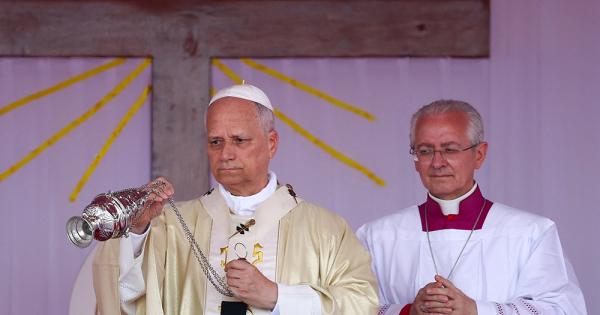
Against that backdrop, Leo’s homily in Saurimo, in which he warned against genuine faith being “replaced with superstitious practices” takes on a new weight.
God, the pope said, should not become an “idol that is sought only when it is advantageous to us and only for as long as it is.” He also said that Christians should avoid “erroneous motives for seeking Christ, particularly when he is considered to be a guru or a good luck charm.”
The previous day, celebrating Mass in Kilamba, Angola, just outside the capital city Luanda, the pope was even more blunt: “We must always be vigilant regarding those forms of traditional religiosity that certainly belong to the roots of your culture, but at the same time risk confusing and mixing magical and superstitious elements that do not aid your spiritual journey.”
“Remain faithful to what the Church teaches, trust your pastors, and keep your gaze fixed on Jesus, who reveals himself in the word and in the Eucharist,” he said.
“We were very happy that the Holy Father talked about this,” Sr. Maria de Lujan Leguizamón, a member of the Sisters of the Workers and Catechists of the Blessed Sacrament from Argentina, told NCR the day after the pope’s Mass in Kilamba.
In Angola, “one can feel not only the presence of these practices, but the fear that it generates in the people — for many people it is difficult to advance in their lives because of the fear that others can do to them with spells,” she said ahead of the pope’s Mass at Saurimo. “This mentality of sorcery keeps people without the possibility of progressing, of creating, of coming out ahead — and more problematic than the practices is the mindset, the fear, the idea that, ‘if you do this or that, they will cast a spell on you.’ “
“What we try to say from a Christian perspective is: ‘If you are united to Jesus, if you are united to Christ, then no one can do you harm,’ ” she said.
Fr. José Muacahamba, a priest of the Diocese of Dundo, some 160 miles north of Saurimo and along the country’s border with the Democratic Republic of the Congo, said that among his community, “We still have some doubtful Catholics.”
“We have many people who profess the Catholic faith but still have one foot behind when it comes to concrete situations that happen in people’s lives: issues of illness, issues of death,” he said. “We need to pray with much intensity, with much transparency and much simplicity so that the people can understand that who encounters Christ is a new person and cannot return to the old practices.”
“We need to get it into people’s heads that Jesus is enough for us,” he said.
While Leo spoke most clearly about the dangers of blending superstitious practices with the Catholic faith in Angola, he had already made reference to it in Bamenda, Cameroon, his most rural stop over his three days in the West African nation.
Before some 20,000 exuberant faithful, Leo stressed the need to “foster inculturation of the Gospel,” but also urged them to “be vigilant, even regarding our own religious practices, so as not to fall into the trap of mixing the Catholic faith with other beliefs and traditions of an esoteric or gnostic nature, which in reality often serve political and economic ends.”
In Mongomo, Equatorial Guinea, during the last leg of the pope’s four-nation tour, Maraino Nve, a 70-year-old catechist from a nearby town, said occult practices also present a problem to the rural Catholic community where he serves.
“The truth is that there is a mix” between the Catholic faith and the occult, fetishistic practices in Equatorial Guinea as well, he said before the pope’s Mass on April 22. “We want that our catechesis spreads, so that this [fetishism] ends, bit by bit, toward a conversion.”
Church leaders are careful, however, to distinguish between harmful syncretism – a blending of distinct religious practices – and what they see as legitimate inculturation, or the adaptation of Christian worship to local cultural expressions.
“With inculturation, we are saying that religion is coming into a culture: what is good in our culture, we take it and use it in religion,” Bishop Rudolf Nyandoro of Gweru, Zimbabwe, who traveled to Saurimo to celebrate Mass with the pope, told NCR. “Take for example, the drums, the dancing, the ‘ouélele,’ ” a form of celebratory chant.
However, “when things are very bad, they [Catholics] want to switch back to their culture – when there’s bad luck in the family, when their children are not employed,” he said. “Our Catholics dabble between the two.”
Source link
