

Putin visit to India: Can India keep on good terms with Moscow and Washington?
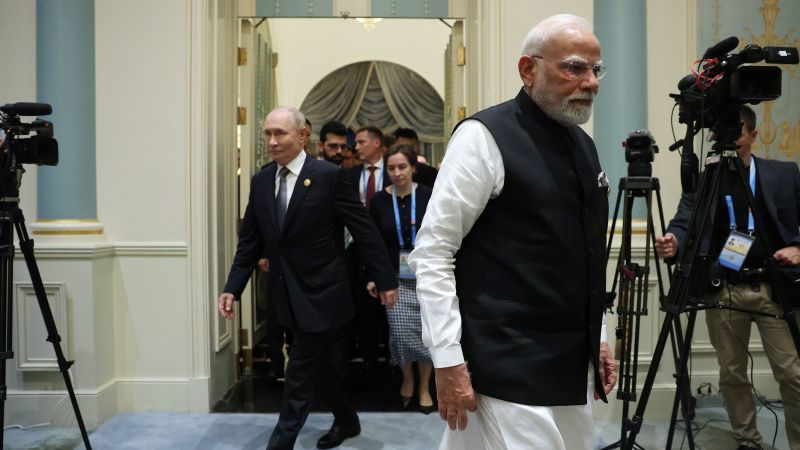
When Vladimir Putin’s plane touches down in New Delhi on Thursday, he will be met with the pomp and ceremony reserved for one of India’s most steadfast partners. Yet his host, Prime Minister Narendra Modi, is simultaneously attempting to maintain a deep strategic relationship with a key global rival: the United States.
This is India’s diplomatic split screen. On one side: the potential purchase of advanced Russian fighter jets, cheap oil, and an ironclad friendship forged in the Cold War. On the other: American collaboration on technology, trade and investment – and the hope President Donald Trump will lift his punishing tariffs.
In the wake of Putin’s invasion of Ukraine, India has leveraged its strategic assets – a massive market and a pivotal location in the Indo-Pacific – to command attention from both the White House and the Kremlin.
Streets in the heart of the Indian capital are lined with Russian and Indian flags flying side-by-side, and towering billboards welcoming Putin to India.
But Putin’s trip – his first to India since the start of his war – comes at a tense time for Modi.
New Delhi is negotiating a much-needed trade deal with Washington, after it was slapped with 50% tariffs – half of which was direct punishment for New Delhi’s continued purchases of discounted Russian oil.
New Delhi has recently made gestures to appease Washington, cutting its purchases of Russian oil and agreeing to buy 2.2 million metric tons of liquified petroleum gas from the US.
Yet, high on the agenda for Putin’s visit are more defense deals with Moscow – purchases of arms India deems vital to defending itself against Pakistan and China, with whom border tensions have flared in recent years.
This underscores how India must navigate a complicated neighborhood: Russia is also a close partner of China, while Beijing is a major source of weapons for Pakistan.
In rolling out the red carpet for Putin, New Delhi is signaling to both the West and China that it “has options,” said Kanti Bajpai, a visiting professor of International Relations at Ashoka University.
“It’s a sign that India is willing to stick with the Russians” even though Moscow faces widespread international condemnation, he said. “Apart from the oil and the arms, it’s diplomatic hedging, showing Beijing and Washington that Delhi has a third option and gives it a bit more bargaining room.”
India’s close ties with Russia were forged during the Cold War, when the newly independent nation was officially “non-aligned” but a recipient of much Soviet industrial and economic aid as it charted its course as a new country.
The tilt towards Moscow, however, came in the 1970s, driven by Washington’s growing military and financial support to India’s arch-rival, Pakistan. Russia started providing arms to India, and Moscow became a reliable counterweight, a role it has valued ever since.
Although India’s procurement of Russian weapons has dropped over the last four years, Moscow remains its top military supplier, according to the Stockholm International Peace Research Institute (SIPRI), a think tank that tracks global arms sales.

Much of this Russian hardware is purchased with an eye on India’s rival China – which has emerged as one of Moscow’s closest partners in recent years, but with whom India has longstanding border tensions.
Beijing, meanwhile, is a major arms supplier to India’s arch-rival Pakistan, including of jets that Pakistan’s military said it used to shoot down Indian fighters during a brief border conflict earlier this year. One of those jets, according to Pakistani officials, was a Russian-made Sukhoi Su-30.
Russian Su-30 jets currently make up the majority of India’s 29 fighter squadrons, according to Reuters.
This week’s talks with Russia will likely cover a potential arms deal for its most advanced fighter, the Su-57, Kremlin spokesperson Dmitry Peskov told reporters Tuesday.
But in recent months, it’s New Delhi’s economic ties with Moscow that have been in the headlines – and have caused the biggest headache.
When Western sanctions over the 2022 invasion of Ukraine caused the price of Russian oil to plummet, India seized the opportunity. Keen to secure a bargain to fuel its booming economy and support a population of over 1.4 billion, the nation significantly ramped up its purchases of Russian crude, becoming one of the Kremlin’s top buyers.
In response to condemnation from the West, India consistently argued that its primary responsibility was to its own people and economy.
“We have hundreds of millions of poor people. We need to raise them out above the poverty line… to deal with that, India needs to maintain a decent working relationship with all great powers,” said Nandan Unnikrishnan, a distinguished fellow at the Observer Research Foundation (ORF) think tank in New Delhi.
But in August Trump’s patience wore thin, and he imposed 50% tariffs on India – punishment for its trade deficit with Washington but also its purchases of Russian oil.
Then in October, Trump announced US sanctions on two of Russia’s largest oil companies, sending immediate ripples through offices in India, with trade and refining sources telling Reuters that the country’s December oil imports are set to hit their lowest in at least three years.

The financial pressure from Washington is not only straining ties but also appears to be accelerating a detente with Beijing. Days after Trump’s India tariffs came into effect, Modi made his first trip to China in seven years for a summit hosted by Chinese leader Xi Jinping designed to showcase Beijing as a global leader capable of providing a counterweight to Western institutions.
That same summit was also the last time Modi and Putin met. Beaming for the cameras, the two exchanged a warm, firm handshake before retreating from the public eye and into the confines of the Russian presidential limousine for a private, hour-long discussion.
“I think people understand what India was trying to do there and thumb its nose a bit at the West,” Ashoka University’s Bajpai said.
Trump’s first administration, as well as that of Joe Biden, saw India as a vital counterweight to China, and boosted strategic ties with New Delhi through technology transfers and joint military drills.
Modi also shared a rapport with Trump, a fellow right-wing populist with a flair for turning diplomatic relations into grand spectacles. The Indian leader hosted the US president in his first term and cast aside diplomatic protocol to campaign for his counterpart’s second term during a rally in Houston, titled “Howdy Modi!”
In a sign that ties may be easing, India and the US recently agreed a new 10-year framework aimed at deepening industrial collaboration, technology, and intelligence sharing.

And New Delhi is still negotiating the contours of a trade deal with Washington, a deal its Commerce Secretary Rajesh Agarwal expects to be finalized by the end of this year, he said at an event last week.
From an Indian perspective, however, such moves do not signal a break from its other partners. As ORF’s Unnikrishnan notes, there is “no contradiction… in having an ambitious trade deal with the United States and having a working relationship with Russia.”
This confidence is bolstered by an understanding within the Kremlin, analysts say.
“There is a close relationship between New Delhi and Moscow,” said Bajpai. “Putin knows that Modi’s under considerable pressure there. He does have a domestic constituency to answer to, and he’s between a rock and a hard place.”
Still, this delicate balance will be under scrutiny from Washington, particularly with major defense contracts on the table during Putin’s visit to New Delhi.
“India will have to be careful to that extent, particularly since the bilateral trade deal has not been arrived at,” Unnikrishnan said.
“You don’t want to inject any more irritants into a difficult phase as it exists today.”
Source link
