

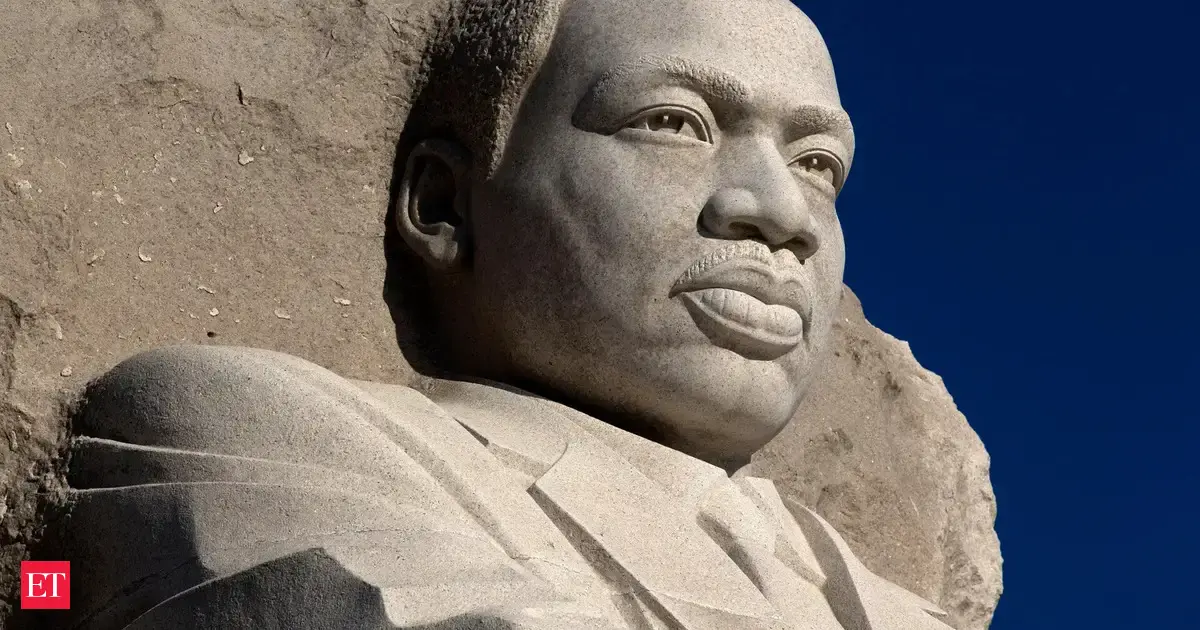
A Quote of the Day matters because it pauses the rush of everyday life and asks readers to reflect. It distills complex struggles into a single, resonant idea that can still guide thought and action. On Martin Luther King Jr. Day, quotes from King serve not only as memorials to his life but as reminders of unfinished work. They urge society to measure how far it has come, and how far it still must go, toward equality, dignity, and shared humanity.
Quote of the Day Today January 19
“Now is the time to rise from the dark and desolate valley of segregation to the sunlit path of racial justice.” — Martin Luther King Jr.
This Quote of the Day comes from one of the most significant speeches in American history: Dr. King’s “I Have a Dream” address. Spoken during a moment of intense national tension, the line captured both the suffering caused by segregation and the moral urgency to move beyond it. To understand its power, it is essential to revisit the man, the moment, and the movement that shaped these words.
Martin Luther King Jr. and the March on Washington
On August 28, 1963, the Rev. Martin Luther King Jr. stood on the steps of the Lincoln Memorial in Washington, D.C., addressing a crowd of approximately 250,000 people gathered for the March on Washington for Jobs and Freedom. The march was a one-day event designed to protest racial discrimination and push for civil rights legislation at a time when the Civil Rights Act was still being debated in Congress, as per Britannica.
King deliberately chose the Lincoln Memorial as the setting for his speech, honoring President Abraham Lincoln, whom he described as “a great American, in whose symbolic shadow we stand today.” The location tied the unfinished struggle for racial equality directly to the promise of emancipation made a century earlier. Musical performances and speeches filled the day before King appeared as the final official speaker, with A. Philip Randolph and Benjamin Mays closing the event with a pledge and a benediction, as per Britannica.
The “I Have a Dream” Speech and Its Historic Power
Early in his prepared remarks, King echoed Abraham Lincoln’s Gettysburg Address with the phrase “Five score years ago,” referencing the Emancipation Proclamation that had ended slavery. Yet he quickly made clear that freedom remained incomplete. African Americans, he said, were still “crippled by the manacles of segregation and the chains of discrimination.” His words described not only injustice but exhaustion, frustration, and deferred hope, as per Britannica.
“I say to you today, my friends, so even though we face the difficulties of today and tomorrow, I still have a dream. It is a dream deeply rooted in the American dream.…I have a dream that my four little children will one day live in a nation where they will not be judged by the color of their skin but by the content of their character. I have a dream that…one day right there in Alabama, little Black boys and Black girls will be able to join hands with little white boys and white girls as sisters and brothers.”
As the speech progressed, observers later noted that King sensed his prepared text was not fully resonating. It was at this moment that gospel singer Mahalia Jackson reportedly called out, urging him to “tell them about the dream.” Though advisers had earlier discouraged the theme as overused, King set aside his prepared notes and began to improvise, shifting into the cadence of a Baptist preacher.
What followed became immortal. King spoke of his dream that his children would one day be judged not by the color of their skin but by the content of their character. He imagined Black and white children joining hands as sisters and brothers, even in states marked by deep segregation. The crowd responded audibly, offering encouragement as the speech rose toward its emotional climax.
The address concluded with words drawn from a Black spiritual, “When we allow freedom to ring, when we let it ring from every village and every hamlet, from every state and every city, we will be able to speed up that day when all of God’s children, black men and white men, Jews and Gentiles, Protestants and Catholics, will be able to join hands and sing in the words of the old Negro spiritual: “Free at last! Free at last! thank God Almighty, we are free at last!”
Largely shaped by King’s improvisation, the speech came to be regarded as the greatest of the 20th century. Its universal appeal extended far beyond the United States, helping to secure passage of the Civil Rights Act of 1964 and reshaping how the world understood the American struggle for racial justice, as per Britannica.
Martin Luther King Jr. Day and His Enduring Legacy
Martin Luther King Jr. Day is observed on the third Monday of January, near King’s January 15 birthday. While many experience it simply as a day off from work or school, King’s family and civil rights advocates emphasize that the holiday is meant to inspire service, reflection, and commitment to justice.
The path to establishing the holiday was long and difficult. Calls for a national day in King’s honor began almost immediately after his assassination on April 4, 1968, when he was killed while standing on a balcony at the Lorraine Motel in Memphis, Tennessee. Despite widespread public support, political and racial opposition delayed federal recognition for years. It was not until November 2, 1983, that legislation was signed making the third Monday in January a federal holiday, first observed nationwide in 1986.
Today, Martin Luther King Jr. Day stands as a reminder not only of King’s leadership but of his philosophy of nonviolent resistance, civil disobedience, and moral courage. As a Baptist minister, he first rose to national prominence during the 1955 Montgomery bus boycott and went on to found the Southern Christian Leadership Conference in 1957. He led the March on Washington in 1963, helped secure the Civil Rights Act of 1964 and the Voting Rights Act of 1965, and was awarded the Nobel Peace Prize in 1964, as per Britannica.
Quote of the Day Meaning
The meaning of “Now is the time to rise from the dark and desolate valley of segregation to the sunlit path of racial justice” lies in its sense of urgency. King was not speaking about gradual change or distant ideals. He was calling for immediate moral action. The “valley” he described represented generations of enforced separation, humiliation, and inequality. The “sunlit path” symbolized dignity, fairness, and shared citizenship.
Importantly, King framed justice not as revenge or dominance, but as collective elevation. Rising from the valley required courage, discipline, and nonviolence. It demanded that Americans confront injustice without surrendering to bitterness or hatred. The quote insists that waiting is itself a choice, and often a harmful one. Justice, King argued, cannot be postponed without consequence.
Decades later, the line remains relevant because it does not describe a completed journey. It challenges each generation to ask whether it is moving toward light or remaining comfortable in shadow. On Martin Luther King Jr. Day, the quote serves as both inspiration and accountability.
Other Iconic Quotes from the “I Have a Dream” Speech
Beyond today’s Quote of the Day, the “I Have a Dream” speech contains many lines that continue to shape political and moral discourse. These quotes are taken from Deseret.
“I have a dream that one day right there in Alabama little black boys and little black girls will be able to join hands with little white boys and white girls as sisters and brothers.”
“I have a dream that my four little children will one day live in a nation where they will not be judged by the color of their skin but by the content of their character.”
“I have a dream that one day on the red hills of Georgia the sons of former slaves and the sons of former slave-owners will be able to sit down together at a table of brotherhood.”
“I have a dream that one day this nation will rise up and live out the true meaning of its creed — we hold these truths to be self-evident: that all men are created equal.”
“I say to you today, my friends, that in spite of the difficulties and frustrations of the moment, I still have a dream.”
“Now is the time to rise from the dark and desolate valley of segregation to the sunlit path of racial justice.”
“We will not be satisfied until justice rolls down like waters and righteousness like a mighty stream.”
“Let us not seek to satisfy our thirst for freedom by drinking from the cup of bitterness and hatred.”
“Now is the time to make justice a reality for all of God’s children.”
“We cannot walk alone. And as we walk, we must make the pledge that we shall march ahead. We cannot turn back.”
“We refuse to believe that the bank of justice is bankrupt.”
“In the process of gaining our rightful place we must not be guilty of wrongful deeds.”
As a Quote of the Day, Martin Luther King Jr.’s words continue to illuminate moments of struggle and hope alike. Spoken in 1963, they remain a call to conscience today, urging societies not to settle for symbolic progress but to pursue genuine justice. On Martin Luther King Jr. Day, the quote reminds us that history is not only something we remember, but something we are still responsible for shaping.
Source link
