

Rapa Nui and its moai head statues are misunderstood by the West.
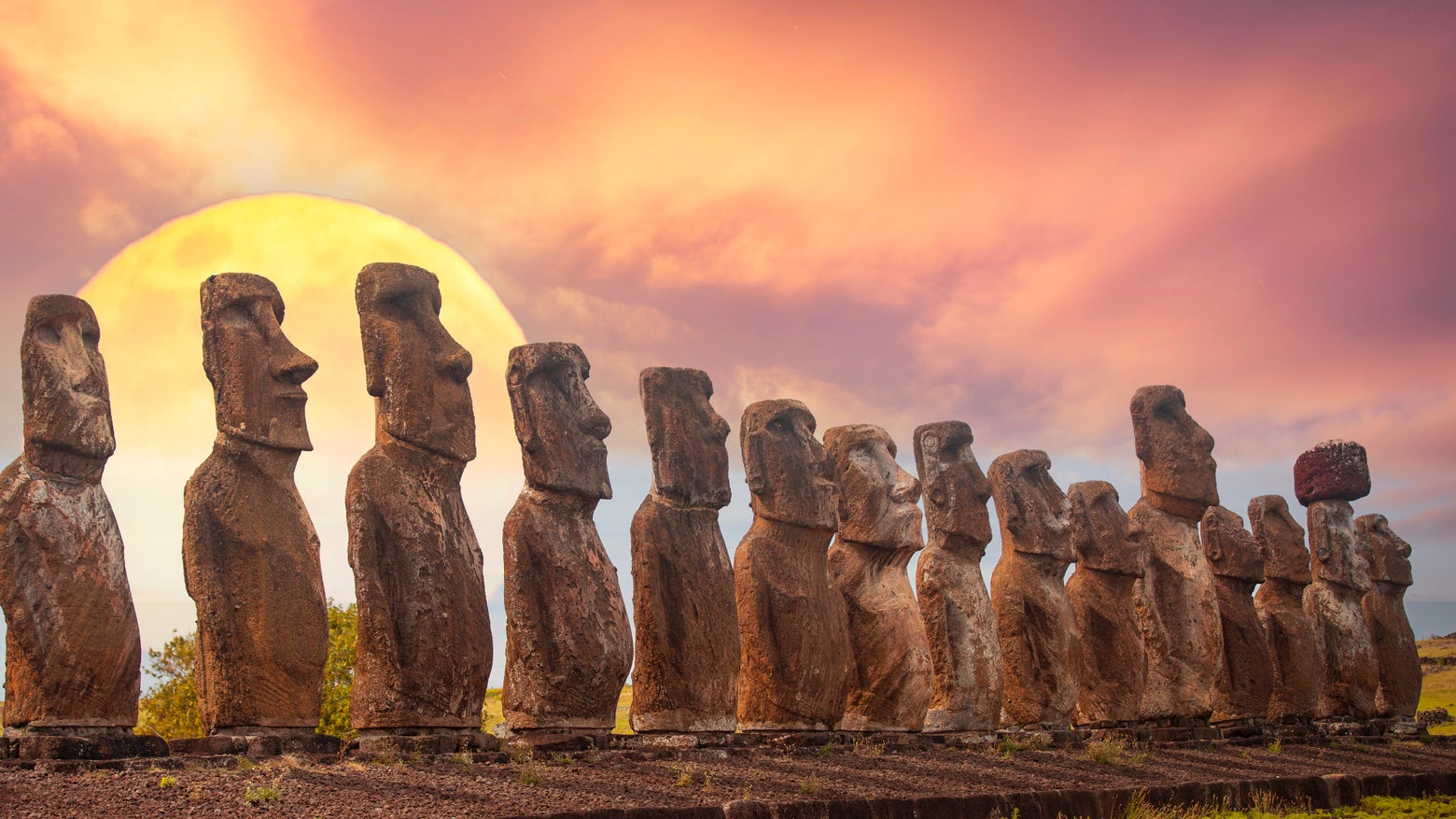
More than 1,289 miles from the nearest human settlement, Easter Island—or Rapa Nui, as its own people call it—is arguably the world’s most remote inhabited place. To the mystique of its isolation amid vast expanses of the South Pacific Ocean, add the hundreds of colossal stone carvings of human figures scattered over the island, from orderly rows placed on plinths near the coast to even larger statues at seemingly random spots along its ridges and highlands.
Rapa Nui’s iconic statues are often presented as a mystery. Who built them, and why? How were the figures, which can weigh as much as 80 tons, moved from the volcanic quarry where they were carved to their positions around the island? What do they represent to whoever made the mammoth effort to carve and situate them? The idea of Rapa Nui as enigma arises from the belief of Westerners, almost from their first contact with the islanders in 1722, that the Rapanui people themselves could not have performed these feats. The most crackpot theories about who did range from ancient astronauts to a sophisticated lost civilization that sank, Atlantis-like, beneath the waves following some catastrophe, leaving only the remnants on Rapa Nui above water. There are other, more respectable hypotheses about how the statues came to be, however, and an ambitious new account of Rapa Nui by an archaeologist who has headed excavations at Stonehenge aims at blowing holes in them.
“The story being told of the island’s ancient past, even today, is profoundly wrong,” writes Mike Pitts, author of Island at the Edge of the World: The Forgotten History of Easter Island. And no, he isn’t just talking about alien architects and other fantasies he dismisses as “demonstrable claptrap.” What Pitt aims to dismantle is “a dominant theory of history that has had the support of many academics, writers, and podcasters, and could well have been true.” Among the prominent figures misrepresenting Rapa Nui, he includes such popular authors as Jared Diamond (author of Guns, Germs, and Steel) and Paul Cooper, whose Fall of Civilizations podcast has over 1 million subscribers. False narratives about Rapa Nui have even been parroted by the likes of Boris Johnson, who claims to have been fascinated by the island since reading Aku-Aku by Thor Heyerdahl, a Norwegian explorer who entertained his own outlandish ideas about it.

By Mike Pitts. Mariner Books.
Slate receives a commission when you purchase items using the links on this page.
Thank you for your support.
One researcher Pitts does admire is the British amateur archaeologist Katherine Routledge, who traveled to the island during the mid-1910s. Routledge, along with her husband, William Scoresby, got stuck there during what was meant to be a relatively brief research trip, first due to an uprising by the Indigenous islanders against a Chilean company that was using their homeland to raise sheep, and then by the outbreak of World War I. As a result, Katherine remained on Rapa Nui for 16 months, cataloging the island’s famous monuments and interviewing its inhabitants, even forming a connection with the aged local “prophetess” who had urged on the uprising.
The result was a vast cache of research that Pitts describes as “very much the most comprehensive description of the island then produced.” Yet as a result of Katherine’s own reluctance and complicated mental health later in life, much of that material has remained unpublished and was scattered all over the globe, some of it possibly lost or auctioned off to private owners. In its absence, the public’s fascination with Rapa Nui has generated a lot of half-baked speculation about the famous statues and their home. Note: Pitts calls the sculptures “statues” rather than “moai,” a commonly used term today, because too many allegedly authentic words like “moai” are drawn from vocabularies written by unreliable Westerners who often just made stuff up. “There are simple English equivalents for what is often obfuscating and meaningless jargon that likely would have meant no more to the statue builders than it does to us,” he writes. (This is a testy book.)
By the time anyone truly interested in the history of Rapa Nui arrived on the island, its Indigenous people and their culture had been subjected to the all-too-familiar depredations of colonialism. In the 19th century, the island attracted the attention of slavers and an international corporation. During a shockingly brief period during the 1860s, a third of the population was kidnapped by Chilean slave traders. Some of these people were eventually returned, infected with smallpox and other diseases for which the Rapanui had no immunity. “Within fifteen years,” Pitts writes, “it was reported that the entire population, from a possible starting point of 5,000, had been reduced to little more than 100. There were just 26 women.”
This atrocity, Pitts argues, accounts for “almost everything that’s been said in the past century and a half to explain Easter Island’s mysteries.” Among the most outlandish of those explanations is Heyerdahl’s. He was convinced, as Pitts puts it, that “the great sculptures and other monuments on Rapa Nui could only have been created by a Caucasian race—tall, fair-skinned, blue-eyed adventurers with beards and fair or red hair (in other words, mirrors of himself).” While most careful observers of the island, like Routledge, believed the ancient Rapanui to be Polynesian, originating from archipelagoes west of the island, Heyerdahl was convinced that his imaginary Viking-like master builders arrived from Peru, in the east.
Pitts seems mostly amused by the more fanciful Easter Island theories. He reserves his true ire for two respected versions of Rapanui history that he regards as unfounded and slanderous. One narrative holds that the Rapanui committed “ecocide,” deforesting and otherwise depleting the island’s resources to the degree that the people starved and their culture withered. The other blames a violent conflict among the island’s inhabitants for both the population collapse and the seemingly haphazard location of many of the statues. The latter story supposedly explains why some statues appear to have been left unfinished in the island’s main quarry at Rano Raraku, while others were assumed to have been abandoned in the process of being transported to the coast.
One of the most stirring sections of Island at the Edge of the World constructs a likely narrative of how Polynesians—among humanity’s greatest mariners—discovered and settled Rapa Nui. The island was never rich in timber to begin with, but rats brought by these settlers did destroy the native palms by devouring their nuts. In a funny aside, Pitts suggests that the crosses that a 19th-century Spanish expedition erected on the island were regarded by the Rapanui as a rich gift and immediately taken down so the wood could be usefully repurposed. Nevertheless, they were able to thrive without a ready supply of wood. The Dutch ship that brought the first Europeans to Rapa Nui in 1722 found a centuries-old community that had adapted Polynesian farming techniques and crops to the relatively poor, shallow soil of the island. They had survived for many generations there without committing ecocide and might have continued to do so indefinitely if not disturbed. Legends about a bloody clash between two different camps of islanders, Pitts asserts, are completely unsupported by the archaeological evidence.
Pitts also argues that the seemingly unfinished statues at the quarry were in fact intentional, and were left attached to the underlying rock to serve as presiding spirits over the sacred acts of carving that took place there. As for the statues long assumed to have been abandoned as they were being transported to the coastline to be displayed in rows on plinths, as in the reconstructed site at Ahu Tongariki, Pitts believes otherwise. One reason Pitts finds Routledge such a compelling figure (besides her comprehensive on-site research) is her sensitivity to the overall environment of Rapa Nui, in contrast to the traditional archaeological tendency to view sites as discrete objects of study. This led her, on a reflective afternoon horseback ride, to notice that the “abandoned” statues were deliberately positioned along a barely detectable old road.
Pitts is an adherent of “landscape archaeology,” which aims to see artifacts and structures in the context of their entire setting. Only by trying to imagine how the Rapanui viewed the statues and the island together, as a spiritual environment, he argues, can we hope to understand what these sculptures meant. This leads him to suggest that the islanders might have regarded the unique geography of Rapa Nui as a sort of metaphor for the course of human life from birth to death, leading from the quarry to a swamp-filled caldera he describes as a “void.” Granted, this imaginative flight seems almost as speculative as some of the theories Pitts criticizes, but it certainly is more respectful of the islanders and their culture. He entertains no doubts about the ability of the pre-contact Rapanui to carve the statues out of the soft volcanic rock found on the island, and notes that there are several methods they might have used to move the sculptures, including making them “walk,” as in this delightful experiment captured on video. From the start, when asked how the statues got to the coast, the islanders would reply that they walked there, and perhaps this is what they meant.
It was not self-destruction, Pitts argues, but contact with Westerners that caused statue-making to peter out on Rapa Nui. Westerners, in turn, sought an answer to the “mystery” of the island by warping it into a mirror of their own problems: environmental devastation and bloody civil wars. If Pitts is also guilty of projecting his own preoccupations onto Rapa Nui and its people, he’s not the first and probably won’t be the last, but he makes a better case than most.
