

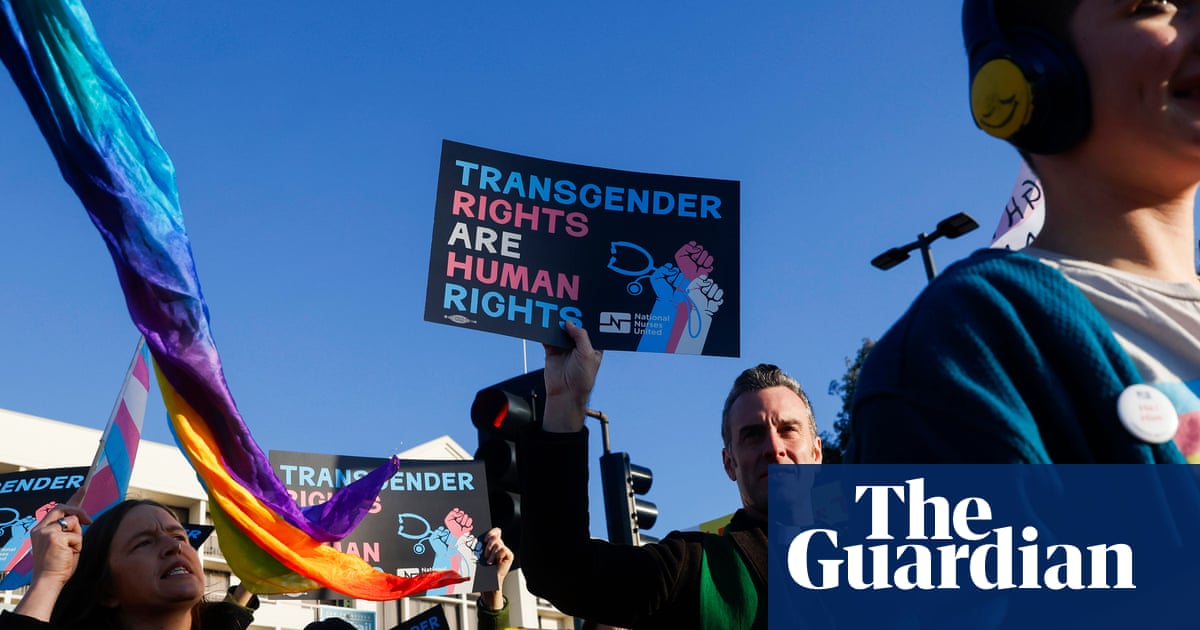
A federal judge overturned the Trump administration’s ban on gender-affirming care for children on Saturday, decrying Robert F Kennedy Jr’s “wanton disregard” for the law that “causes very real harm to very real people”.
It’s another loss for Kennedy’s agenda as secretary for the US Department of Health and Human Services (HHS) under the second Trump administration – an agenda that has focused on restricting healthcare, including vaccines, abortion and gender-affirming care.
A different legal decision recently halted the agency’s attempt to raze vaccine recommendations, and new research and regulatory decisions have undermined controversial announcements by Trump and Kennedy on autism.
“Unserious leaders are unsafe,” Mustafa T Kasubhai, a US district judge in Oregon wrote in the opening to his final judgment on the gender-affirming care case, a 49-page decision that excoriated the administration for disregarding the law and overreach in its regulations. The judge also barred the administration from implementing similar policies under any other names to restrict care nationally by withholding funding.
Shannon Minter, legal director of the National Center for LGBTQ Rights, called the ruling “incredibly powerful” and “far-reaching”.
“It enjoins them from doing anything to interfere with the authority of states to regulate medical practice,” Minter said.
For healthcare providers and families who have been in limbo for months, “this is a huge, huge step forward”, said Jan Oosting, an associate professor of nursing at City University of New York (Cuny).
Khadijah Silver, director of gender justice and health equity at Lawyers for Good Government, who uses they and them pronouns, said they were “so overwhelmingly ecstatic” and “couldn’t actually process” that the ruling “was real life”.
In December, Kennedy announced that any health system providing pediatric gender-affirming care would be suspended from receiving Medicaid and Medicare funding. Medicaid and Medicare would also be banned from paying for any gender-affirming care, he said.
As nearly all major hospitals and health systems rely on Medicaid and Medicare, the proposed rule amounted to a ban on gender-affirming care for children, setting a precedent for the government limiting healthcare for any patients.
At the same time, Kennedy issued a declaration invoking a regulation to allow the HHS to exclude healthcare providers from Medicaid and Medicare when the providers no longer “meet professionally recognized standards of healthcare”. Unusually, the new rule was enforced immediately, without going through the usual rule-making process, including public comment.
Gender-affirming care often includes puberty blockers and hormones, but can also involve psychosocial support and, very rarely and after extensive medical consultation, surgery. It is widely agreed to be essential to the health of gender-expansive individuals. The Kennedy declaration claimed pediatric gender-affirming care for minors was “neither safe nor effective” and therefore fell below these standards.
Declarations like these are meant to be used for emergencies when the HHS needs to communicate the steps it’s taking to protect public health, Silver said, who added: “They have never once been abused in such a fashion to go against standards of medical care that are widely accepted … let alone to override the state’s primary authority in the regulation of medicine.”
Minter said: “This was an attempt by the federal government to impose a national ban and usurp the authority of states to regulate medical practice within their borders.”
Within eight days, the HHS general counsel, Mike Stuart, began referring health systems to the HHS office of inspector general for violating the new policy. The decision included several screenshots of posts from Stuart celebrating referrals of health systems for violating the rule.
At least 40 health systems have said the threat of losing federal funding is why they stopped providing care in recent weeks. Oregon and 21 other states sued the administration. In response, the US government argued that the Kennedy declaration was merely an individual’s personal opinion.
When the judge overturned the declaration, he called this argument “a bald-faced lie” and an attempt to “bully or gaslight” the court. The judge said the Kennedy declaration was “clearly unlawful” because it violated administrative law and the Medicare statute that forbids federal officials from exercising “any supervision or control over the practice of medicine or the manner in which medical services are provided”.
Following the judge’s preliminary injunction against the new rule in March, Children’s Minnesota began offering gender-affirming care again.
When another health system, Children’s Hospital Colorado, ceased care, patients and families sued the hospital. The case is currently before the Colorado supreme court, where judges have expressed concerns that forcing the hospital to resume care could bring federal backlash, endangering even more children. Silver noted that reversing the federal ban now could change the outcome of that case.
“This should be a huge relief and a tremendous source of protection” for families and children whose care was delayed or disrupted, Minter said. When health systems announced they would comply in advance with the directive and stop providing gender-affirming care, often effective immediately, it was “shocking and appalling behavior”, he said, but this decision “should remove that fear” and allow the care to resume.
Oosting noted that the “biggest source of fear, which was the threat of losing Medicare and Medicaid funding, is removed now, so I think that there will be reassessment by each individual hospital of what programs are going to be put back into play, what programs will have to be modified”. That’s especially true in states like New York that have laws against discrimination in healthcare, she said.
The proposed rule preventing Medicaid and Medicare from paying for gender-affirming care is also blocked by this decision, Minter said. The rule did not come before the judge because it hasn’t been finalized, but Minter reads the ruling as “effectively prohibiting those rules from being enforced as well”.
Challenges still exist for children who need gender-affirming care but may not be able to access it.
“Although this removes a major federal barrier, it doesn’t erase those state-level restrictions,” Oosting said. Some states have introduced bans on the care. In Ohio, the state’s supreme court will rule on whether a ban is constitutional in coming months.
Some families in states with bans or gaps in healthcare are once again able to access care by moving or traveling out of state – a “burdensome”, disruptive and expensive process, but an “important” one, Minter said.
Overturning the ban was a “meaningful win for patients and providers and, honestly, for healthcare integrity in the US”, Oosting said. It lessens fear and uncertainty around seeking and providing care, and it shows that “major changes in healthcare policy have to follow the law,” Oosting said – which has repercussions for other politicized changes to health regulations, like limitations on abortion. It was “a powerful tool to stop the federal government from that type of attempted overreach” in healthcare, Minter said.
The decision reinforces the fact that “the federal government can’t use Medicare and Medicaid restriction as a blunt-force instrument to control care and access to people’s bodies,” Oosting said. It’s significant not just for making gender-affirming care available again but also because it sets “the rules of the road – how far the federal government can go in terms of influencing what’s happening in a patient exam room”, she said.
Source link
