

Scientists Uncover Hidden Superconductivity in Material Once Thought Only Magnetic
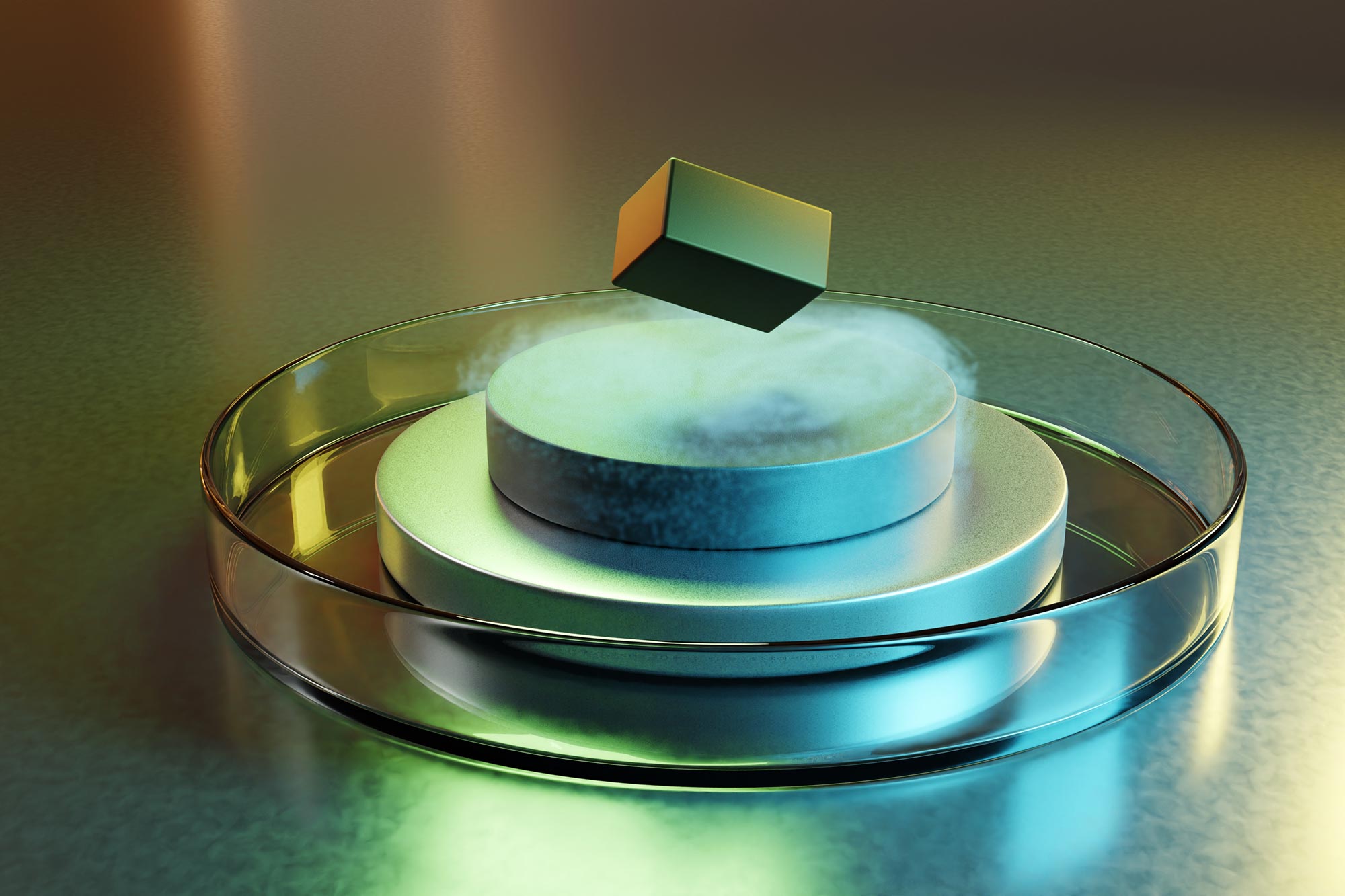
Removing excess iron reveals FeTe as a superconductor, and its properties can be engineered using layered structures and moiré effects.
Superconductivity is the ability of a material to carry electricity with no energy lost as heat. This property supports highly efficient, ultrafast electronics used in technologies such as magnetic resonance imaging (MRI), particle accelerators, and potentially quantum computers.
A new study shows that iron telluride (FeTe), a compound made of iron and tellurium and long considered a simple magnetic metal, is actually a superconductor. The researchers discovered that hidden excess iron atoms create the material’s magnetism. When those extra atoms are removed, electricity can move through the material with zero resistance.
The findings are detailed in two papers published back-to-back in the journal Nature, both led by Penn State physicist Cui-Zu Chang. The first paper explains how to activate superconductivity in FeTe. The second describes a new type of “quantum dance” in which superconductivity interacts with the material’s atomic structure when a different top layer is added, allowing scientists to adjust its properties.
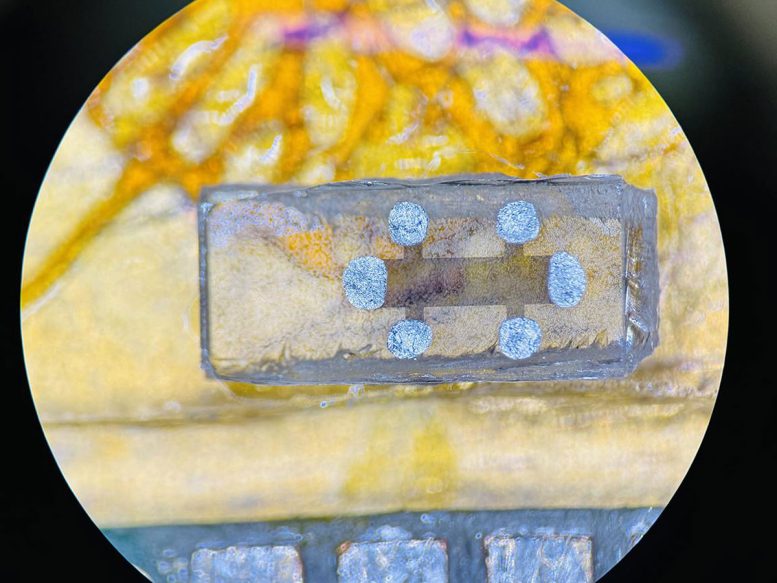
Mystery Behind FeTe’s Missing Superconductivity
“Unlike the well-known iron-based superconductor iron selenide (FeSe), FeTe has long been considered a magnetic metal without superconductivity, despite having an almost identical crystal structure,” Chang said. “It has remained a mystery why FeTe doesn’t share this important property.”
To investigate this difference, the team created thin films of FeTe using molecular beam epitaxy. This method produces extremely clean, atomically thin materials by slowly depositing source elements onto a suitable surface.
When the researchers examined the samples at the atomic level using scanning tunneling microscopy, they found that the structure was not perfectly uniform. Extra iron atoms were embedded within the crystal lattice of FeTe.
Excess Iron Atoms Disrupt Superconductivity
“These excess iron atoms disrupt the ideal one-to-one ratio of iron and tellurium atoms in FeTe and upset the balance of magnetism and superconductivity,” Chang said, explaining that the researchers theorized that removing the excess atoms to make truly pure FeTe might result in a superconductor.
To test this idea, the researchers developed a way to control the material’s purity by exposing the FeTe films to tellurium vapor. This process offsets the excess iron and pushes the material toward its ideal composition.
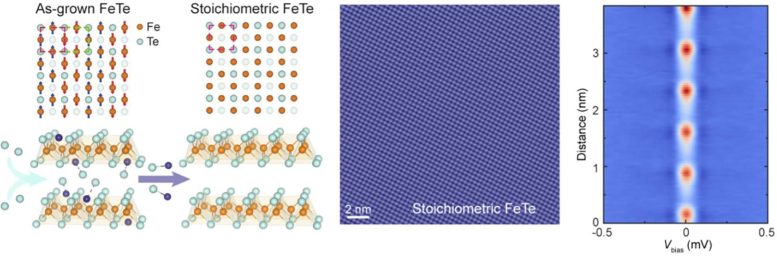
“The resulting ideal FeTe exhibits superconductivity with a critical temperature of around 13.5 Kelvin, or about negative 435 degrees Fahrenheit,” Chang said. “The excess iron atoms had disguised its superconductivity, leading to the decades-old view that FeTe was an ordinary magnetic metal. Our findings redefine the phase diagram of this class of iron-containing compounds. Similar phenomena are likely to be present in other correlated materials, where hidden superconducting states or competing magnetic orders remain concealed until disorder is removed or carefully controlled. Understanding the crucial role of disorder will help us to uncover and stabilize such hidden superconducting states in other materials.”
Engineering Superconductivity with Layered Structures
In the second study, after confirming that FeTe is inherently a superconductor, the researchers investigated how its superconducting behavior could be controlled. They built layered structures by placing a thin material with a different crystal lattice on top of FeTe. Because the two materials have different atomic arrangements, they form a larger repeating pattern at their boundary, known as a moiré superlattice.
“The mismatch between the crystal structures at the interface creates what we call a moiré superlattice, which modifies the superconducting properties of FeTe,” Chang said. “In recent years, moiré superlattices in two‑dimensional materials have emerged as an important platform for discovering new quantum states.”
Using scanning tunneling microscopy, which allows imaging at the atomic scale, the team observed that superconductivity appears as a repeating, droplet-like pattern that follows the moiré superlattice, described by the researchers as a “quantum dance.” They also found that this pattern can be tuned by changing the material used in the top layer.
“The role of crystal lattices has often been overlooked in superconductors,” Chang said. “Our findings encourage a renewed focus on the interplay between superconductivity and lattice structure and highlight how moiré interface engineering can serve as a potentially powerful tool for tuning superconductivity and designing next‑generation quantum materials.”
References:
“Stoichiometric FeTe is a superconductor” by Zi-Jie Yan, Zihao Wang, Bing Xia, Stephen Paolini, Ying-Ting Chan, Nikalabh Dihingia, Hongtao Rong, Pu Xiao, Kalana D. Halanayake, Jiatao Song, Veer Gowda, Danielle Reifsnyder Hickey, Weida Wu, Jiabin Yu, Peter J. Hirschfeld and Cui-Zu Chang, 32 March 2026, Nature.
DOI: 10.1038/s41586-026-10321-0
“Moiré engineering of Cooper-pair density modulation states” by Zihao Wang, Bing Xia, Stephen Paolini, Zi-Jie Yan, Pu Xiao, Jiatao Song, Veer Gowda, Hongtao Rong, Di Xiao, Xiaodong Xu, Weida Wu, Ziqiang Wang and Cui-Zu Chang, 32 March 2026, Nature.
DOI: 10.1038/s41586-026-10325-w
The first study was supported by the U.S. Department of Energy (DOE), with additional support from the U.S. National Science Foundation, the Office of Naval Research (ONR), the Army Research Office, the Penn State MRSEC for Nanoscale Science, the University of Florida, and the Gordon and Betty Moore Foundation’s EPiQS Initiative.
The DOE, ONR, Penn State MRSEC for Nanoscale Science, Air Force Office of Scientific Research, and Gordon and Betty Moore Foundation’s EPiQS Initiative funded the second study.
Never miss a breakthrough: Join the SciTechDaily newsletter.
Follow us on Google and Google News.
Source link
