

Scientists Uncover the Secret Ingredient Behind the Spark That May Have Started Life on Earth

Environmental carbon coatings determine charge transfer direction between identical insulating materials, enabling control of static electricity in natural and experimental systems.
When two microscopic particles collide, they can generate a tiny spark. This simple interaction may have helped supply the energy needed to start life on Earth. But when identical materials come into contact, what determines which way the electric charge moves? A new study published in Nature points to an unexpected answer: carbon-based molecules from the environment that cling to the surface of materials.
This type of charge transfer plays a role in many natural events, including Saharan dust storms, volcanic lightning, and the swirling disks of matter around stars. In each case, small electrical discharges are a key part of the process. Scientists have long suspected that such sparks could drive chemical reactions.
As early as the 1950s, researchers proposed that lightning in volcanic plumes might have helped form amino acids, the building blocks of proteins. More recently, observations from NASA’s Perseverance rover suggest that similar electrical activity may occur in Martian dust storms.
Mystery of Charge Direction in Identical Materials
Despite how common these interactions are, scientists have struggled to explain why the charge consistently moves in one direction when two insulating materials touch. Researchers led by Scott Waitukaitis at the Institute of Science and Technology Austria (ISTA) set out to solve this mystery. Their work revealed that thin layers of environmental carbon on material surfaces play a decisive role.

To investigate, lead author Galien Grosjean focused on silica, a material widely found throughout the universe. However, studying charge transfer proved challenging because even minimal contact, such as touching with tweezers, could alter the results.
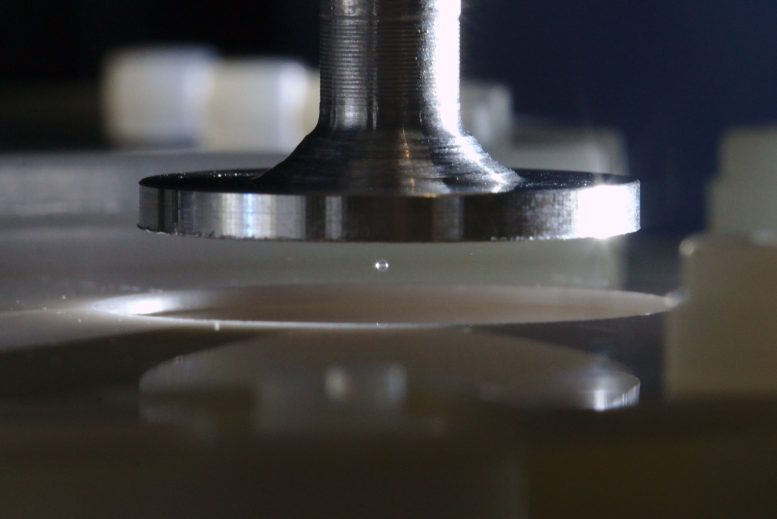
To avoid this, the team used acoustic levitation to suspend a single grain without physical contact. By repeatedly bouncing the grain against a plate made of the same material, they could measure how the charge changed after each collision. Some samples consistently gained a positive charge, while others became negative.
Testing Theories: From Surface Models to Water Hypothesis
The question remained: why would identical materials behave differently, and could the effect be reversed? Earlier theories suggested that surfaces contained random patches with different properties.
“Essentially, scientists imagined a ‘dairy cow pattern’ model,” says Grosjean. Waitukaitis adds, “Initially, I thought that we would validate this model and move forward. We expected random fluctuations averaging out to zero as the grains rotated and made contacts on different tiny patches.”
However, the experiments showed a consistent charging pattern, contradicting this idea. The team also tested whether water molecules attached to the surface could explain the effect.
Breakthrough via Heat and Plasma Treatment
“We focused myopically on water for a long time, which led us down so many wrong turns,” says Waitukaitis. “We took those leading theories in the field for granted, and they took us off track. We needed time to build up the confidence to recognize that the reality was different.”
A breakthrough came when the researchers heated some samples. These treated samples consistently developed a negative charge after contact.

“Since quartz glass is highly resistant to thermal changes, heat does not affect the material itself. As a result, we thought that any alteration must be due to molecules adsorbed to the material’s surface,” he says.
A similar effect was observed when the team used plasma to strip the surface.
Carbon Identified as the Key Factor
“At this point, we started contacting other groups that study material surfaces and can precisely measure surface compositions to compare the samples before and after baking,” says Grosjean. “That’s when we found that subjecting the materials to such treatment stripped them of their natural coating of environmental carbon species.”
Plasma cleaning, a standard method in surface science, is known to remove carbon layers.
“Here, we knew that carbon mattered, but it was not quite the smoking gun yet,” he says.
To confirm the link, the researchers tracked how the effect changed over time. After treatment, the charge behavior gradually weakened over about a day.
Contact electrification. A video narrated by the study’s first author and former ISTA postdoc Galien Grosjean. Credit: Galien Grosjean/Scott Waitukaitis
Reversing Charge Trends Across Materials
“In parallel, our collaborators showed that the carbon species also returned to the materials’ surface over the same period, making the correlation much stronger,” Grosjean notes.
Water molecules returned much faster, ruling them out as the main cause. These results confirmed that environmental carbon was responsible.
The ISTA scientists then sought to examine whether the effect of environmental carbon on charge applied to insulating oxides other than silica, including alumina, spinel, and zirconia. After standard cleaning, done without stripping their surfaces of adsorbed carbon species, these materials naturally fall into a series known as a triboelectric series, ranging from the most positively charged to the most negatively charged following contact.

While this suggests that the materials have intrinsic tendencies, the team suspected that the carbon coating also contributed. By examining each pair of materials and stripping the surface of the one that naturally charges more positively while keeping the other one intact, they could invert the entire series. Therefore, introducing this clear imbalance in the carbon coating helped the researchers demonstrate that the carbon effect can outweigh the materials’ inherent tendencies.
Experimental Challenges and Precision Measurements
Waitukaitis emphasized how difficult these experiments were.
“These experiments are really hard. The carbon coating is never at equilibrium; a single monolayer of carbon already makes a difference, and the materials are sensitive to the slightest touch,” Waitukaitis says. “That’s why the phenomenon remained unexplained for so long.”

Using acoustic levitation allowed the team to avoid unwanted contact and measure charge with high precision, down to about 500 electrons.
In related work, the group found that the contact history between soft silicon-based polymers also affects charge direction. While both studies began by testing older models, they ultimately showed that different materials follow different rules.
“It is tempting to think that any finding must apply to all materials,” says Grosjean. “But we stopped making this mistake.”
Implications for Life and Planetary Formation
These findings extend beyond the lab. Static electricity between tiny particles is widespread in nature and may have played a role in the origin of life and even planetary formation.
“Most of these materials in nature are little particles smaller than one millimeter. They charge by colliding, rubbing, and rolling all over each other. That’s why desert sand, volcanic ash clouds, and dust particles get charged,” says Waitukaitis.
Understanding this mechanism may also help scientists study protoplanetary disks, where planets form.
“Some current models of planetary formation rely on a predominant effect of charge,” Waitukaitis concludes. “As such, our research might have just shed light on the mechanism underlying the sparks of creation.”
Reference: “Adventitious carbon breaks symmetry in oxide contact electrification” by Galien Grosjean, Markus Ostermann, Markus Sauer, Michael Hahn, Christian M. Pichler, Florian Fahrnberger, Felix Pertl, Daniel M. Balazs, Mason M. Link, Seong H. Kim, Devin L. Schrader, Adriana Blanco, Francisco Gracia, Nicolás Mujica and Scott R. Waitukaitis, 18 March 2026, Nature.
DOI: 10.1038/s41586-025-10088-w
This project has received support from the European Research Council (ERC) under the European Union’s Horizon 2020 research and innovation program (grant agreement no. 949120) and from the Marie Skłodowska-Curie program (grant agreement no. 754411). The authors acknowledge the state of Lower Austria and the European Regional Development Fund under grant no. WST3-F-542638/004-2021, Fondecyt grant 1221597, and a Serra Húnter fellowship. This research was supported by the Scientific Service Units of the Institute of Science and Technology Austria through resources provided by the Miba Machine Shop, Nanofabrication Facility, Scientific Computing Facility, and Lab Support Facility.
Never miss a breakthrough: Join the SciTechDaily newsletter.
Follow us on Google and Google News.
Source link
