

Sinking Iran’s Frigate IRIS Dena and the Law of Naval Warfare
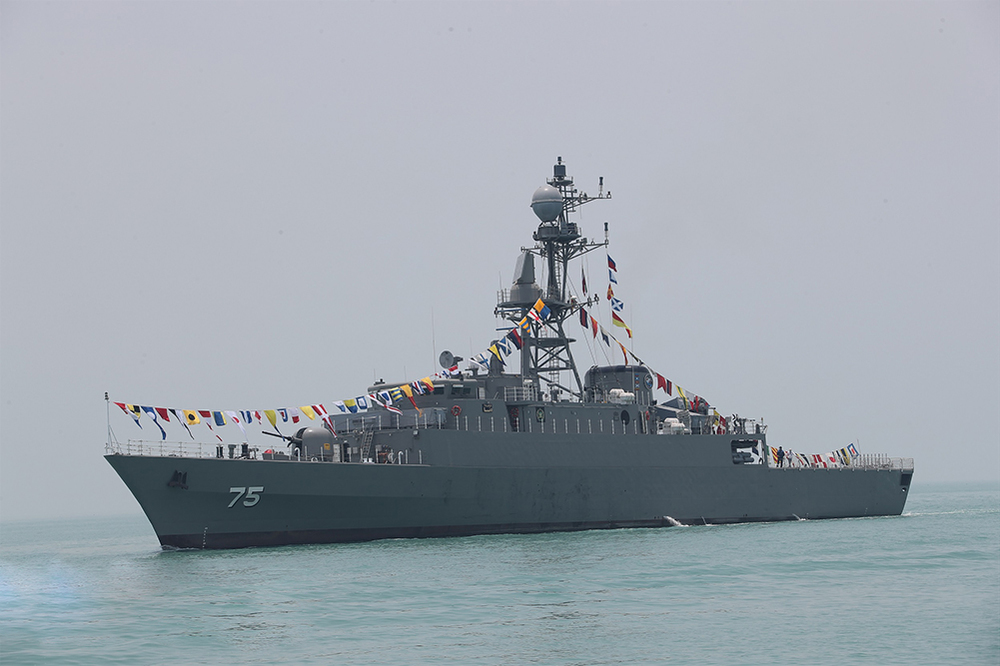
Early in the morning of March 4, a U.S. Navy attack submarine, the USS Charlotte, sank an Iranian Navy frigate, the IRIS (Islamic Republic of Iran Ship) Dena, in the international waters roughly 20 nautical miles off the southern coast of Sri Lanka. The Iranian warship had just participated in a multinational naval exercise, MILAN 2026, and the International Fleet Review in India. As the Dena sailed home to Iran where armed hostilities were raging, it was struck by an MK-48 torpedo, resulting in a large explosion and rapid flooding.
Almost immediately, the Dena transmitted a distress call, triggering a large-scale search-and-rescue (SAR) operation involving the Sri Lankan Navy, Coast Guard, and Air Force, as well as Indian assets. Although they arrived quickly, the vessel reportedly sank within two to three minutes of the torpedo’s impact. SAR forces rescued 32 survivors and recovered over 80 bodies among the crew of approximately 130 (although there are reports that as many as 180 were aboard).
The sinking triggered a debate over the attack’s lawfulness that focused on the location of the vessel, the attack itself (due to the vessel’s activities), and the failure of the submarine to attempt the rescue of those who were shipwrecked. Indeed, Iran’s Foreign Minister labeled the attack “an atrocity at sea” and warned that the United States “will come to bitterly regret” the attack.
In this explainer, we outline the applicable international law rules regarding those three issues. They are found primarily in the law of naval warfare, which is applicable because Iran and the United States are undeniably involved in an international armed conflict. We do not address the question of whether the overall U.S. operations comport with the law governing the resort to force by States as an instrument of their national policy, the jus ad bellum, specifically the prohibition on the use of force and the right of individual and collective self-defense (UN Charter, arts. 2(4) and 51).
Location of the IRIS Dena
During an armed conflict, the world’s oceans are generally split into three areas in the law of naval warfare–neutral waters, belligerent waters, and international waters. Understanding the distinction between these maritime zones is critical because they define the geographic areas in which belligerents may lawfully conduct military operations at sea and those in which such operations are restricted.
Neutral waters encompass both the territorial sea and internal waters (e.g., ports, bays, rivers, etc.) of neutral States (meaning States that are not a party to the conflict). The 1907 Hague Convention XIII prohibits States from engaging in hostilities in them (art. 1). States universally recognize that prohibition as customary in character (see, e.g., DoD Law of War Manual, § 15.3.1.2; Newport Manual, 2nd ed., § 11.3.2.1; San Remo Manual, ¶ 15).
Obviously, warships of the parties to the conflict may exercise “belligerent rights,” including conducting attacks, in their own waters and those of their enemy (meaning the territorial seas and internal waters of States that are a party to the conflict). They may also engage in hostilities in international waters, which encompasses all waters that lie outside of any neutral State’s territorial sea, including contiguous zones, exclusive economic zones (EEZ) and the high seas (absent a treaty to the contrary, like the Antarctic Treaty) (DoD Law of War Manual, § 13.3.1; Newport Manual, § 4.1.2; San Remo Manual, ¶ 10).
There is no “zone of naval operations” to which naval engagements are limited. The paradigmatic example illustrating this point occurred during the 1982 Falklands War, when a British submarine torpedoed and sank the Argentine cruiser ARA General Belgrano well outside the United Kingdom’s declared 200 nautical mile exclusion zone around the Falklands Islands. Despite significant political controversy, the United Kingdom argued, correctly, that the zone was intended only to improve the safety of neutral shipping and did not restrict lawful attacks on Argentine warships beyond it (Dinstein, ¶ 913).
In principle, then, an enemy warship may be engaged anywhere in the world except neutral waters, meaning that belligerent naval operations may lawfully occur across vast expanses of the ocean, including areas that are far removed from the immediate land theater of any given conflict. Since the Dena attack took place in international waters and the law of naval warfare imposes no zones of engagement, there is no issue as to its location. Simply put, as noted in the US Navy/Marine Corps/Coast Guard’s Commander’s Handbook on the Law of Naval Operations (NWP 1-14M), “Enemy warships and military aircraft, including naval and military auxiliaries, are subject to attack, destruction, or capture anywhere beyond neutral territory” (§ 8.6.1).
Attacking the IRIS Dena
It is self-evident that in an international armed conflict, the enemy’s warships are subject to attack (DoD Law of War Manual, § 13.4.2; NWP 1-14M, § 8.6.1; San Remo Manual, ¶ 65-66). As noted in the Newport Manual (§ 8.6.1),
Enemy warships and naval auxiliaries, whether manned or unmanned, are military objectives by nature that may be targeted anywhere and at any time (so long as they are not present in neutral waters). The definite military advantage gained from sinking an enemy warship will be self-evident in any campaign in the maritime domain. Warships and naval auxiliaries may be targeted regardless of the composition of the crew or passengers on board.
A narrow exception to this rule exists for a warship “that in good faith unambiguously and effectively conveys a timely offer of surrender,” for instance, by hauling down her flag, hoisting a white flag, taking to the lifeboats (NWP 1-14M, § 8.6.1; Newport Manual, § 8.6.7.1). There is no indication that the Dena expressed a desire to surrender, if only because it may have been unaware it was about to be attacked; indeed, Iranian officials claim the frigate was attacked without warning. Yet, there are reports that Charlotte twice warned Dena to surrender and abandon ship, but the captain refused to give that order. Regardless of which story is accurate, there is no obligation in the law of naval warfare for a warship to demand surrender before attacking; warships may be attacked without warning.
The fact that a submarine carried out the attack on the Dena instead of a surface warship is also of no legal significance with respect to the attack. On the contrary, despite employing different means (e.g., torpedoes) or methods (primarily underwater engagement) of warfare, the same law of naval warfare rules apply to both surface and subsurface naval assets. (DoD Law of War Manual, § 13.7.1; NWP 1-14M, § 8.7; Newport Manual, § 8.1.3).
We note that Iran’s Deputy Foreign Minister protested that the Dena “was [in the area] by invitation of our Indian friends, attending an international exercise. It was ceremonial. It was unloaded. It was unarmed.” But that protest has no basis in the law of naval warfare because, as noted, warships are lawful military objectives. Under the law of the sea, a warship is “a ship belonging to the armed forces of a State bearing the external marks distinguishing such ships of its nationality, under the command of an officer duly commissioned by the government of the State and whose name appears in the appropriate service list or its equivalent, and manned by a crew which is under regular armed forces discipline” (UNCLOS, art. 29; see also NWP 1-14M, § 2.2.1; Newport Manual, § 3.2.1). They need not be armed, have weapons, or be engaged in military operations to qualify as such, and no State or expert manual addressing the law of naval warfare suggests otherwise.
In addition to warships that have effected a surrender as noted above, exceptions from liability to capture or destruction also exist for “specially protected vessels,” such as a cartel vessel exchanging prisoners of war, coastal fishing vessels, SAR assets, and hospital ships (NWP 1-14M, § 8.6.3; Newport Manual, § 10.4; San Remo Manual, ¶ 47). No such exemption exists for warships participating in a multinational exercise or engaged in “ceremonial” duties. There is no question that the Dena, an Iranian Navy Moudge-class guided-missile frigate, qualified as a warship enjoying no special protection subject to attack.
As in land warfare, even lawful military objectives at sea are subject to a rule of proportionality during naval engagements (DoD Law of War Manual, § 13.3). As the Commander’s Handbook explains (§ 8.3.1),
The principle of proportionality requires the anticipated loss of civilian life and damage to civilian property incidental to attacks must not be excessive in relation to the concrete and direct military advantage expected to be gained. When targeting a legitimate military objective, effects on civilians and civilian objects is considered collateral, or incidental, damage.
This rule applies to civilians in the vicinity of the ship under attack and to any civilian vessels or other civilian objects nearby. However, as to the ship itself, the law of naval warfare is “platform-based.” If a ship is targetable as a warship, auxiliary, or other targetable vessel, the crew of the ship need not be considered in the proportionality assessment, even if they are civilians (NWP 1-14M, § 5.3.3; Newport Manual, § 8.8.1). This distinguishes them from passengers on a merchant vessel that qualifies as a military objective, for whom consideration in a proportionality calculation is unsettled (Newport Manual, § 8.8.1). As is usually the case in an attack on a warship in international waters, the torpedoing of the Dena does not appear to have risked any incidental injury to civilians or collateral damage to civilian vessels or other civilian objects. Simply put, and despite the high number of casualties, there is no proportionality issue in the sinking of the Dena.
For the same reason, the absence of any expectation of civilian harm means there was no “precautions in attack” issue. That rule, applicable on land and at sea, requires an attacker to “decide, in light of all the facts known or reasonably available to the them, including the need to conserve resources and complete the mission successfully, whether to adopt an alternative method (i.e., tactics) or means (i.e., weapons) of attack, if reasonably available, to reduce civilian casualties and damage” (NWP 1-14M, § 8.3.1).
In our estimation, there is simply no basis to claim that the Dena did not qualify as a military objective at the time of the attack or that the manner of attack was unlawful. The only possible question, therefore, is whether the Charlotte was obligated to effect a rescue of the Dena’s shipwrecked crew.
Failure to Rescue IRIS Dena’s Shipwrecked Crew
In the aftermath of World War II, the issue of rescuing survivors following submarine attacks took center stage during the trial of Admiral Karl Dönitz before the International Military Tribunal at Nuremberg. After Allied attacks on a U-boat attempting to rescue survivors of an ocean liner, the RMS Laconia, Dönitz issued the Laconia Order, which instructed: “All attempts at rescuing members of ships that have been sunk, including attempts to pick up persons swimming, or to place them in lifeboats, or attempts to upright capsized boats, or to supply provisions or water are to cease.” The court held that the order violated the 1936 London Protocol on submarine warfare, which required that the passengers and crew of merchant vessels be placed in safety before a warship could sink them. Yet, because British and U.S. submarines engaged in the same practice during the conflict, it did not factor the breaches of the law of submarine warfare into Dönitz’s sentence.
The treatment of shipwrecked persons during the war significantly influenced the post-war law of naval warfare. Article 18 of the 1949 Convention (II) for the Amelioration of the Condition of Wounded, Sick and Shipwrecked Members of Armed Forces at Sea (Geneva Convention II), to which both Iran and the United States are Party, and that reflects customary law (ICRC Customary IHL study, r. 109), provides:
After each engagement, Parties to the conflict shall, without delay, take all possible measures to search for and collect the shipwrecked, wounded and sick, to protect them against pillage and ill-treatment, to ensure their adequate care, and to search for the dead and prevent their being despoiled.
The Convention expressly extends the protection to enemy forces who are shipwrecked (art. 12).
The obligation to rescue those who have been shipwrecked as a result of hostilities is universally acknowledged by experts (Newport Manual, § 10.6) and has been included in Additional Protocol I for Parties (not Iran or the United States) to that instrument (art. 10). The Commander’s Handbook is in accord: “As far as military exigencies permit, after each engagement all possible measures should be taken without delay to search for and collect the shipwrecked, wounded, and sick and recover the dead” (§ 8.6.1; see also DoD Law of War Manual, § 7.4.1).
However, reflecting a concern Dönitz had regarding the rescue of survivors, today the obligation is conditioned by operational feasibility. Note how the Commander’s Handbook caveats the obligation with “as far as military exigencies permit.” And in the specific case of submarines, it states (§ 8.7; see also Newport Manual, § 10.6),
To the extent that military exigencies permit, submarines are required to search for and collect the shipwrecked, wounded, and sick following an engagement. If such humanitarian efforts would subject the submarine to undue additional hazard or prevent it from accomplishing its military mission, the location of possible survivors should be passed at the first opportunity to a surface ship, aircraft, or shore facility capable of rendering assistance.
The ICRC’s 2017 Commentary to Article 18 makes the same points. It acknowledges that “it may occur that the commander of a single warship … considers, in a good-faith assessment, that it is impossible to undertake, with the assets under his or her command, any of the activities required under Article 18” (¶ 1637). With respect to submarines, it points to the fact that “space is extremely limited on board a submarine, thus complicating their ability to take on board shipwrecked, wounded and sick, let alone dead, persons” (¶ 1637).
However, the Commentary emphasizes that this does not exempt the submarine from taking other reasonable steps to help the shipwrecked crew of an enemy warship. For example, it points out that, depending on the situation, submarines might be able to “supply materials such as lifeboats, survival craft (including inflatable rafts), buoyancy aids, alert aids, detection aids, food, and water.” In that regard, though, it observes that submarines may need to surface to do so, which might not always be possible (¶ 1644).
Alternatively, the submarine “may alert [its] own authorities and, where possible, other entities, to the location of the attack and to the possibility that there may be survivors,” but only “so long as it does not render the submarine detectable to the enemy.” (¶ 1643). But demonstrating further sensitivities to the nature of submarine warfare, the Commentary acknowledges,
that a submarine’s greatest strength is its stealth capabilities. Usually, therefore, a submarine will receive messages from its higher command without responding to them. Depending on the technology used, any form of transmission by the submarine, such as an electronic communication, might be subject to interception by the enemy. The same risk arises where a submarine moves closer to the surface. This would reveal the submarine’s location, and risks exposing it to a counter-attack. To the extent technology allows submarines to transmit messages without revealing their precise location, this would of course change the analysis in terms of what “possible measures” it may be able to take in the circumstances (FN 35).
And the Commentary suggests that while alerting others as to the need for SAR “may not be possible seconds after launching its weapon, it may become feasible once the submarine has moved away from the area” (§ 1643).
Article 21 of Geneva Convention II also bears on SAR following the Dena attack. It notes that “Parties to the conflict may appeal to the charity of commanders of neutral merchant vessels, yachts or other craft, to take on board and care for wounded, sick or shipwrecked persons, and to collect the dead.” As noted in the Commentary to the article, “[s]uch vessels may also come to the rescue of these persons on their own initiative, without having received an appeal from or been requested to do so by one of the Parties to the conflict” (¶ 1857). As discussed, neutral Sri Lankan SAR forces, in response to Dena’s distress call, did conduct a SAR operation to recover survivors and bodies soon after the attack.
Whether the Charlotte (and U.S. forces more broadly) complied with these obligations depends on facts that are not fully available in publicly available sources. What we can say is that the submarine was under a legal obligation to take feasible measures to rescue those who were shipwrecked. If it could not, it was to communicate the need for SAR in a way that would effectuate rescue, so long as doing so was feasible in the circumstances.
Given the size of Dena‘s crew and the submarine’s limitations, executing a rescue would likely have been impractical. We assume, but do not know, that the vicinity of the attack was relatively benign since there are no reports of the Dena being accompanied by other Iranian warships at the time. Nevertheless, although we are only speculating, it is unlikely that the submarine remained in place. It is standard tactical practice for a submarine to conduct evasive maneuvers after an attack to avoid detection by surface ships, aircraft, and other submarines. It also maintains communications silence until out of the engagement area for the same reason. That said, as explained, those security procedures would need to involve military exigencies, such as avoiding undue additional hazard to the submarine in the actual circumstances, to avoid the SAR legal obligations.
As to calling for assistance, most open source reports do not indicate that Charlotte did so, although U.S. Indo-Pacific Command stated that “U.S. forces planned for and Sri Lanka provided life-saving support to survivors in accordance with the Law of Armed Conflict.” But even if the Charlotte did not, it was probably unnecessary given Dena’s immediate distress call and the expeditious Sri Lankan activation of SAR assets, assisted by the Indian Navy. Within the hour, SAR forces were on scene. In other words, a call for assistance from the submarine would likely have had no practical effect.
Moreover, the submarine and other U.S. forces were almost certainly aware that a SAR effort was underway based on the distress transmission itself, maritime traffic monitoring, and intelligence and regional ISR (intelligence, surveillance, reconnaissance) capabilities. Indeed, maritime distress alerts are usually transmitted on international maritime distress frequencies and via satellite systems. The presence of rescue vessels, aircraft, and radio traffic would also have been apparent to the submarine’s own detection systems and its monitoring of open maritime communications.
Concluding Thoughts
The law of naval warfare leaves no doubt that the torpedoing of the Dena by the Charlotte was lawful as a matter of location and targeting. Enemy warships qualify as military objectives and are accordingly subject to attack whenever found outside neutral waters. Neither the fact that the Dena was in Sri Lanka’s EEZ nor that it had been performing ceremonial functions alters that fundamental rule. The same is true regarding the claim that it was unarmed. And the fact that a submarine was used as the platform from which to mount the attack triggered no constraints beyond those that would apply to surface warships, such as proportionality and precautions in attack. Those were certainly satisfied.
The more difficult question is whether U.S. forces complied with their obligation, so far as military exigencies permit, to search for and collect those who were shipwrecked after the engagement. It is an obligation that undeniably applies in submarine warfare. However, it is not absolute and has to be applied in light of operational realities. Although we do not have access to the full picture of the attack, our conclusion is that even if the Charlotte did not call for assistance, there was no breach of this obligation, given the immediate distress call from the Dena, the rapid dispatch of SAR maritime and air assets by Sri Lanka and India, and the near certainty that the U.S. submarine and other U.S. forces were aware of the immediate and ongoing SAR response.
The thoughts and opinions expressed are those of the authors and do not necessarily represent those of the U.S. Government, the Department of War, Department of Homeland Security, the U.S. Navy or U.S. Coast Guard, or the U.S. Naval War College.
FEATURED IMAGE: File photo of Iranian frigate IRIS Dena from 2021 commissioning (MojNews, Wikipedia Commons)
Source link
