

“When evaluating the extent of parents’ legal rights, we should not merely consider how ideal parents exercise their power to provide the effective care and guidance children need. The extent of what the law enables imperfect parents to do to their children must also be taken into account… Thinking only in terms of how the best parents conduct themselves is a mistake; it is also necessary to account for what the worst parents can get away with.”
— Samantha Godwin, Against Parental Rights, Columbia Human Rights Law Review
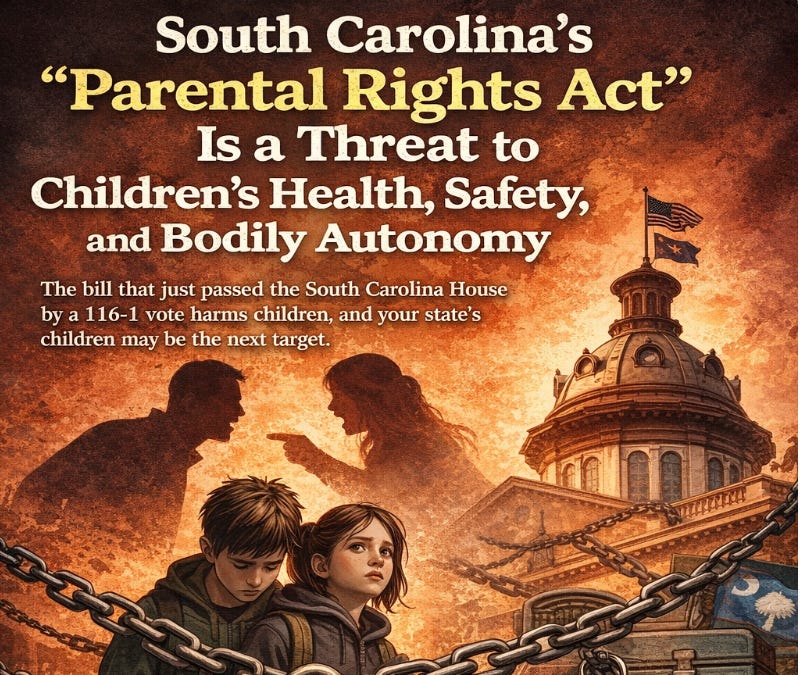
The South Carolina House has passed H. 4757, the so-called “Parental Rights Act.” The legislation now moving to the Senate fits a well-worn pattern: lofty language about the “fundamental rights of parents,” wrapped around provisions that strip children of privacy, cut them off from trusted adults, and erode legal protections that exist in states across this country specifically to keep young people safe.
Each iteration of these bills threatens children as the property of parents and ignores their voices, concerns, and issues of importance to their own bodily autonomy.
The bill passed the South Carolina House on February 19, 2026, by a vote of 116 to 1. Only one legislator – Republican Rep. Rob Harris of Spartanburg County – voted against it because he thought it did not go far enough.
Every present-and-voting Democrat supported the bill after amendments were made. That near-unanimity should not be mistaken for consensus that the bill is good for children. It reflects the political traps that child advocates know all too well:
-
Getting a few positive concessions results in legislators yielding to language that is likely a fait accompli anyway – some improvements are better than none.
-
When a bill is called a “parental rights” bill, voting against it may mean handing a political opponent a thirty-second attack ad.
We have seen this movie before. The question is what it costs children when the credits roll.
H. 4757 has two major components: an education title and a health care title. Both are disturbing.
Overall Frame
Section 59-28-320 of the bill declares that “the liberty of a parent to the care, custody, and control of the parent’s child, including the right to direct the upbringing, education, healthcare, and mental health of the child, is a fundamental right.”
That phrase is not symbolic. It is sweeping.
In constitutional law, labeling something a fundamental right triggers strict scrutiny – the highest level of judicial scrutiny.
The bill also proclaims any government actions affecting that right must serve a compelling state interest and be the least restrictive means of achieving it. That is an extraordinarily demanding standard.
The fundamental rights of children and respect for their concerns and interests are gutted by this language. Furthermore, the legal doctrine of parens patriae, in which government plays a critical role in protecting children from harm is greatly diminished.
The practical effect is that schools, child-protection systems, and health care providers may face legal challenges whenever they attempt to act in a child’s best interests in ways that conflict with parental wishes. This is a major legal escalation – a one-way ratchet that invites litigation against educators, counselors, and child-serving institutions. And it makes everything that follows in the bill harder to fix, even when harm to children becomes apparent.
The Education Title
The education provisions create a sweeping framework of parental control over public schools. Under the bill, every local education agency (LEA) would be required to develop a parental rights policy granting parents access to all curriculum, teacher-training materials, and counseling records. Parents would need to give affirmative consent with at least five days’ notice before a child can participate in any instruction that touches on “gender roles or stereotypes, gender identity, gender expression, or sexual orientation.”
Parents could also pull children from extracurricular activities they find objectionable. And school employees would be prohibited from “knowingly withholding” from a parent any information “relevant to the physical, emotional, or mental health of the child, including any request by a child to be treated in a manner that is inconsistent with his or her sex.”
A student who confides in an educator or school official about something they do not feel they can tell their parents or caregivers, including that they do not feel safe at home, could have their confidentiality effectively stripped away. The school official could be legally required to report it to the parent.
South Carolina law already requires notification if a student requests to be addressed by a different pronoun or asserts that their gender is inconsistent with their sex at birth. H. 4757 extends that logic further.
The result is that school, which is sometimes the one safe place in a young person’s life, becomes a surveillance apparatus for parents who may be the very source of the danger. School counselors and nurses, who build trust with young people as a prerequisite for providing any effective care, would be forced to operate as parental informants.
Trust, once broken, cannot easily be rebuilt. And for a teenager with an abusive or hostile home environment, that broken trust can be the difference between seeking help and suffering in silence.
This is not hypothetical. The Network for Public Health Law documented in January 2026 how similar laws have already upended school nursing across the country. When nurses must consider which topics must be reported to parents, whether counseling notes are subject to disclosure, and whether they should “encourage a student to stop discussing an issue at school” — particularly discussions about sexual health and gender identity — the care relationship is compromised. Children lose access to trusted adults at exactly the moment they need them most.
It is also worth noting what the bill does not do. Read through the full text and you will find extensive protections for parental access, parental consent, parental objections, parental lawsuits, and parental damages.
Nowhere in the legislation do you find parallel language protecting the best interests of the child, the voice of the child, the developing maturity of adolescents, the privacy interests of young people, or the professional judgment of educators and clinicians. The structure of the law makes clear that when parental preference conflicts with child welfare, school judgment, or adolescent medical needs, the presumption runs toward parental power. That omission is not accidental. It is the philosophical core of the problem.
The Health Care Title
The health section in H. 4757 is even more alarming.
The bill asserts that parental rights include making decisions “without obstruction by or interference from the State” of matters such as “making and consenting to all physical and mental healthcare decisions for the child” and “accessing and reviewing all health and medical records of the child,” short of a “parental action or decision that would end life” or “prevent death or imminent, irreparable physical injury to the minor.”
Does this mean that an unemancipated teenager who has a baby controls all aspects of that newborn’s life but has to get parental consent for their own care? Can a child abuser access the child’s medical record and deny consent to a child’s treatment before a child abuse investigation has been formally launched? Does a child have to wait – while a parent is located and reached –before being treated for a broken bone? Can an athletic trainer wrap a child’s ankle to protect the child from being injured without parental consent? If parents disagree, is the default non-treatment? Can a parent force a child to do something against the will of a child, such as conversion therapy?
Under current South Carolina law, a minor who has reached the age of sixteen may consent to important health services without parental involvement. That law has existed for good reason. Adolescent access to confidential health care is a cornerstone of adolescent health policy.
It is why teenagers, under current law, can get tested for a sexually transmitted infection (STI), seek mental health care, receive substance abuse treatment, and obtain reproductive health services without being forced to disclose sensitive information to a parent who may react with violence, rejection, or other harm.
H. 4757 would repeal that law. It would also repeal two companion statutes: one that allows health services to be provided to minors of any age without parental consent when a health care provider determines such services are necessary, and another that makes consent by a minor not subject to being voided once they reach adulthood.
Under the new framework, virtually all health care for anyone under 18 would require parental consent, except in true emergencies, prenatal care for those 14 and older, prehospital care, and first aid. And the scope of what triggers the consent requirement is broader than it might first appear.
The bill requires parental consent before “procuring, providing a referral for, or rendering healthcare” to a minor. That word “referral” matters. The bill does not merely regulate treatment – it includes the act of helping a young person navigate the health system at all.
Imagine a school nurse or counselor who learns that a student may be experiencing sexual assault, severe depression, suicidal thoughts, or family violence. Under the bill’s language, even suggesting that the student seek outside help could be interpreted as a referral requiring parental consent. Faced with that legal uncertainty, many professionals will choose the safest course: say less, do less, refer less.
For adolescents in crisis, delay is not neutral. Delay is often the harm.
The “emergency” exception is also far narrower than it sounds – defined as situations where it is necessary to prevent death or “imminent, irreparable physical injury.” That standard is dangerously inadequate for the full range of serious adolescent health situations.
Suicidal ideation, escalating eating disorders, abusive relationships, severe anxiety, pregnancy complications, and sexually transmitted infections may all require immediate intervention long before they meet the threshold of imminent catastrophic physical harm. A statute that waits until a child is standing at the cliff’s edge before permitting care is not child protection. It is cruelty dressed in the language of family values.
The state’s own fiscal impact analysis is striking. The Department of Public Health told the legislature that complying with the bill’s parental consent requirements would violate federal Title X funding requirements, which prohibit mandatory disclosure to parents for family planning services. The estimated consequence: the loss of approximately $5.1 million in federal Title X funds, the elimination of 74 positions, and the loss of access to 340B pharmaceutical pricing — an additional $3.1 million hit. Total estimated cost just to the Department of Public Health: approximately $17.7 million per year to maintain current service levels. That is not a fiscal footnote. That is a policy alarm.
Every time one of these bills comes up, its supporters point to ideal parents: devoted, attentive, loving adults who simply want to be involved in their children’s lives and decisions. And of course, this is the case of the vast majority of parents. Nobody disputes the importance of engaged, caring parents in the lives of children.
But Samantha Godwin’s insight – the one I return to again and again, and the one at the top of this post – is exactly right. We do not write laws for ideal behavior. We write laws that must hold up when the people subject to them are the worst-case actors, not the best-case ones. And the “worst parent” problem is not rare or hypothetical.
In South Carolina, as in every other state, there are parents who abuse their children. There are parents who would use mandatory parental notification about a child’s gender identity as an opportunity for violence or rejection. There are parents who, when notified that their teenager sought reproductive health care, would remove that teenager from care entirely. There are parents who would use access to a child’s counseling records – records created in a confidential therapeutic relationship – to punish the child for what they disclosed.
The bill pays lip service to this reality. It includes a carve-out noting that nothing in the education section is meant to be used to abuse or neglect a child, and that DSS and law enforcement are not obstructed. But these safeguards are structurally inadequate.
A mandatory disclosure requirement does not pause while DSS investigates whether a particular home is safe. A prohibition on school employees withholding information from parents does not include an exception for “except when the parent is the threat.” The harm occurs before any investigation begins.
This is the “organized abandonment” dynamic I have written about throughout this Substack. First, we remove the scaffolding of support from around vulnerable young people – the trusted school counselor, the confidential healthcare provider, the legal right to seek care without parental involvement.
Then, when things go wrong, we express shock that children did not seek help. The system was specifically redesigned to make help harder to reach.
As I documented in “From Idaho to Texas to Florida“ and “The Dark Side of Parental Rights Laws,” this playbook has been road-tested across the country, and the results have been consistently harmful to children.
In Texas, SB 12 was written so broadly that school nurses were prohibited from applying a Band-Aid without documented parental consent. The lawmakers who wrote the law later urged school nurses to use “common sense,” which is a remarkable instruction to give to healthcare professionals facing potential license revocation. Texas eventually clarified what counted as “general caretaking,” but only after the chaos that broad, ideologically-driven drafting created was already in motion.
In Idaho, parental rights laws have enabled parents to deny children life-saving medical treatment on religious grounds.
Idaho’s 2024 “Parents’ Rights in Medical Decision-Making Act” SB 1329) went further and failed to protect minors, who are victims of rape or incest, from having to obtain parental consent – potentially from the very abuser – before receiving a sexual assault exam or rape kit.
That same law limited 988 suicide and crisis hotline operators from serving or following up with adolescents without parental consent.
Numerous problems with Idaho’s “parental rights” bill have been raised since its passage in 2024. news reports by KTVB, Idaho’s news Channel 7 in Boise had the following four news exposes on the failures of the State’s “parental rights” law.
After two years of tragic circumstances that threatened many aspects of the health of children and youth caused by Idaho’s sweeping parental rights law, the legislature is considering a bill, HB 860, by Rep. Barbara Ehardt, that attempts to do a significant cleanup of current law failures. The following KTVB video reports on this past week’s public hearing on the legislation.
According to the Idaho Capital Sun, the new bill seeks to:
-
Clarify that the law should not be interpreted to prohibit providing non-emergency first aid to a child that appears sick or injured, such as dressing a minor wound or applying a topical ointment.
-
Allow treatment to address “a serious bodily harm” or prevent “serious physical illness or injury.”
-
Add new requirements for receiving blanket consent for care from parents.
-
Allow certain treatment and examinations related to an allegation of a crime against the child, or to collect evidence of an alleged crime when the collection is time-sensitive, such as a sexual assault case.
-
Allow the 988 Crisis and Suicide Hotline to provide immediate services, and if the child is experiencing suicidal ideation, allow the hotline to do a follow-up call.
-
Allow diagnosis of pregnancy, prenatal care, and peripartum care (but not to include abortion care).
Although South Carolina’s bill does not go as far as Idaho’s 2024 bill, the South Carolina legislation’s repeal of adolescent medical consent law, combined with its mandatory disclosure provisions in schools, follows the same disturbing logic: children are property to be governed by parents. Their independent interests, their safety, and their need for trusted relationships with adults outside the home are subordinated to the absolute authority of the parent.
South Carolina’s bill will create many of the same problems that Idaho’s “parental rights” bill did.
That is not a family values framework. It is a “childism” framework, which is the systematic devaluation of children as rights-bearing subjects that deserve protections and safeguards in the law.
Supporters of H. 4757 in the South Carolina House explicitly cited Mahmoud v. Taylor, the U.S. Supreme Court’s 2026 decision holding that parents have the right to opt their children out of public school lessons that conflict with their religious beliefs, including LGBTQ-themed curriculum. State Rep. Jordan Pace, chairman of the South Carolina Freedom Caucus, called H. 4757 “a clear extension of that ruling.”
It is worth being precise about what Mahmoud did and did not say. The Court held that parents whose religious beliefs were burdened by mandatory exposure to certain curriculum could opt their children out. It did not hold that children have no independent rights. It did not hold that school counselors must report every private conversation with a student to parents. It did not hold that states must strip sixteen- and seventeen-year-olds of the ability to consent to their own health care. H. 4757 goes well beyond what Mahmoud required or even suggested.
Moreover, as the Network for Public Health Law noted, federal law already provides robust parental rights protections through Family Educational Rights and Privacy Act (FERPA) and the Protection of Pupil Rights Amendment. The state-level legislation being passed across the country is not filling a legal vacuum – it is using the “parental rights” frame to advance a specific ideological agenda that goes far beyond what existing law requires.
H. 4757 now heads to the South Carolina Senate, which is debating its own parental rights bill. Before proceeding, South Carolina should carefully examine the lessons from history, including:
-
Why have at least 35 states passed “mature minor” laws
-
How “parental rights” laws in Idaho, Texas, Florida, Tennessee, and other states have created enormous problems for the health of children and present a cautionary tale (see links at the end of the blog)
-
The results of a 2025 study showed “…we found a near or clear majority agreed with adolescent consent for preventive, reproductive, and mental health care. Taken together, the need for legislation that protects adolescent access to specific services would be in line with parental opinion and should be considered.”
There is still an opportunity to strip or substantially modify the most dangerous provisions of the South Carolina law. The South Carolina Senate should consider, at a minimum:
-
Restore meaningful adolescent medical access to care, including the existing right of 16- and 17-year-olds to access health care without parental involvement. The repeal of this long-standing protection is not required by any federal ruling, is not demanded by the public, and will demonstrably harm vulnerable teenagers.
-
Protect the confidential relationship between students and health professionals. Pediatricians, school nurses, mental health professionals, and counselors must be able to function as health care providers, not parental intelligence services. Any mandatory disclosure provision must include explicit safe harbor protections for situations where disclosure would place a child at risk.
-
Preserve Title X compliance. South Carolina’s own fiscal analysts have flagged the risk of losing more than $5 million in federal family planning funds. The Senate should take that warning seriously and ensure that any consent framework complies with federal program requirements.
-
Include children in the analysis. Legislation that will profoundly affect the health, safety, and autonomy of adolescents should be evaluated through the lens of the children it will affect. We should ask and honestly answer: “Does this keep children safe?”
In testimony before the House Judiciary Committee last year, a Texas pediatrician told lawmakers that, in the name of “parental rights,” child abusers were often left in the hospital room as decision-makers over their child’s health, including treatment for the abuse they inflicted:
In my extensive pediatric trauma experience at [Texas Children’s Hospital], I took care of dozens of children who suffered unfathomable abuse such as intentional starvation, cigarette burns, finger amputations, etc. I would find their abusers in their room the very next day. I did not go to CPS [Child Protective Services] because I never saw evidence that they actually protected children.
South Carolina’s “Parental Rights Act” is being sold as a common-sense protection for families. But when you read the actual text, follow the fiscal impact, understand the federal compliance issues, analyze the mandatory disclosure provisions, and consider the repeal of adolescent medical consent, what you find is a bill that fails children. The legislation narrows the circle of trusted adults around vulnerable children, removes confidential pathways to health care for teenagers, and bets everything on the assumption that every home is safe.
That assumption is false, and children will pay the price.
Professor Godwin is right. The law must account for what the worst parents can get away with — not just celebrate what the best parents do. H. 4757 fails that test.
-
Contact your state legislators to urge them to protect the fundamental rights of adolescents.
-
Share this post to spread awareness about the needs and problems facing children with these “parental rights” bills being promoting in states across the country
-
Subscribe to Speaking of Kids, and please consider upgrading to a paid subscription, because kids can’t vote, but with your support, we can help advocate for them.
-
Join us as an Ambassador for Children and help raise the problems and needs of kids to the attention of lawmakers.
For more on this topic, see previous Kids Can’t Wait posts:
Source link
