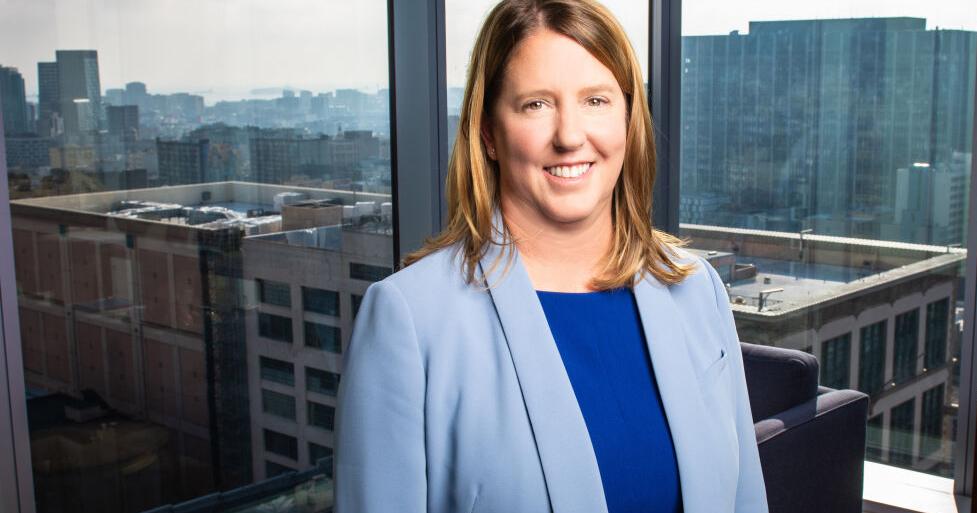
In June Hollie Seeley became the CEO of Sutter Health’s California Pacific Medical Center. She previously served as CEO of Sutter Medical Center in Sacramento.
Spencer Brown
Running a major health care organization is not for the faint of heart. And Hollie Seeley, CEO of Sutter’s California Pacific Medical Center, is not faint of heart.
Seeley, a former flight nurse in Colorado, was once buried in snow for almost 30 minutes to practice avalanche rescue techniques and routinely performed critical care interventions in high-pressure, resource-limited environments. She is also a 10-time marathon runner and has recently taken up rowing on Lake Merced.
Since her time as a flight nurse, Seeley has mostly stayed on the ground, working as a hospital executive. Most recently, she served as CEO of Sutter Medical Center, Sacramento. In June of this year, Seeley was appointed CEO of CPMC, prompting her move to San Francisco with her wife, Ashley Seeley, and two children. In her role, Seeley oversees the program expansion and construction of a $442 million neuroscience complex at its Mission Bernal Campus.
Seeley, a former flight nurse, with pilot Jessy Fontes, area manager for the Eastern Colorado North Central Region with Air Methods
I had the opportunity to sit down with Seeley in her office on Van Ness overlooking her adopted city. We talked about her vision for the future of CPMC, AI and health care, and her first impressions of the City by the Bay.
You worked as a nurse for nearly two decades in emergency and trauma services. Tell me about your journey from nurse to health care executive. Thanks for recognizing that work because I actually think it makes me a much better leader, that I was at the bedside for 18 years. Ten of those years was as a Flight for Life nurse. So I flew around in helicopters in Colorado, rescuing people mostly on the side of a mountain, the side of a road. We did some hospital-to-hospital transfers as well, but all the adrenaline-seeking care that you could want.
That sounds very intense. It’s the top of its class as far as nursing’s concerned. We are trained to do everything an emergency room physician could do, so intubations, chest tube, central lines, and you were doing it in the open environment often.
I did that for 10 years and loved it. After that I decided to get into administration and became an ER director. As an ER director, I loved the finances so I got my MBA and then [ran a] flight program, which was one of the highlights of my career. I was able to take that flight program — not the one I flew with as a nurse, but another one — [that] had lost money for 30 years, and I made $25 million in four years.
Wow. Then the opportunity was: What do you want to do next? I said I wanted to be a CEO. And [employer at the time] said, “Oh, I’m sure you want to be a chief nurse.” I said, “No, I actually want to be the chief executive because as a CEO you can impact nursing as well.” So that was how it all evolved.
What led you to Sutter Health? What drew me to Sutter was the vision of where Sutter’s going and the mission: patients first and people always.
How do you think your clinical experience has informed your leadership approach? I played a lot of sports growing up — being on teams, being the captain of teams. When you’re at the bedside, everyone’s focus is the patient, and everyone works as a team to make the best outcome for the patient. So I take that kind of philosophy and style into leadership. We have every type of role you can have in a hospital. You have people cleaning, you have people cooking, you have people managing the money and then, of course, you have doctors and nurses. But everyone needs each other to be successful, so that philosophy of, we’re a team and we’re here to always take care of the patients first, I think resonated throughout my athletic career and then the clinical career and now as a leader.
Seeley spent 10 years as a Flight for Life nurse in Colorado.
What is your vision for CPMC over the next three to five years? We talk a lot about access, access to care. And I came from Denver, Colorado, where there were a lot of hospitals, and we were all trying to earn business, earn the patients. Here, in California, [it] is something very different. The patients need care. The more efficient we can be, the more patients [we] can care [for], and that’s something we work on all the time. … Access to quality care is a priority.
Sutter is investing heavily in mental health and neuroscience. What excites you about that kind of expansion, and how are you preparing the organization? Both are top of mind. Mental health, we’ve all seen the impact, and I think COVID accelerated some of the impact on behavioral health. So we’re looking at where we need to expand bed access for behavioral health. We have an 18-bed behavioral health unit at the Davies Campus. We’re looking at possibly building more inpatient capacity. We’re also looking at how we do outpatient and maybe intensive outpatient care for behavioral health.
As far as neuroscience, the investment in the CPMC Mission Bernal Campus … Sutter Health is making a bold $442 million investment to improve brain health for patients in San Francisco. The complex [expected to open in 2028] will unite care delivery, advanced diagnostics and research in one location.
How do you balance financial sustainability with keeping care affordable and accessible? That must be a very difficult tightrope you’re constantly walking. I think everybody probably thinks that what they do is the most difficult, but I really do think health care is very difficult. And you learn a lot. I have my MBA. A lot of the rules that apply in the business world don’t apply in health care. I say it’s the only business where you can come in as a patient and I, as a hospital, treat whatever you need — without questions. I don’t know what you’re going to pay me, and you don’t know what I’m going to charge you. But all of that interaction happens first and then we settle it on the backside. So it’s not easy to plan for that. … But I’ll say this, one thing that I love about [Sutter Health], when we report on our pillars — patients, service, quality — finance is always at the end. Our slogan is, if you take care of everything else right, the patients first and our people, our staff, the finances will come.
How is CPMC embracing new technologies like AI to improve patient care and outcomes, and what other patient-centric tools are you excited about? This is an area [in which] I think Sutter outperforms and excels, and it’s because of our CEO Warner Thomas. He says that we are small enough to be able to trial AI and technology in a way other companies can’t, yet big enough that you can trial it at scale to see what the outcomes are. So we are on the forefront, I think, of AI and we are very open to collaborating with different companies on products and trialing things to see what the outcomes are.
Spouses Ashley and Hollie Seeley are raising two children in their new home city of San Francisco.
I was an ER director, gosh, 20-plus years ago, and thought if we could only narrate our care as a nurse. I could come into your room, I could tell you what I’m doing. You would then know, as a patient, and then the phone would capture it and chart it for me. I said this years ago. They’re doing that now. We have partnered with Abridge. So our primary care physicians will look at you and do your exam, and then the computer captures it, so they’re not spending hours and hours charting. So those are the kinds of things that we’re looking at — what enhances clinical care.
And Warner challenges us every day: “What do you do that’s mundane? What do you do that you’re like, why am I doing this, why does it take so long? How do we introduce AI to help us with that?” So I think it’s really endless possibilities as long as we do it safely and we keep the patients first.
The price of health care is on everyone’s mind. What accounts for the exponential increases in health care costs? And what, if anything, can be done about it? That’s a great question. I think there are multiple inputs into the cost of health care. You’ve got pharmaceutical prices, you’ve got insurance costs, and then the cost of doing business at a hospital because of regulatory [requirements] is way higher than anything I’ve ever seen. With the seismic rule of 2030 [for earthquake safety], all the hospitals have to be seismic compliant. Like you can’t hang anything on a wall that is more than 20 pounds. So if we want to hang any equipment or do any of the work, the cost that it takes to do that is way higher than it would be for you to remodel your home or do construction on a business that’s not a hospital. Then there’s labor costs, especially since COVID.
So you put all of the inputs in one and that’s why you get the costs that go directly to, well, to insurance companies and then some to the patients. You’ve got to get everyone willing to give a little … then we’ll get somewhere. But I haven’t seen really one sector step up and say, we’ll give a little bit back. And I think there’s a lot of opportunity. It costs too much; it doesn’t have to cost that much.
Seeley and her children
If you could remake one aspect of the American health care system from scratch, what would it be? Ooh, that’s a great question. You know what, I think if I could do one thing, there would have to be a level of quality provided to the patients — because quality isn’t equal.
In an ideal world, wouldn’t it be wonderful if everyone had access to preventative, primary care? Yes. That’s one thing Sutter Health is going all-in [on] in San Francisco. I was in Sacramento, the primary care world was built out, it was great, and it worked seamlessly with the acute care facility. Here in San Francisco, we have a lot of hospitals, but we don’t have a lot of primary care. We don’t have a lot of urgent cares, so that’s something that is a priority for Sutter and Warner Thomas. We’re expanding access by opening urgent cares. We opened our first in the Financial District [in November]. We’re opening an urgent care on the old Pac[ific] Campus [in Presidio Heights]. I think we have eight to 10 urgent cares planned. Some people say, “Well, that’s not primary care.” A lot of the younger generation, that’s their primary care. They don’t go to a doctor. They don’t want to wait for an appointment. So that’s what the urgent cares are for, same-day easy access.
Your job is obviously stressful, 24/7. How do you relax and recharge? How do I relax? That’s a good one. I should learn to relax more. I keep telling myself that I’m going to journal, I’ll start that. But I love to cook. … When I’m stressed or when I actually want to relax, I do a lot of cooking. And then I’m learning to row. The one thing that’s different about Denver and California, there’s a lot of water, so I’ve always wanted to row. I’m learning how to scull, so the single-boat sculling. … When you’re on the water, all you can think about is the technique …. [when] you’re outside, in nature, I don’t think about work, which is really helpful. So that’s been amazing. And then I like to work out on a regular basis.
I read that you’re a runner. I used to run a ton. I have a neck injury. As a flight nurse, I wore a helmet and then with night vision goggles you’re bending over for hours in the helicopter. And then I got in a car accident, so I can’t run anymore. But I’ve run 10 marathons.
You’re new to San Francisco, so tell me, what do you love about your new home city? I love the food here. I’m at the Ferry Building every weekend, going to the farmers market. I love the water. I wake up and I can see the Bay, just a sliver, but I can see it. I’m like, “Wow.” The Bay Bridge, living in a big city, with the culture. I like the diversity too. And the people … have been very welcoming. The hardest part is deciding what to do because there are so many things to do!
This interview has been edited for clarity and length.
Digit is a versatile content creator with expertise in Health, Technology, Movies, and News. With over 7 years of experience, he delivers well-researched, engaging, and insightful articles that inform and entertain readers. Passionate about keeping his audience updated with accurate and relevant information, Digit combines factual reporting with actionable insights. Follow his latest updates and analyses on DigitPatrox.