

The news over the past week has included significant discussion about whether the U.S. Department of Homeland Security — specifically, U.S. Immigration and Customs Enforcement — is violating federal court orders.
The short answer is: Yes.
The longer answer is: Yes, it’s happening, though it appears to be caused by a variety of factors and is a problem of the Trump administration’s own making, but initial non-compliance does appear to — for the most part — get resolved when a judge puts their foot down.
The longer answer does suggest that the current situation is dire. It’s not at all how things should work and it is not a sustainable system, but that does — at least in areas where a lot is happening quickly — appear to be what is happening.
As was seen in court on Tuesday.
Fox News 9’s Paul Blume reported that an attorney working with the U.S. Attorney’s Office in Minnesota told U.S. District Judge Jerry Blackwell on Tuesday, “I wish you would just hold me in contempt of court so I can get 24 hours of sleep.”
Julie Le’s comments came as Blackwell, a Biden appointee, was asking about “non-compliance with orders.“ Blackwell was not the first judge in Minnesota to do so, and he almost certainly won’t be the last.
Le — representing the federal government in court — told Blackwell, “The system sucks, this job sucks, I am trying with every breath I have to get you what I need.“
To understand what this means, though, we have to take a step back before we can move forward.

Like senior DHS officials unilaterally decided in May 2025 that ICE was going to change its interpretation of the Fourth Amendment when it comes to entering private residences when trying to arrest people for deportation, DHS and the Justice Department announced internally on July 8, 2025, that the executive branch unilaterally decided — “revisited its legal position“ — about how a key aspect of immigration enforcement works.
In short, the administration decided that anyone in the country who was never legally admitted to the country is subject to a section of law that requires mandatory detention, as opposed to a different section of law that allows release and requires bond hearings.
Here’s the problem with that: Virtually everyone thinks they’re wrong, for many reasons.
One key ruling addressing this claim — from U.S. District Judge Lewis Kaplan in the Southern District of New York — summed things up quite well, on two fronts:
This is not the first time the administration’s change of heart has been challenged in court. By a recent count, the central issue in this case – the administration’s new position that all noncitizens who came into the United States illegally, but since have been living in the United States, must be detained until their removal proceedings are completed – has been challenged in at least 362 cases in federal district courts. The challengers have prevailed, either on a preliminary or final basis, in 350 of those cases decided by over 160 different judges sitting in about fifty different courts spread across the United States. Thus, the overwhelming, lopsided majority have held that the law still means what it always has meant.
Kaplan noted that “none of these decisions by other district judges is binding here,“ and he went on in his decision — issued on the day before Thanksgiving 2025 — to make his “own independent assessment” of the law in the case before him.
He found that the government’s argument failed as to “the ordinary meaning of the statutory text,“ that “[t]he structure of the statute thus undercuts or contradicts their position,” that the “statutory history reflects an unbroken chain of granting discretion to immigration authorities to release noncitizens pending final removal decisions,” and that court precedent was in agreement with the above. He also found the action violated due process.
In conclusion in the case of Sergio Alberto Barco Mercado, he wrote:
Requiring the detention of noncitizens like Mr. Barco would be inconsistent with how immigration law in this country long has worked, not to mention the rule of law and basic notions of due process. Respondents’ arguments otherwise are unprecedented.
Despite that and the literal hundreds of other decisions like it, DOJ and DHS were still making the same argument — and operating under the same (unilateral executive branch) belief — as Operation Metro Surge got underway in Minnesota.
In addition to the aggressive, unilateral detention change, the U.S. Supreme Court had also opened the gates to more aggressive immigration stops when it allowed racial profiling of Latino workers in low-wage jobs via a shadow docket order in a case out of California — a position that Homeland Security Secretary Kristi Noem has said the department believes (again, unilaterally) can be stretched ever further.
And, the unilateral Fourth Amendment changes — expanded further (and, yes, unilaterally) in a January 26 memo first reported by The New York Times on January 30 — have been utilized in Minnesota as well.
All of that has led to thousands of arrests during Operation Metro Surge — and hundred of habeas corpus petitions being filed by the lawyers of people challenging their detentions.
Those people and Minnesota’s judges operate under the Constitution and laws of the United States — and not what acting ICE Director Todd Lyons writes in memos — which has led to a complicated month for the lawyers addressing these requests.
Law Dork has identified 253 federal habeas corpus petitions filed in the month of January — 21 general habeas petitions and 232 “alien detainee” petitions — in the U.S. District for the District of Minnesota.
Law Dork identified only 6 habeas corpus petitions filed in Minnesota — all general habeas petitions — in the entire month of January 2025.
At the same time, the response to those petitions is coming from the U.S. Attorney’s Office that is being led by Daniel Rosen, a Trump appointee who had no prosecutorial experience before taking office in October 2025.
As Operation Metro Surge has worn on — most notably following federal immigration agents killing Renee Good and Alex Pretti, as well as the Trump administration’s responses to those killings and another shooting — and as the public opposition has spread, the office has taken many losses — including two large sets of resignations and departures thus far.
As Mother Jones’s Samantha Michaels reported on January 30, “The myriad frustrations of the staffers at the Minnesota US Attorney’s Office has fueled a new wave of departures from an office that was already hemorrhaging personnel.“
More cases, fewer lawyers.

As a result of Operation Metro Surge being carried out on the shaky foundation of these unilaterally changed legal positions, combined with the visible lawless activity from the federal immigration officers and the quickly disintegrating federal prosecutor’s office, habeas petitions are being granted — and often.
In one order issued January 14 in Juan Tobay Robles’s case, Chief Judge Patrick Schiltz — a George W. Bush appointee — noted that the habeas petition was filed on January 8 and a response was ordered to be filed by January 12.
“Respondents failed to respond by that date and have filed no response since,” he wrote. “The Court will therefore grant Juan’s petition to the extent of ordering that respondents provide him with a bond hearing“ under the permissive statute — finding that the mandatory detention provision does not apply to people already in the U.S.
Notably — and key to understanding why DOJ should have been prepared for this and for what followed from the chief judge — Schiltz highlighted that this question had been addressed previously.
“This Court recently held that, because such aliens are not ‘seeking admission’ [as required under the mandatory detention law], that provision does not apply to them,” he wrote — citing to a decision issued on November 25, 2025. That decision was issued by Schiltz.
And so, on January 26, when Schiltz was informed that Juan still had not been given a bond hearing — and noting that the Trump administration “decided to send thousands of agents to Minnesota to detain aliens without making any provision for dealing with the hundreds of habeas petitions and other lawsuits that were sure to result“ — Schiltz stated in an order:
The Court’s patience is at an end. Accordingly, the Court will order Todd Lyons, the Acting Director of ICE, to appear personally before the Court and show cause why he should not be held in contempt of Court.
Schiltz noted that “the Court will cancel the hearing and will not require Lyons to appear” if Juan was released before the scheduled hearing.
Juan was soon released.
In a January 28 order canceling the hearing, though, Schiltz was not done. He detailed “96 court orders that ICE has violated in 74 cases“ in Minnesota in January — attached as an appendix — and continued:
This list should give pause to anyone—no matter his or her political beliefs—who cares about the rule of law. ICE has likely violated more court orders in January 2026 than some federal agencies have violated in their entire existence.
Then, we now know, on January 29, federal prosecutors secured indictments in connection with an Operation Metro Surge-related church protest, and arrests were made — including of journalists Don Lemon and Georgia Fort — on January 30.
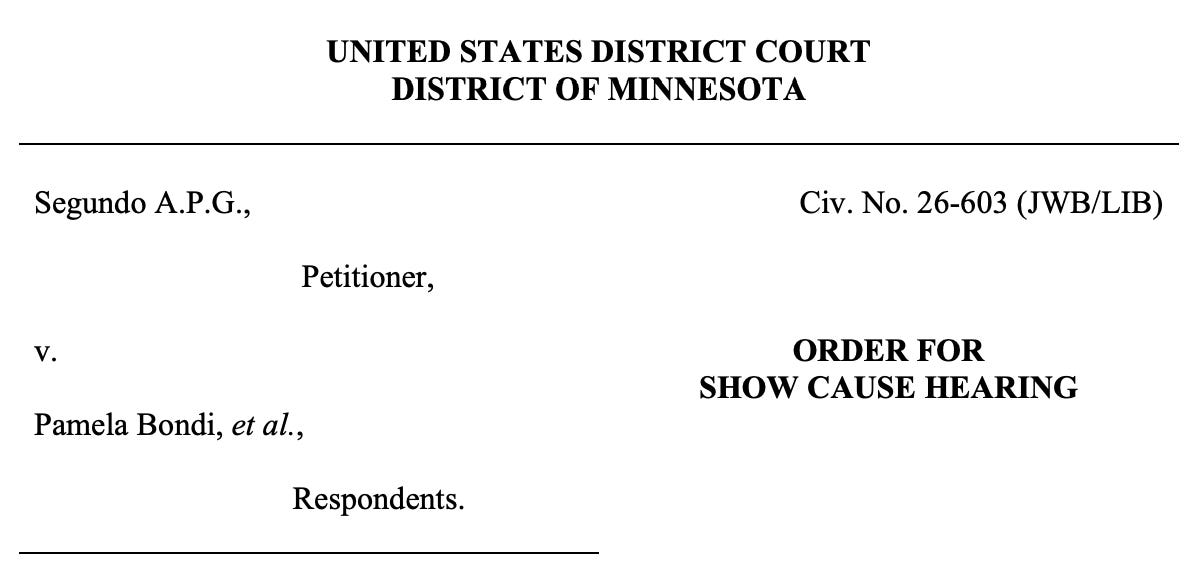
On Monday, detailing a series of missed deadlines in another habeas case, Judge Blackwell set another show cause hearing for Tuesday.
“These failures—particularly the failure to release the Petitioner—are especially alarming given that Respondents’ persistent noncompliance with orders in this District was extensively detailed just last week,“ Blackwell wrote — citing Schiltz’s order in Juan’s case — referencing four other cases in front of him as well.
Which brings us to Tuesday, and Julie Le’s statement to Blackwell that the “system sucks.”
Le, who one source told Law Dork is a Special Assistant U.S. Attorney, worked for ICE for less than a year prior to Operation Metro Surge. As a Special Assistant U.S. Attorney, Le likely would return to her prior role after the surge. To that end, and according to another source, Le’s signature block as recently as this week still identified her as “Assistant Chief Counsel; Office of the Principal Legal Advisor, Minneapolis; U.S. Immigration and Customs Enforcement.” Blume reported that she volunteered to take on the role “as habeas petitions started to flood into federal court.”
Despite, as NOTUS’s Jose Pagliery noted, Le having been assigned 88 habeas cases since joining the U.S. Attorney’s office, she is not an experienced federal court litigator, having only previously worked in immigration court in the federal government — which is a part of the Justice Department, not an actual court.
By Tuesday, she was asking a federal judge to hold her in contempt so she could get some sleep.
To be sure, there is little sympathy for the government lawyers in this position. And yet, it is important to see how — when these show cause orders are going out — it does appear that the lawyers are using those to get DHS, ICE, or whichever entity needs to act to act.
Le suggested as much on Tuesday, telling Blackwell, “I am trying with every breath I have to get you what I need.“ Multiple sources tell Law Dork that their experience with Le is in fitting with what she said in court on Monday.
As Matt Sepic noted in his report for MPR, “DHS had released all five [people mentioned in Blackwell’s Monday order] from custody starting on Jan. 17. The last to be freed, an Ecuadoran man, was released late Monday night.“
In several of those orders cited by Schiltz in his appendix review by Law Dork in recent days, there was a status report filed by DOJ in the days after the order — with nothing further on the docket. Although there could still be later follow-up filings to show continued non-compliance, that suggests to me that, as with Juan’s case, those initial orders are helping to get action.
As federal judges continue to take steps to get action, they will — if they don’t get results — eventually seek to figure out exactly where compliance is failing and why.
That will include determining whether non-compliance is based on orders from the top of DHS, ICE, or elsewhere in agency leadership (or from the White House); whether DOJ leadership is involved or pushing back; whether it is malicious or intentional non-compliance on the ground; whether it is incompetence or failures of staffing, communication, or training; or whether it is some combination of those possibilities.
None of that is good and none of it excuses non-compliance — especially when continued violations of people’s rights are at issue — but differences in answers would mean different things for how judges would respond and for how the public would need to respond.
Ultimately, Le’s comments on Tuesday are more of a sign of just how unsustainable the current administration’s policies and implementation of them are than the comments are any statement about Le herself.
Source link
