

The ‘Trump effect’ may test appeal of Europe’s far-right parties. Portugal shows how.
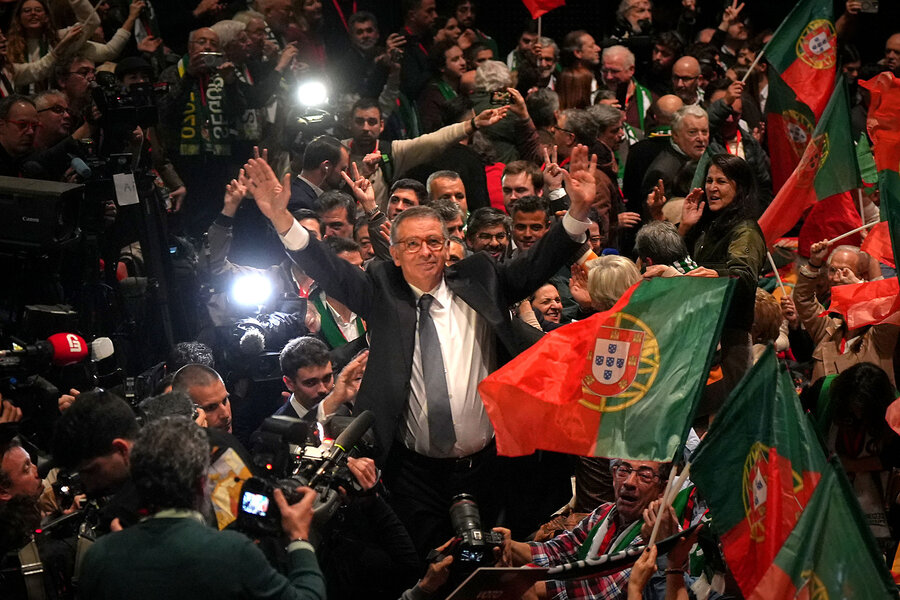
Portugal, at the southwestern tip of Europe, is perhaps best known to Americans as a delightful tourist destination. But this week, its voters delivered a message that has become increasingly rare: a full-throated rejection of one of Europe’s rising far-right populist parties.
Still, with Europe’s populist surge unlikely to recede, the wider significance of Portugal’s presidential election was to underscore a deepening divide between Europe and its traditional ally, America, over the continent’s political future.
This “Trump factor” has been a growing cause of concern for mainstream European leaders.
Why We Wrote This
Portuguese voters rejected the far-right presidential candidate in February, showing the potential limits of Donald Trump’s brand of far-right populism in Europe.
But the Portuguese election result could reinforce their hope that Mr. Trump’s polarizing effect will strengthen their hand and eventually slow the advances of the far right.
The Trump administration, as its recent National Security Strategy made explicit, views the anti-immigration nationalists as “patriotic” forces to be supported in a struggle to prevent Europe’s “civilizational erasure.”
For Europe’s mainstream politicians, they’re a threat – and not chiefly because of their calls to limit immigration, which even left-of-center leaders increasingly recognize as an urgent issue.
It’s because of the anger underpinning their message, the suggestion that only a root-and-branch overhaul can keep established parties and national institutions from betraying their citizens’ true interests and values.
The center-right mayor of Portugal’s capital, Lisbon, voiced this concern after Sunday’s election.
Carlos Moedas was among the conservative politicians who set aside partisan rivalries to support the Socialist candidate, António José Seguro, in his runoff with André Ventura, the charismatic leader of the far-right Chega party.
Mr. Seguro won nearly 67% of the the vote.
Yet Mr. Ventura’s one-third share established Chega as unchallenged leader of the country’s conservatives – a position held for years by Mr. Moedas’ Social Democrats.
And while Mr. Moedas welcomed the election as a demonstration that Portugal remained a “moderate country,” he told The New York Times that a “big question” remained: whether Europe’s leaders could find a way to defuse the anger driving many far-right supporters.
“It’s a worldwide trend,” he said, “and I hope we can stop it.”
The concern he and many European leaders have about the effects of unbridled anger, as well as the value they place on democratic stability, are rooted in a pre-World War II history, which they feel Mr. Trump has failed to comprehend.
The endangered “civilization” that Mr. Trump’s National Security Strategy suggests “patriotic” populists can reclaim was, in fact, a period of power struggles and war, culminating in two devastating world wars in the first decades of the 20th century.
The past eight decades of peace have been the exception, not the rule.
So, too, the steady expansion of democratic government across the continent since World War II, and not just in the defeated powers, Nazi Germany and Fascist Italy.
Portugal itself was governed for decades by the dictator António de Oliveira Salazar and his feared secret police, the PIDE.

It was only in 1974 that a group of young military officers, politicized by the army’s war against pro-independence insurgents in Angola and Mozambique, staged a coup d’état. It was nearly bloodless: the half dozen casualties came from PIDE gunfire.
Yet the political aftermath was messy, as I well recall from covering it as a young reporter. There were a series of attempted mini-coups as leftist and more moderate officers vied to set the political agenda. An army general, António Ramalho Eanes, led the moderates’ decisive takeover in late 1975, setting the stage for elections and democratic government.
The country led by Mr. Salazar was poorer and less developed than most other European countries. Yet democratic Portugal was also transformed economically, joining the European Economic Community, the precursor to today’s 27-nation European Union, in the 1980s.
It’s perhaps little wonder that despite the genuine grievances on which Chega has built its growing influence – including housing affordability, public services, and immigration – most Portuguese voters still seem to prioritize a stable democratic government.
Nor is it surprising that Chega has been drawing much of its support from young Portuguese, for whom the dictatorship, and the early months of the transition to democracy, are mere pages in the history books.
Chega might yet further widen its base of support.
In Italy, Giorgia Meloni, a right-wing politician with roots among postwar supporters of Fascist leader Benito Mussolini, has transformed herself into a prime minister working effectively within the country’s institutions and the EU.

In France, Marine Le Pen’s National Rally party – heir to the National Front headed by her father, a Holocaust denier – has long been hoping to chart a similar path.
Yet the effect of Mr. Trump’s support for such parties, as vanguards in a grand civilizational struggle for Europe’s future, remains unclear.
In Portugal, certainly, most voters seem leery of the anger and potential instability that scenario suggests. And Mr. Trump’s truculent approach to Europe in recent weeks – his push to take over Greenland, and his inaccurate suggestion that European NATO troops supporting the United States in Afghanistan had stayed back from the front lines – have not gone down well among Europeans.
He has not only angered centrist politicians.
He has unsettled political soulmates. A range of voices on the far right – including the National Rally, Britain’s Reform UK, and even Prime Minister Meloni – have criticized him.
And that could be partly due to what the opinion polls are saying: The number of voters across Europe who like the American president is small, and it’s been getting smaller.
So while the “Trump effect” could add impetus to their own version of MAGA nationalism, they will worry – and center-ground leaders will be hoping – it may tarnish their appeal with the voters they’re striving to attract.
Source link
