

This Nearby Earth-Sized Planet Could Answer Big Questions About Alien Worlds
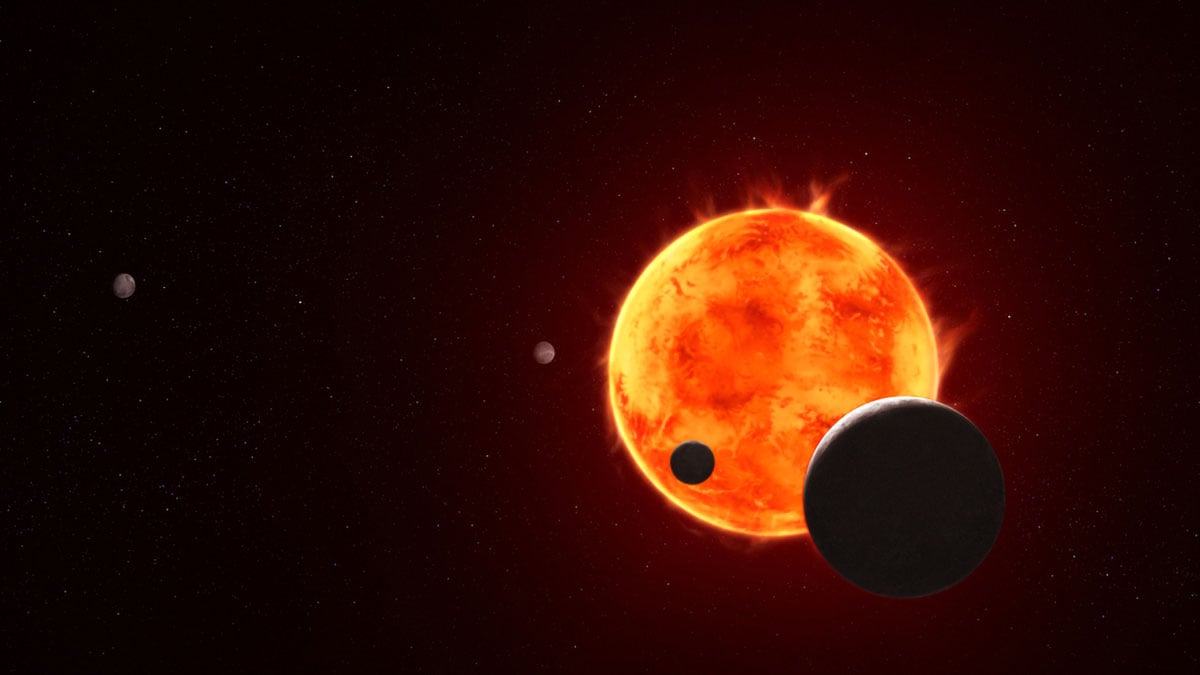
TOI-4616 b is an Earth-sized exoplanet orbiting an M-dwarf that offers a strong benchmark for studying atmospheric loss and planetary evolution.
Astronomers have identified a rocky exoplanet that may become an important reference point for future research. The planet orbits an M-type star, a class of small, cool stars that are extremely common in our galaxy. While rocky planets around these stars are also widespread, this particular world stands out.
Researchers say it could help scientists better understand similar planets and how their atmospheres behave. The study’s authors describe it as “a reference system for highly irradiated rocky planets.”
The new research has been submitted to the Monthly Notices of the Royal Astronomical Society. The lead author is Francis Zong Lang, a doctoral researcher at the Center for Space and Habitability at the University of Bern in Switzerland. The paper is currently available on arXiv.
Astronomers have confirmed more than 6,000 exoplanets so far, giving scientists a clearer picture of the variety of planetary systems beyond our own. Although observational biases still affect the data, certain patterns are starting to emerge. One increasingly clear trend is the close connection between M dwarf stars and rocky exoplanets.
M Dwarfs and Rocky Planet Abundance
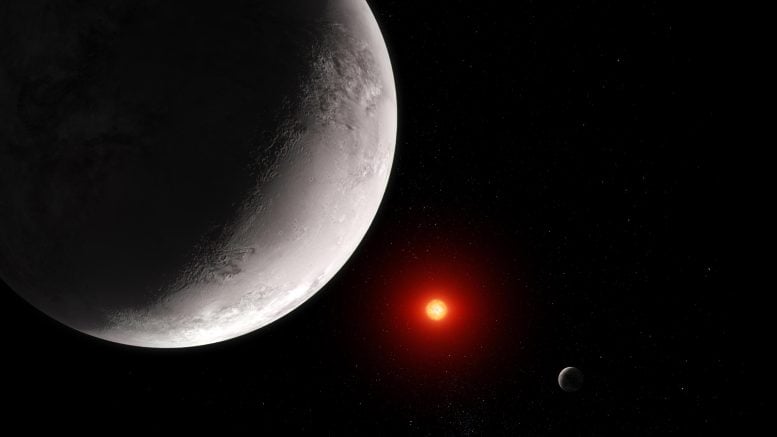
Studies indicate that M dwarf stars are especially likely to host terrestrial exoplanets. Many of these stars have several rocky planets orbiting them. A well-known example is the TRAPPIST-1 system, which contains seven rocky worlds.
These numerous rocky planets around faint stars provide valuable opportunities to investigate and better understand exoplanet atmospheres.
“Rocky exoplanets are particularly abundant around M-type stars,” the authors of the new research write. “Their small radii and low luminosities provide favorable conditions for detecting transiting terrestrial planets and probing their atmospheric properties.”
Discovery of TOI-4616 b and Atmospheric Risks Around M Dwarfs
“We report the discovery and statistical validation of TOI-4616 b, an Earth-sized planet transiting a nearby mid-M dwarf observed by the Transiting Exoplanet Survey Satellite (TESS),” the authors write.
The thing about rocky planets around M-dwarfs is that they typically orbit very close to their stars. This puts them in atmospheric peril, as powerful radiation and flaring can strip their atmospheres away. It’s even worse. M-dwarfs take up to 1 or 2 billion years to reach the main sequence. Before that, their luminosity is much higher, putting additional dissipative pressure on the atmospheres of any rocky planets orbiting them.
There’s some good news for these atmospheres, though. While primordial hydrogen-rich atmospheres are easier to remove, thicker atmospheres dominated by CO₂ might resist dissipation. Secondary atmospheres could also form through volcanism and outgassing long after the star has entered the main sequence. It’s also possible that a strong enough magnetic field can help a planet retain its atmosphere.
Atmospheric Complexity and Need for Benchmark Systems
So there’s a lot of complexity around these atmospheres, and no clear conclusions. More study is the answer, and part of that is the ability to compare the atmospheres of these planets to a benchmark.
That’s what makes this discovery important.
“Owing to its proximity to Earth, well-constrained stellar properties, and extensive multi-band follow-up, TOI-4616 b constitutes a valuable benchmark system for comparative studies of terrestrial planets around mid-M dwarfs and for future atmospheric investigations,” the researchers explain.
Stellar and Planetary Characteristics of the TOI-4616 System
TOI-4616 is about 91 light-years away. Its radius is about 0.1889 solar radii, its mass is about 0.1881 solar masses, and its temperature is about 3150 Kelvin. These are pretty typical characteristics for a cool, small M-dwarf.
The exoplanet, TOI-4616 b, has a radius of 1.22 Earth radii and an orbital period of 1.55 days. Its equilibrium temperature is around 525 Kelvin. “This places TOI-4616 b in a regime intermediate between Earth-sized planets orbiting early M dwarfs and those around ultra-cool hosts,” the authors explain. Like other planets in this situation, the bulk of its atmosphere may be long gone.
But the fact that its atmosphere is in peril is what makes it such an interesting exoplanet.
Extreme Irradiation and Benchmark Value for Models
“TOI-4616 b resides in an extreme irradiation environment for an Earth-sized planet orbiting a mid-M dwarf,” the researchers explain. “This makes it a particularly informative test case for models of atmospheric escape, interior composition, and volatile retention.”
It can serve as a benchmark for the study of terrestrial planets in these situations. The authors say it’s “well-suited for comparative investigations of planetary structure and evolution in the strongly irradiated regime.”
One of the reasons the JWST was built is to study exoplanet atmospheres. But not all M-dwarf Earth-like exoplanets are great targets for the space telescope. For many of them, we lack precise measurements of the star or are restricted to only a few transit measurements. And though all M-dwarfs are dim in comparison to Sun-like stars, they still vary in luminosity.
Observational Advantages and Long-Term Data Coverage
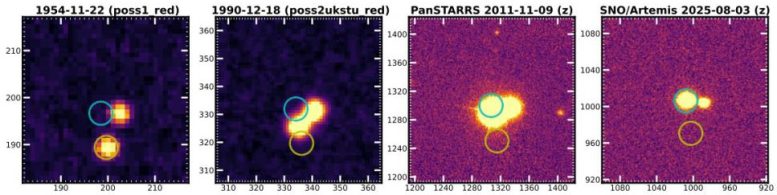
TOI-4616 is well understood because it’s been observed for so long. Archival data dates back to 1954, so that means that there are more than 60 years of data, though obviously, the most detailed measurements were taken well after the 1950s. PanSTARRS observed it in 2011 and SNO/Artemis in 2025. A host of other telescopes with different capabilities have observed it over the decades.
“The combination of precise stellar parameters, consistent multiband transit measurements, and the host star’s brightness makes TOI-4616 a particularly valuable system for future atmospheric and dynamical studies,” the authors write.
Reference: “TOI-4616 b: a benchmark Earth-sized planet transiting a nearby M4 dwarf” by F. Zong Lang, B. O. Demory, Y. Gomez Maqueo Chew, Y. Schmid, M. Timmermans, F. J. Pozuelos, M. Gillon, Artem Y. Burdanov, Benjamin V. Rackham, Didier Queloz, Keivan G. Stassun, Khalid Barkaoui, Amaury Triaud, Julien de Wit, S. Zuniga-Fernandez, A. J. Burgasser, Elsa Ducrot, Madison G. Scott, D. Sebastian, A. Soubkiou, M. Lendl, I. Plauchu-Frayn, U. Schroffenegger, Erik Meier V., P. Pedersen, A. Khandelwal, Roman Gerasimov, C. Aganze, Chih-Chun Hsu, J. M. Jenkins, Aishwarya R. Iyer, C. Watkins, C. A. Theissen, K. A. Collins, H. P. Osborn, A. Shporer, Claudia Jano Munoz, Toshi Suganuma, Norio Narita, Akihiko Fukui, F. Murgas, J. de Leon, Enric Palle, Yasmin Davis, D. Kitzmann, M. Pichardo Marcano and M. J. Hooton, 11 March 2026, arXiv.
DOI: 10.48550/arxiv.2603.10905
Adapted from an article originally published in UniverseToday.
Never miss a breakthrough: Join the SciTechDaily newsletter.
Follow us on Google and Google News.
Source link
