

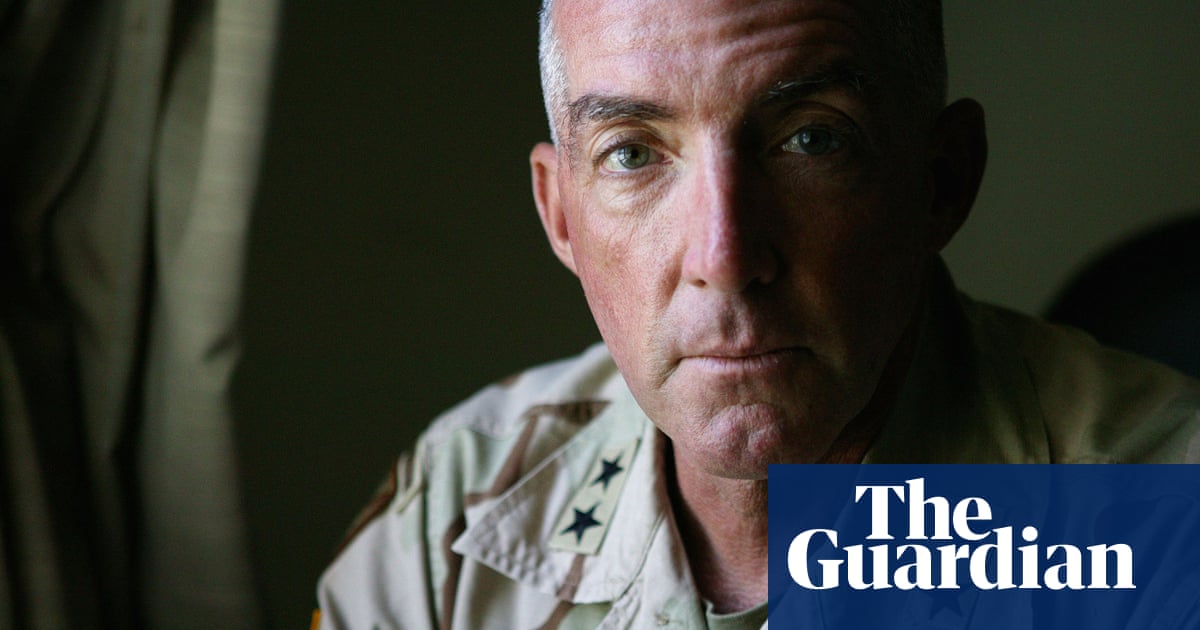
Donald Trump and his defense secretary Pete Hegseth are mounting an aggressive push to politicise the top ranks of the US military – a push that smacks of Stalinism and could take years to repair, the former infantry chief who trained troops to invade Iraq has warned.
Maj Gen Paul Eaton has sounded the alarm, saying in an interview with the Guardian that the effort to bend the higher echelons of the military to the US president’s will was unparalleled in recent history and could have long-term dire consequences. He warned that both the reputation and efficiency of the world’s most powerful fighting force was in the balance.
“There is an active effort to politicise the armed forces,” Eaton said. “Once you infect the body, the cure may be very difficult and painful for presidents downstream.”
He added that the actions of Trump and his chosen head of the Pentagon were putting the standing of the military as an independent entity, free from party politics, at risk. “As the phrase goes, reputation is built a drop at a time and emptied in buckets.”
Eaton, 75, has spent his entire life in military circles, including 37 years in active service. His father was an air force pilot whose B-57 bomber was shot down over Laos in 1969, when Eaton was 18.
Air Force Col Norman Eaton’s remains were found and identified in 2006.
Eaton himself trained at West Point, the US military academy in New York that trains commissioned officers, graduating soon after the end of the Vietnam war. He rose through the ranks of the US army to infantry chief and then, after the initial invasion of Iraq in 2003 was completed, was sent to that country to rebuild the Iraqi armed forces.
In recent years Eaton has been a sharp critic of Trump’s manipulation of military structures. In the summer of 2024 he participated in war games conducted by the Brennan Center for Justice thinktank, that sought to anticipate the then Republican nominee Trump’s most dangerous authoritarian moves were he to return to the White House.
Many of the actions predicted in those tabletop exercises – including politicisation of the military and other key government institutions, and deployment of the national guard into Democratic-controlled cities – have already come to pass under Trump’s second presidency.
In Eaton’s analysis, Trump’s first step towards compromising military independence was the act of appointing Hegseth as secretary of defense. The former Fox & Friends host had been an adviser to Trump and had supported his first presidential run in 2016.
“Hegseth not only swears loyalty to Trump, he swears fealty to Trump – whereas the military swears an oath to the constitution,” Eaton said.
Soon after Hegseth was ensconced in the Pentagon the firings began. Within a week of Trump’s inauguration the military inspector general who acted as an independent watchdog was dismissed, followed by the top military lawyers (judge advocates general) who advise on the laws of armed conflict.
Out, too, went the top officers. Charles Brown, chairman of the joint chiefs of staff, was ousted in February and replaced by Lt Gen Dan Caine who Trump claimed had express his love for the president and would “kill for him” (Caine denied ever saying such things). The top officers in the navy and air force were ditched in quick succession.
The Pentagon purge sent a clear and chilling message that reverberated throughout the military services, Eaton said. “Toe the line, or we will fire you. You’re in a different world now. This is Trump’s world, and by God, this is what we’re going to do.”
The dismissals also sowed doubt throughout the ranks. Would senior officers kowtow to Trump and his defense secretary? Or would they stand up for following the military rules of engagement?
Eaton said the effect reminded him of Joseph Stalin’s 1940s purges of the top officers in Soviet forces. “Stalin killed a lot of the best and brightest of the military leadership, and then inserted political commissars into the units. The doubt that swept the armed forces of the Soviet Union is reminiscent of today – they are not killing these men and women, but they are removing them from positions of authority with similar impact.”
The end result, Eaton said, was that “you’ve got a 1940s Stalin problem inside the American military right now”.
The furor over the lethal US military strikes on boats in Latin American waters is for Eaton a sign of the damage that is being wrought. The administration claims the strikes have been targeted on “narco-terrorists” who are in “armed conflict” with the US by bringing illegal drugs into the country.
The first of more than 20 strikes that have occurred took place on 2 September. It involved a controversial second strike that killed two survivors who had been clinging to the bombed wreck of the boat.
The Washington Post revealed that Hegseth had given an order to “kill everybody”. Under the Department of Defense manual on the laws of war, it is forbidden to order that every combatant must be killed irrespective of whether they pose a threat.
Eaton has no doubts about the illegality of the 2 September second strike. “It was either a war crime or a murder. So we have a real problem here. This decision looks a whole lot like a U-boat commander machine gunning victims in the water during world war two.”
Hegseth sought to drive home the new way of doing things in a bizarre summit in September in which he gathered military commanders to Quantico in Virginia. He berated them about so-called wokeness, liberal thinking, and the presence of “fat generals and admirals in the halls of the Pentagon”.
Anyone in the room who disagreed with him was encouraged to resign.
For Eaton, the meeting was “disgusting” and “antithetical to the US military. The senior leadership of our armed forces are sober people who do not speak in terms of fatness or ‘kill them all’ or ‘the gloves are off’.”
Looking ahead to 2026, Eaton is profoundly concerned that the violations of rules of war that have arguably been committed by the Pentagon outside US territory might soon become a reality domestically. The Trump administration has federalised national guard troops and sent them into numerous cities against the wishes of Democratic mayors and state governors.
The presence of national guard soldiers in Los Angeles, Washington DC, the Chicago area and other locations has been challenged in federal courts, where cases continue to play out.
In October Eaton took part in a delegation that included the organisation Vote Vets, to which he acts as an adviser, to see the Democratic governor of Illinois, JB Pritzker. The retired two-star general said they counseled Pritzker to stand firm in countering troop deployment to Chicago.
“We told him: you have a requirement to protect your citizens from federal assault.”
Eaton’s biggest fear is at some point a dramatic clash of forces might take place, with the federalised national guard facing off against state and local police. He conjured up the imaginary scenario of the Texas national guard being federalised – ie ordered out of state control into national control – and imported into Baltimore, Maryland, contrary to the city and state’s wishes.
“What could go wrong?” Eaton said. “You can very easily see an escalation in which both sides think they are right, obeying orders that they believe were given legally.”
Sooner or later, he warned, a “memorable event” was likely to take place. “There are going to be people getting hurt who really don’t need to get hurt.”
Source link
