

- Provo’s Rocky Mountain University of Health Professions offers dozens of graduate-level health care degrees.
- The school was founded over 25 years ago to meet the evolving needs found in the health care industry.
- University leaders tout the school’s high return of investment for graduate students pursuing high-demand jobs.
Rocky Mountain University of Health Professions President Cameron Martin is a higher education administrator by profession. He’s not a health care clinician.
But while Martin can’t teach a course in physical therapy or perform an eye exam at the school’s Provo campus, he knows firsthand the importance of lifesaving care delivered by well-trained professionals.
In his own words, Martin’s been on the business end of “medical miracles.”
Twelve years ago, he suffered a subarachnoid brain hemorrhage while exercising on a treadmill. Martin would spend a month in the ICU.
Meanwhile, his wife has endured a series of heart attacks.
“So we’ve had a history of medical challenges,” he said, wryly.
But for Martin, those life-threatening experiences now inform his leadership at the private, for-profit institution that focuses entirely on graduate-level health care education.
“I bring to the table the voice of the patient in the business discussions about what we do and the importance of how we do it,” Martin told the Deseret news.
“Let’s not lose sight of listening to the patient. Let’s not lose sight of seeing them.
“So, yes, why I am here is very personal. Not only do I believe in the school’s mission, but I’ve experienced it.”
A Sizzler booth and a school’s genesis

Rocky Mountain was founded more than a quarter-century ago by a pair of retired Navy health care professionals — Richard Nelson and Michael Skurja Jr. — and a Brigham Young University educator and coach, Larry Hall.
While sitting at a Sizzler restaurant booth and sketching possible graduate degree programs on paper napkins prior to the school’s existence, the founders asked themselves what needs were unmet in health care education.
And while they had no capital at the time, they shared a vision of training healthcare professionals and improving lives. So Rocky Mountain’s founders relied on personal resources in the school’s early years — drawing upon pensions and leveraging personal assets to get things moving.
As a for-profit private institution without the benefit of public dollars, the early school leadership took its operational cues from market needs. Those impulses still remain at the Utah County institution with a student body of approximately 1,700.
“You live and die by the market … and because we are self-sufficient, we are dependent upon it,” said Martin.

Rocky Mountain’s founders had to be innovative in their early operations by offering programs such as doctor of physical therapy and online instruction. Such elements are now commonplace. But at the time, said Martin, they were industry novelties.
Today, Rocky Mountain offers a variety of master’s degrees in programs such as medical science, speech-language pathology, nursing and occupational therapy. Meanwhile, the school’s doctoral degree programs include physical therapy, optometry, occupational therapy, nursing practice/family nurse practitioner and philosophy in health sciences.
The school also offers almost two dozen certificate options in fields such as nursing, counseling, occupational therapy and psychiatry.
Prioritizing student ROI at RMU

Today’s “higher ed-speak” includes academic acronyms such as Ph.D., M.S., MBA and now, perhaps more than ever, ROI … aka “Return on Investment.”
Unlike many other Utah higher education institutions offering graduate programs in health care fields, Rocky Mountain cannot draw public funds or financial support from a sponsoring institution such as Brigham Young University. So student tuition fuels RMU operations.
Again, said Martin, the market must always be respected.
Rocky Mountain is in the top quartile of costs compared to peer institutions, but the school opts to hold tuition flat for each student.
“So from day one, we can tell our students their total cost of attendance — whereas other institutions may have an annual escalation,” said Martin. “If we have to raise tuition, it will be on the next cohort. So our students know, beginning-to-end, what their costs are.
“That means our margins are razor thin.”
Plus, Martin added, resources are prioritized into the student learning experience. That makes for lean operations.
So while the furniture around campus may not be brand new, the trade-off, said Martin, is that Rocky Mountain U. students will graduate with the essential tools they need to succeed.
A former associate commissioner in the Utah System of Higher Education, Martin is quick to point to several key metrics that define the “RMU-ROI”: A 91% retention rate. An 87% graduation rate. And a 97% employment rate for graduates.
“And here’s a stat I love,” he added. “A zero percent cohort student loan default rate.”
Meanwhile, 77% of Rocky Mountain students are receiving federal financial aid. The remaining tuition costs are self-funding. “And, again, that’s why that tuition is so critical, and we’re watching that ratio very carefully,” said Martin.
“But (students benefit) because they’re earning a degree in a high-demand area that meets the workforce needs — and at typically a higher income than you would in other degrees outside the medical domain.”
Martin is also enthused about being included in the Wasatch Front’s medical education community. “We are looking and making developing partnerships with other institutions on the undergrad experience, marrying their strength with our strength.”

For example, Utah Valley University students can attend their first three years of undergraduate study at the public university in nearby Orem — and then during their senior year attend the school’s graduate programs.
“They can get into the market that much faster,” said Martin.
Meanwhile, the Rocky Mountain University Foundation operates as a registered nonprofit organization designed to support the school’s academic and clinical initiatives.
“The RMU Foundation created six community health clinics where the public can come in and get the health care that they need, and no one is turned away,” said Stephen Whyte, the school’s executive vice president of university relations.
“If someone has insurance, we’ll accept the insurance — and if they don’t, we’ll still provide service for them. It’s helping to meet the community health care needs, while providing an educational experience for the graduate students under faculty supervision.”
Training confident health care professionals

A tour of Rocky Mountain’s clinical elements offers a glimpse of daily student life for the graduate students — many of whom will soon be practicing healthcare in the Beehive State.
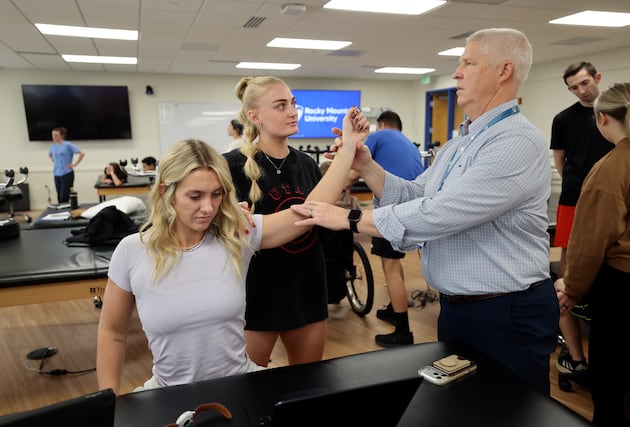
While a classroom of students is receiving cervical spine exam training under the direction of veteran physical therapists, students up the hall are mastering skills they will need as eye doctors to help prevent blindness and identify diabetes and other ailments.
There’s also a counseling clinic, an electrophysiology clinic, a center for communication disorders and a spacious laboratory where students learn anatomy lessons working with cadavers.
The school has 462 employees, with 268 residing in Utah.
“We don’t have tenure — so our faculty is all about the experience of teaching,” said Martin. “And we encourage them all to be in clinic once a week.”
David Paulson is a doctor of physical therapy who served in the military for several decades and now works with the school’s physical therapy students.
“It’s great to be able to give back to the profession that I love,” said Paulson. “I’m still in clinic 2½ days per week, so I get to see patients and bring relevant stories to the classroom.”

Another military veteran, Dr. Matthew Orgill, works with students mastering “the bread and butter” of optometry.
“We can have up to 32 students being monitored by four or five faculty members all at once,” said Orgill. “We’re training them how to safely perform these procedures.”
Students, observed Martin, experience equal parts rigor and institutional support during their years at RMU.
“I tell our students, ‘We will push you, and we will push you hard — because you have to have the confidence that you know your craft. So that when I’m your patient, I know that you know your craft’.”
Source link
