

What it takes to film 60 Minutes on Mount Everest
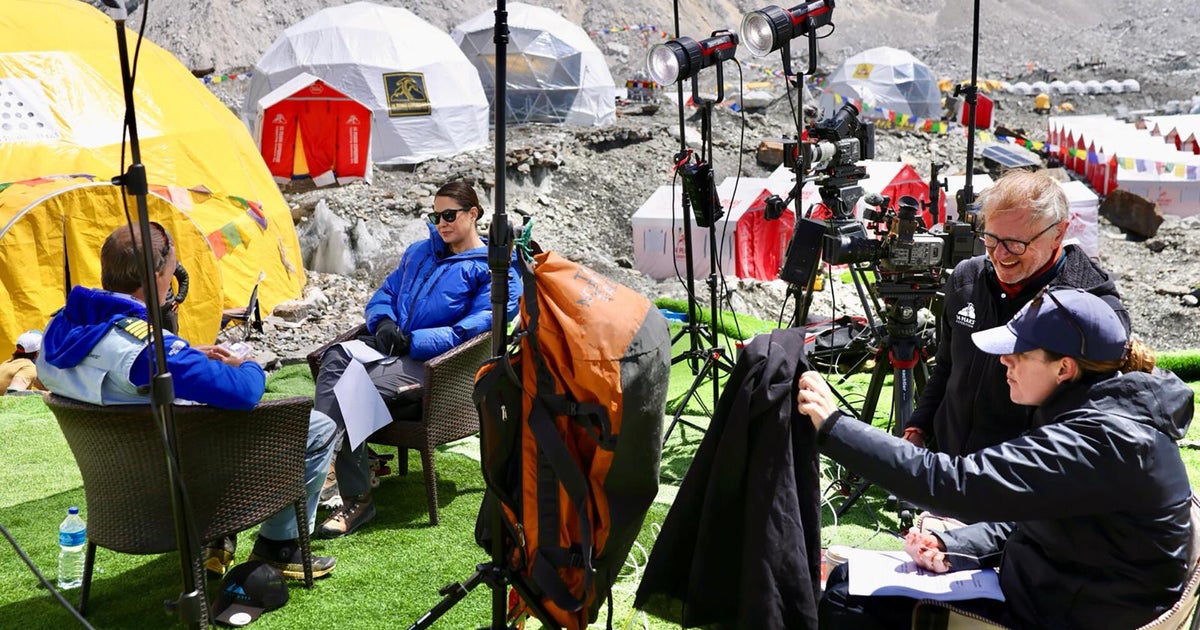
In December 2024, 60 Minutes producer Jacqueline Williams had read an article about Nima Rinji Sherpa, a 19-year-old mountaineer from a family of Sherpas, Nepalese mountain guides who have lived and worked on Mount Everest for generations.
The mountain climber had recently become the youngest person to summit the world’s 14 highest mountains.
“I thought… ‘This kid is pretty interesting.’ And [I] got in touch with him. And he happened to be on a mountain,” she told 60 Minutes Overtime.
Nima told Williams that he would be going to Everest Base Camp in the spring of 2025.
“And I’m thinking, ‘Wow, how amazing. We could go to Everest Base Camp,'” Williams told Overtime. “But in order to do this, you need a correspondent.”
After Williams successfully pitched the story, she reached out to correspondent Cecilia Vega to see if she’d be interested. Within minutes, Vega responded “…YES!!”
“Was there profanity in that email?” Vega asked Williams in an Overtime interview.
“There might have been,” Williams said laughing.
They needed to find a crew that was up for the challenge. It would require more than the climb to Base Camp: they would also have to light, film and record sound for a 60 Minutes story as they ascended.
The crew consisted of photographer Jonathan Partridge from London, United Kingdom, sound recordist Matthew Magratten from Brooklyn, New York, sound recordist Drew Levinson from Boulder, Colorado, and photographer Andy Taylor, based in Sydney, Australia.
Jonathan Partridge/60 Minutes
Starting in January, Williams, Vega and the team began their physical training. The goal was to be in the best physical shape possible before their ascent.
“We were told we had to do about an hour of exercise, six days a week,” Williams told Overtime. “Everybody had to be willing to do months of preparation.”
Magratten climbed stairs in Prospect Park, Brooklyn. Partridge worked out with a personal trainer. Levinson went for long hikes in the mountains around Boulder, Colorado. Taylor hiked with a loaded backpack in the “bush” near his home in Sydney Harbour.
Vega regularly used a rowing machine at Row House, a gym in Washington, D.C.
She told 60 Minutes Overtime that she wanted to improve her lung function for higher altitudes, where there is less oxygen and a higher risk of altitude sickness.
Don Lee/60 Minutes 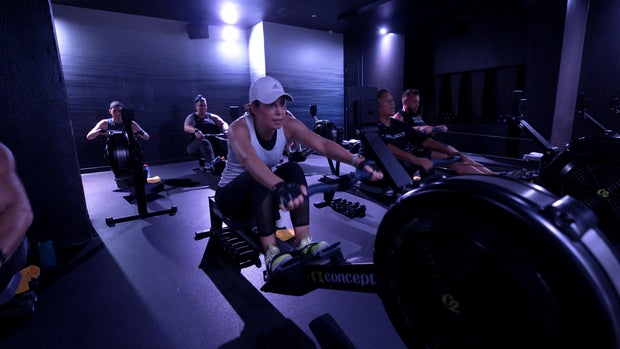
“You can very easily get very sick very quickly if you climb too fast,” she said after an intense workout. “You have to train your lungs in order to do this.”
Williams did cardio and strength training at Combine Air Altitude Training in her hometown of Sydney, Australia. In that gym, nitrogen is pumped into the air to simulate an altitude of 3,500 meters above sea level.
“It does feel like you’re not getting as much oxygen,” Williams told Overtime. “And I honestly do feel like it helped me on the mountain.”
But even with all the preparation, there is no predicting how someone will be affected by the altitude as high as Everest Base Camp, which is at 17,598 feet elevation.
“We all showed up really fit for this assignment,” Vega said.
“[But] it almost didn’t matter… you could’ve done the hour training every single day. But if the altitude knocks you down, it knocks you down. There’s nothing you can do to avoid that.”
The entire trek up to Everest Base Camp took 10 days, a 50 mile trek and an 8,261 foot climb.
Andy Taylor/60 Minutes 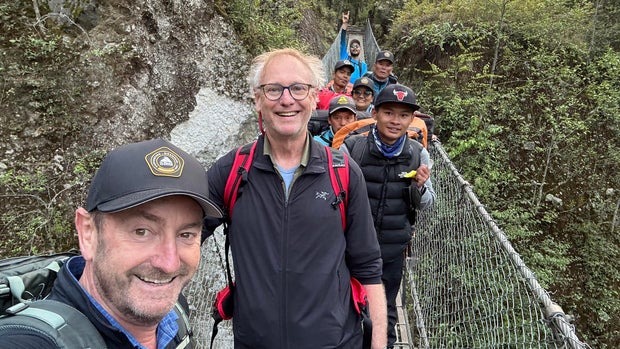
“This was the hardest thing I’ve ever done physically,” Vega told Overtime. “There were days where I definitely wanted to quit.”
“And then there were these moments where you would look up, and go, ‘Wow, we are at nearly the top of the world.’ And there’s a silence that is undescribable. There is a beauty that is undescribable.”
60 Minutes 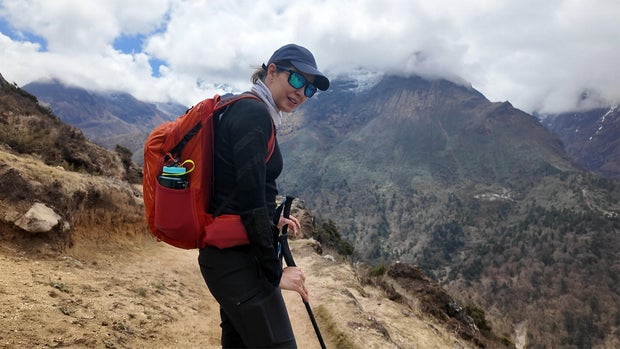
Because helicopters can’t reach the altitude of shoot locations while carrying heavy equipment, the 60 Minutes team had to hire local porters to carry lights, sound and camera gear up the mountain, over 800 pounds total.
“We could not have done this journey without them,” Vega told Overtime.
“Not only do they carry all of our gear… they are walking with you, they’re laughing with you, they are showing you their country, their mountain, all while strapped with gear that is twice their body weight.”
Jonathan Partridge/60 Minutes 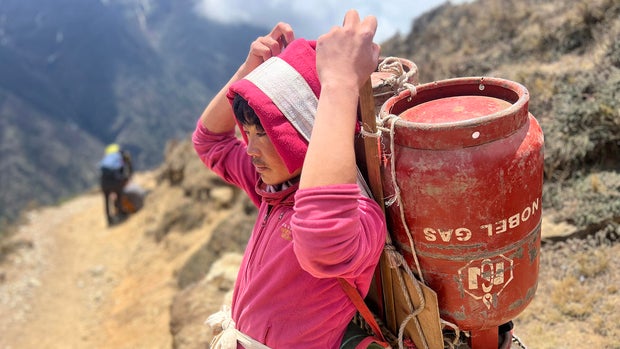
Along the route, they stopped in Nepalese villages, warming up at tea houses where they could drink tea and have lunch.
“[We] ate a lot of dal, a lot of rice, [and] a lot of momos, which are Nepalese dumplings,” Vega told Overtime.
After 10 tough days of climbing, the team finally reached their destination, Everest Base Camp. Vega said the effects of the altitude kicked in for almost every member of the team.
“We could not breathe, our lips were blue, you could hear your heart beating in your head,” Vega said. “We barely slept at night.”
“There is a very real danger you could die in your sleep. The Sherpas would do tent checks, they would walk all along the tents, and just kind of do a, ‘Cecilia, you in there, you okay?'”
Jonathan Partridge/60 Minutes 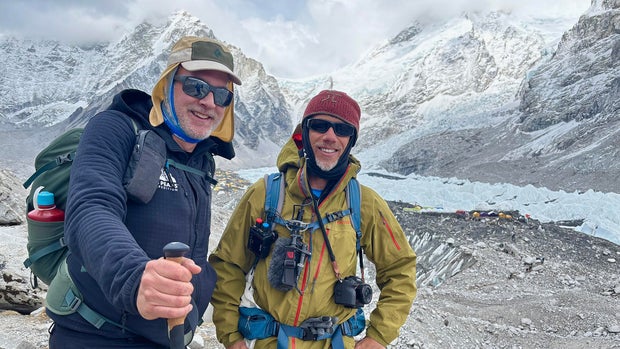
Williams and Vega both said they experienced confusion, another side effect from being at such a high elevation.
“When you’re up at those heights… you become very discombobulated. It’s hard to think clearly. Things are slow,” Williams explained.
One night while the team slept in their tents, they were suddenly woken up by an avalanche, caused by a 5.5 magnitude earthquake, in the middle of the night.
“It’s pitch black, it’s night, and we hear this loud crash. And it sounds like it’s right outside your tent. And I just kind of laid there and went, ‘Oh, my God, what is this?” Vega said.
“I woke up in the middle of the night to this sound, but also, the tent shaking. And, you know, that can only mean one thing,” Williams told Overtime. “And it came pretty close to where we were sleeping.”
“It’s why we ended up cutting the Base Camp portion of our trip short,” Vega added.
“There ended up being so many avalanches… it felt like we needed to get back down the mountain as quickly as we could.”
The team took a helicopter back down the mountain. It took 10 days to make the journey up to Everest Base Camp, but it only took three hours to get back to Kathmandu, where their journey began.
Looking out the window of the helicopter as they flew down from Base Camp, the team could see the route they took up the mountain.
“The view is humbling, it is satisfying… you are awestruck that you did that. You are thankful that you survived,” Vega said. “It is one of the most amazing and challenging things I have done and probably will ever do.”
The video above was produced by Will Croxton. It was edited by Nelson Ryland.
Source link
