

Ahead of the midterm elections, Republicans are again pushing for legislation that requires documentary proof of U.S. citizenship to vote.
The Trump-backed Safeguard American Voter Eligibility Act, or the SAVE America Act, seeks to address the president’s longstanding demands to “fix” U.S. elections that he says are “rigged” and “stolen,” despite no evidence of widespread voter fraud.
“American citizens, and only American citizens, should decide American elections,” the White House posted on X in support of the SAVE America Act, repeating a talking point Trump has leaned into for years.
Noncitizen voting is exceedingly rare. It has been illegal in U.S. federal elections for more than a century and is a crime that can lead to fines, imprisonment and deportation. Despite this, Republicans argue that noncitizen voting is a grave concern.
The bill is slated for a key House vote this week, said Rep. Chip Roy, R-Texas, who described it as “common sense legislation.” But the legislation has an uncertain pathway in the Senate, where previous iterations of the measure stalled. The Senate is considering its own bill on noncitizen voting.
Voting rights groups say the SAVE America Act would disenfranchise millions of Americans if passed.
The president has ramped up his election demands in recent weeks. Trump, who has long cast doubt on the electoral process, called for the federal government to “nationalize” elections last week, a position he later reiterated. The president’s stance alarmed election officials and is in direct conflict with the U.S. Constitution, which stipulates that elections are handled by the states.
Here’s a short guide to the election-related bills in the spotlight in Congress right now.
What does the SAVE America Act do?
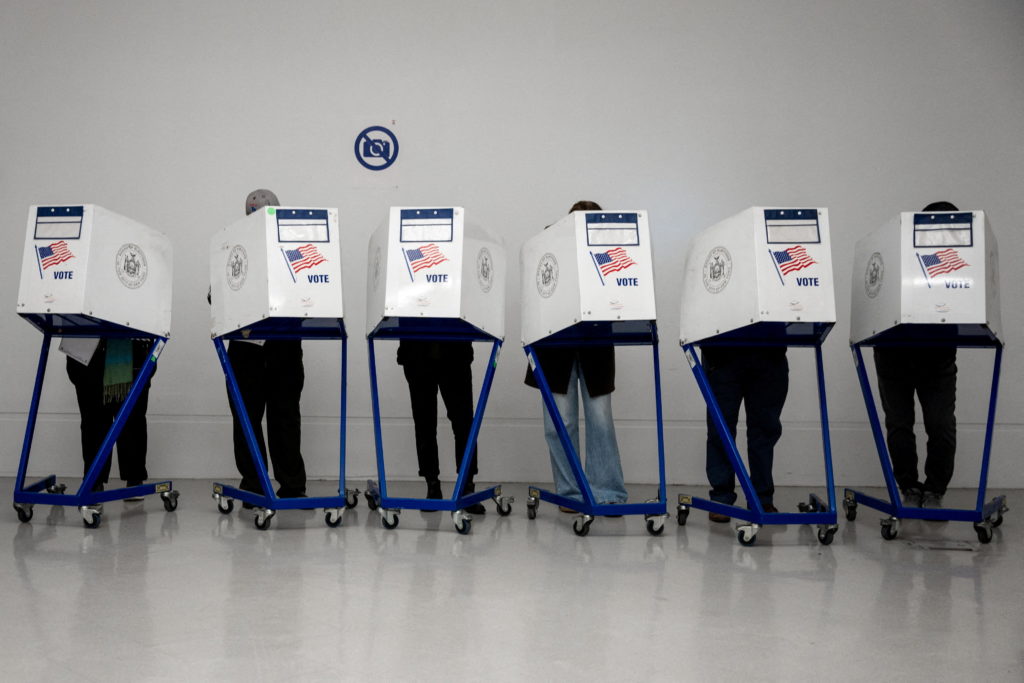
A woman holds the voting booth at an East Harlem school turned into a polling center on Election Day in Manhattan, New York, in 2024. Photo by Kent J. Edwards/Reuters
The Save America Act is an expanded version of legislation that the House passed twice in as many years. It failed to clear the Senate in both cases.
Every version of the SAVE Act has had a common throughline: Requiring Americans to provide proof of citizenship when registering to vote in federal elections. For most people, this would likely mean a passport or birth certificate.
While the bill lists other eligible documents that can prove citizenship, they may not meet the measure’s requirements, said Sean Morales-Doyle, director of the voting rights and elections program at the Brennan Center for Justice.
One of those documents is an ID that is compliant with the provisions of the REAL ID Act of 2005 and “indicates the applicant is a citizen of the United States.”
REAL IDs are available to both citizens and noncitizens, Morales-Doyle said.
No one state’s REAL ID explicitly marks citizenship status, nor do most state-issued driver’s licenses.
The act also requires a government-issued photo ID to vote in person, and a copy of an eligible photo ID both when requesting and submitting an absentee ballot.
There are other provisions in this latest iteration of the SAVE Act, such as requiring mail-in applicants to provide proof of citizenship in person and mandating that states take steps to make sure only U.S. citizens are registered to vote.
The bill would also add criminal penalties for any election official who registers an applicant who fails to provide documentary proof of citizenship. Those penalties apply even if an individual is a U.S. citizen, said Rachel Orey, director of the Bipartisan Policy Center’s Elections Project.
This is one of the “most concerning gray areas” in the SAVE America Act because it gives “vague discretion” to an election official who could face a criminal penalty, they said.
This “risks creating an environment where election officials are almost overly compliant, taking a very hyper interpretation of the statute, which might mean that this process that is meant to be a fail-safe doesn’t actually operate like one in practice because election officials don’t have the protection that they would need to make that decision on a case-by-case basis,” they said.
A second bill, called the Make Elections Great Again Act, also requires documentation of citizenship to register to vote, along with photo ID provisions. But it also adds an array of other election changes, such as banning universal voting by mail.
Orey said all of the bills under consideration are “unfunded mandates” that need time and resources to implement. A one-year lead is the “optimal” amount of time for states to implement a new policy or procedure, according to recommendations released by The Bipartisan Policy Center following the 2020 election.
Given the range of changes suggested by the SAVE America Act and other bills, Orey said a longer lead time would be warranted.
“We don’t recommend that states or the federal government implement election administration policy changes in a federal election year, let alone a policy change that would be as significant as this,” they said.
What voters think
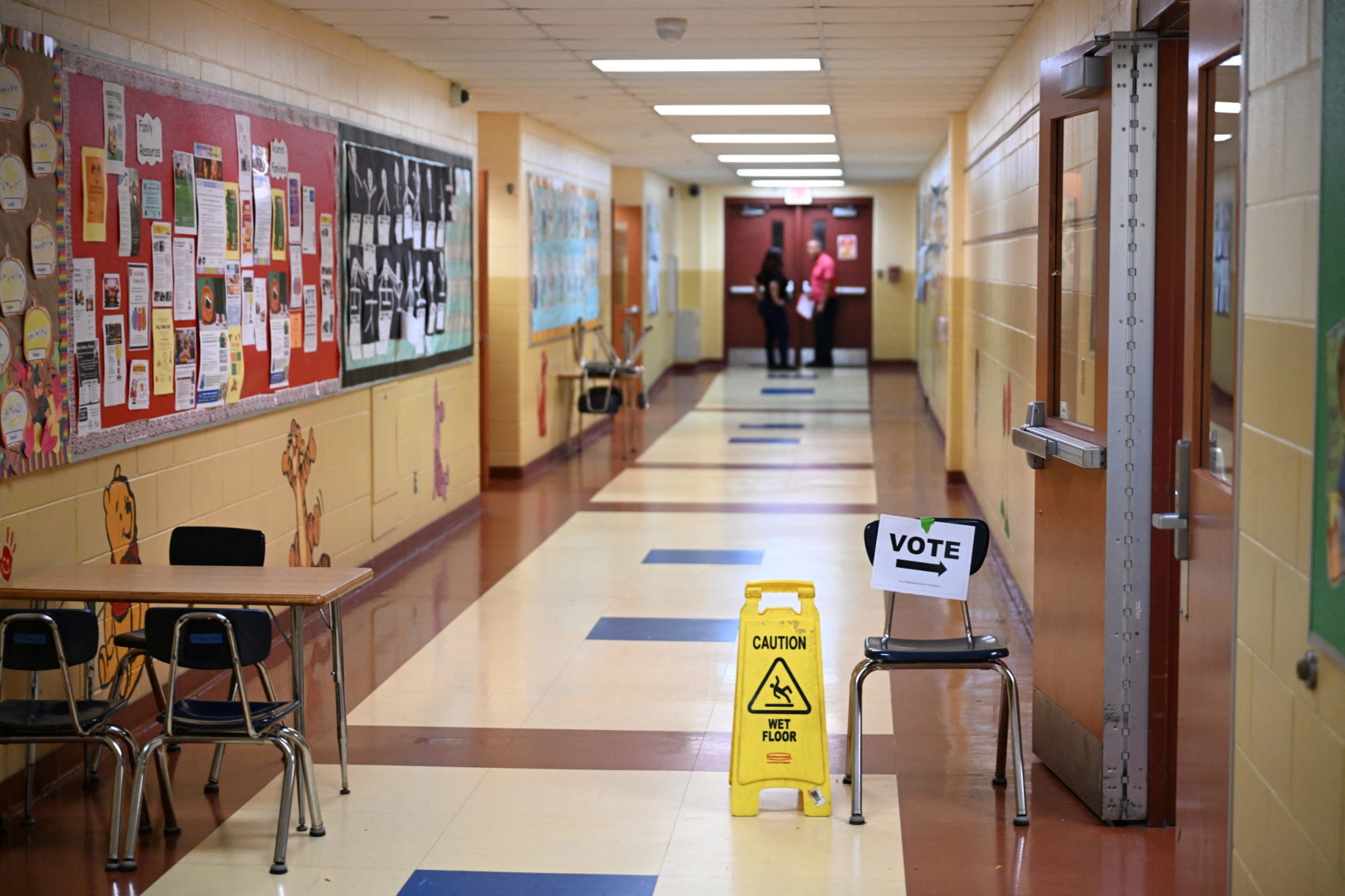
A vote sign is pictured during the 2024 U.S. presidential election on Election Day in Milwaukee. Photo by Vincent Alban/Reuters
Republicans, including Roy, say polling indicates broad support for their reforms, “regardless of your background.”
Michael J. Hanmer, director of University of Maryland’s Center for Democracy and Civic Engagement, said there tends to be strong support for voter ID, which applies when someone casts a ballot.
“As you might expect, Republicans tend to have stronger support, but majorities of Democrats in most surveys also support it,” he said.
Voters broadly support requiring photo ID to vote, which is already in place in 36 states. According to an August poll by Pew Research, 83 percent of U.S. adults felt that way, including 71% of Democrat or Democratic-leaning voters and 95% of Republican or Republican-leaning voters. Fifty-eight percent of U.S. adults supported mail-in voting for any reason, an idea far more supported by Democrats (83%) than Republicans (32%).
Voter ID “gets such broad support because large majorities of people have these documents and have them ready, and they don’t quite realize that significant portions of the public don’t, or that it’s hard to get, or that the information’s expired,” Hanmer said.
In a separate October 2024 poll by Gallup, 83% of voters said they supported requiring people who are registering to vote for the first time to provide proof of citizenship.
The White House released a statement online Tuesday, compiling several of these figures, and more.
Who would be most affected if the SAVE America Act is passed
Nine percent of American citizens — or 21.3 million people — don’t have ready access to proof of citizenship, the Brennan Center for Justice found in a national survey it conducted in 2023. The survey was done in collaboration with VoteRiders, PublicWise, and UMD’s Center for Democracy and Civic Engagement.
“These aren’t documents that people walk around with,” Morales-Doyle said.
Only about half of Americans own a passport, he added.
“This is making Americans have to prove that they are Americans,” Morales-Doyle added. “In order to exercise fundamental constitutional rights, they have to show their papers.”
More than 3.8 million adult U.S. citizens lack any form of citizenship documents, such as a birth certificate, passport, or naturalization papers, according to UMD’s Center for Democracy and Civic Engagement.
- This is a critical issue among people of color. Three percent said they had no document at all, compared to 1% of white citizens.
- Another 11% of people of color, or some 8.4 million people, cannot readily access citizenship documents compared to 8% of white Americans.
- The issue cuts across political affiliation, too. Independents were more likely than Democrats and Republicans to lack citizenship documents or not have ready access to them.
- Young people, aged 18 to 24, are also less likely to have access. Many young people may not know where their birth certificate is stored or it may be in another location, another state, with parents or other family members, the center’s analysis suggested.
“We have a highly mobile society,” said Hanmer, the center’s director. “A lot of people, when they move to another state, are blown away by the changes and the differences that creates” for getting re-registered and voting.
There’s another hurdle: Birth certificates may not be up to date.
For millions of married women who have taken their spouse’s name, birth certificates may not match the legal names they now use. This was a concern when the SAVE Act was introduced before and one that prompted outrage last year from constituents who confronted their representatives — Republican and Democrat — over their support of the measure.
Zooming out, there’s already a process for verifying citizenship when you register to vote, Hanmer said. That process, “which is really 51 separate systems,” is done differently depending on the state because that’s how our system is built, he added.
Hanmer pointed to state audits, some led by Republicans, that have found few instances of noncitizens casting ballots.
Ahead of the 2024 general election, Georgia announced that an audit of its voter rolls found that 20 people registered to vote in the state were not U.S. citizens, and Michigan found that 16 noncitizens cast ballots in the 2024 general election — both amounting to fractions of a percentage point when considering the millions registered to vote in each respective state.
“Our election is complicated, and there’s a lot of challenges for people to keep up,” said Hanmer, who noted that people may be unaware of election changes or confused about their state’s existing voter ID requirements or voter registration rules.
What helps is getting the correct information out there, which also requires the “discipline from public officials in trying to do the same or at least not making it worse by making accusations that they either don’t have evidence for, or worse, they know are not correct,” he said.
Which other states have attempted proof of citizenship?
Though efforts to approve the SAVE Act have so far stalled on the federal level, state legislators have pushed since the mid-2000s for bills that have similar restrictive citizenship requirements.
Arizona has had a proof-of-citizenship requirement on the books since 2004. A new law in 2022, which expanded on the original measure, was challenged in court and later made its way to the Supreme Court. The justices allowed Arizona to partially reinstate its law, which has led to a bifurcated voting system where tens of thousands of voters who haven’t provided a citizenship document are able to vote in federal elections, but are blocked from casting ballots in state and local races.
In 2018, a federal judge struck down Kansas’ law that required proof of citizenship, saying it violated the U.S. Constitution and the 1993 National Voter Registration Act (NVRA). Evidence in that case showed that Kansas suspended or cancelled more than 30,000 voter applications that lacked documentary proof of citizenship. A district court found that cancelled or suspended applicants amounted to about 12% of new voter registration applications submitted after the law was implemented in 2011.
“As with anything in election administration policy, the devil is in the details,” Orey said. “We need to be very careful about how we implement citizenship verification so that we don’t inadvertently create new barriers for eligible citizens.”
New Hampshire is one of the latest states to enforce a documentation requirement, passing its law in 2024. It is one of six states not beholden to the NVRA. A report A report from the New Hampshire Campaign for Voting Rights later found that more than 240 people were turned away last year — a non-presidential election year — after the law went into effect.
All these instances “kind of illustrate the reality that we are predicting when we say the SAVE Act could block millions of Americans from voting,” Morales-Doyle said.
A free press is a cornerstone of a healthy democracy.
Support trusted journalism and civil dialogue.
