

Why hasn’t the US military used force to secure the Strait of Hormuz?
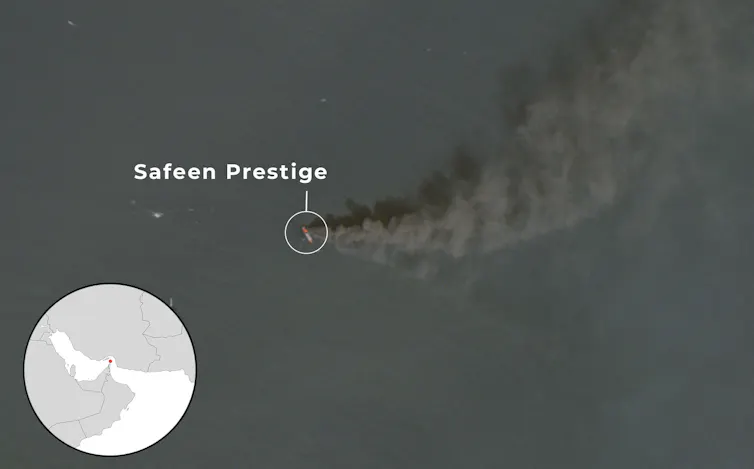
Since the United States and Israel launched their war against Iran in late February, Iran has retaliated by targeting commercial ships in the Strait of Hormuz, effectively shutting down the narrow channel of water.
It’s caused a global fuel crisis, even though some ships are managing to get through the strait. US President Donald Trump has given Iran an ultimatum to fully reopen the waterway to oil and gas shipments, and called on NATO allies to help in the effort.
We asked naval expert Jennifer Parker, who served for 20 years with the Royal Australian Navy, to explain what kind of military force would be required to reopen the strait to commercial shipping and why the US hasn’t yet taken this step.
Why is it so hard to prevent attacks on ships?
The geography of the region has a lot to do with this.
The Conversation, CC BY-SA
Iran clearly dominates the northern part of the Persian Gulf, the Strait of Hormuz and the Gulf of Oman. That proximity allows it to use its cheaper weapons such as drones to target ships.
Creating the conditions to make merchant shipping safe – or at least reduce the risk – requires a two-phase campaign.
The first phase is taking out Iran’s ability to target ships. There are two ways to do this:
- persuade or force Iran to stop attacking ships
- destroy Iran’s ability to attack ships by taking out its radar facilities, command and control structure and weapons bunkers along the coast.
The US has air power, intelligence, surveillance and reconnaissance capabilities to identify and destroy most of these targets. Locating and destroying Iran’s masses of drones will be harder, as they can be stored almost anywhere, so intelligence will be crucial here.
Copernicus Sentinel-2 satellite, CC BY-SA
Once you reduce the risk through a bombing campaign, the second element of getting ships back through the strait is a reassurance campaign.
This requires airborne early warning aircraft and maritime patrol aircraft to monitor not only the strait, but also the Gulf of Oman, the Persian Gulf and along Iran’s coastline.
Fighter aircraft would need to be stationed above the strait and gulf, as combat air patrol and helicopters would need to be ready to deploy against attacks, if necessary. And in the water, the US would need to station warships to provide the occasional escort.
If mines are confirmed or even suspected of being in the strait, this complicates things. The US would require an extensive and time-consuming mine clearance operation.
So, why won’t the US try to militarily secure the strait?
There are four key reasons the US won’t attempt to militarily secure the strait without first achieving phase one (taking out Iran’s ability to target ships) — and why it hasn’t been a focus of the campaign thus far.
First, it would divert military assets, such as aircraft, that are needed elsewhere to carry out Trump’s war objectives.
Second, to make the strait safe for shipping, you actually need to secure not just the water, but the land on either side of it. And this would likely require ground forces – or perhaps raiding parties on Iran’s coastline – which would be complicated and risky for the US military.
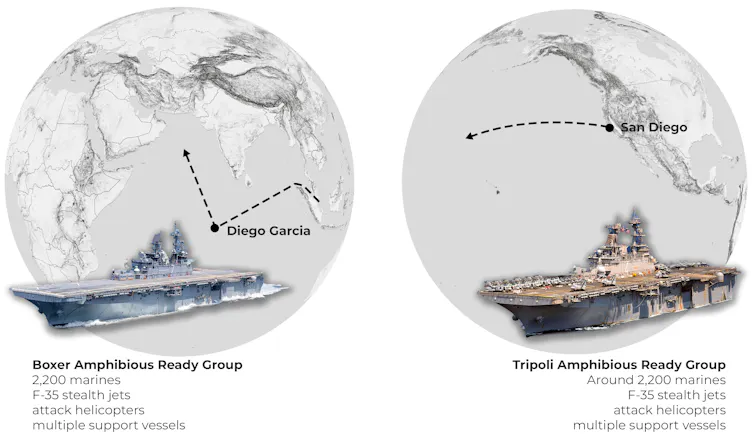
Third, securing shipping would require a significant number of naval ships. Realistically, you’d need one or two naval ships per escort operation. A convoy any larger than that would be at increased risk of attack, unless the US and Israel have dramatically reduced Iran’s ability to target the ships.
The Conversation, NYT, Al Jazeera, CC BY-SA
And fourth, the military needs to think about the risk to its assets versus the benefits of opening the strait. A US warship has a crew of more than 200 personnel. Given Iran’s ability to hit ships with uncrewed surface vessels, drones and cruise missiles, is it worth putting those personnel at risk before you’ve reduced the threats from Iran’s coastline?
What about mines in the strait?
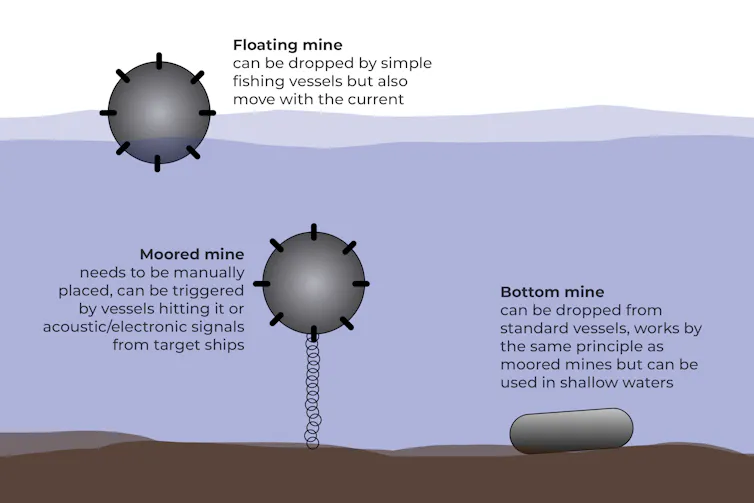
This would be a significant challenge. But one thing first: Iran doesn’t actually need to physically lay the mines, it just needs to convince the US and others that it has. This is enough to prevent civilian ships from wanting to transit through the strait.
NYT, CC BY-SA
Sometimes mines can be floating on the surface of the water, so they’re visible. Often, though, mines are submerged or moored. The US would need to send in divers or remote-controlled vehicles launched from ships to remove them. This would take weeks or perhaps even months.
Although it’s not been confirmed publicly, I think it’s unlikely Iran would extensivley lay mines. There are two reasons for this.
First, Iran’s economy relies on its ability to ship its own oil from Kharg Island in the Persian Gulf through the strait. Iran does have other ports outside the strait, but they can’t accommodate bigger ships, so mining would interfere with their trade.
Second, some reports have suggested Iran has used acoustic mines, a type of influence mine that detonates based on an acoustic “signature”, essentially what a ship sounds like as it moves through the water. While this technology certainly exists, it is unlikely such mines would be designed to reliably differentiate between Iranian-flagged merchant vessels and those flagged to other countries.
Maintaining accurate and comprehensive signature data for large numbers of commercial vessels — particularly in a dense and dynamic shipping environment such as the strait — would be extremely challenging. In practice, these mines would pose risks to a wide range of shipping.
The US also has significant intelligence assets and surveillance and reconnaissance systems along the Iranian coast, so it would likely detect mine-laying operations, although this can also occur from any vessel, including fishing boats.
And what about Iran’s ability to target ships with drones?
Iran has used different types of drones so far in the war. The uncrewed aerial craft or uncrewed surface vessels are remotely controlled and have been used to hit merchant tankers.
Compared with other weapons, such as missiles, it’s much harder for the US and Israel to target Iran’s drones on the ground because they can be launched from almost anywhere. And while they can’t be built anywhere, drones don’t require the same advanced manufacturing facilities as missiles. In short, they are harder to detect and wipe out.
But the US can bomb some of Iran’s launching points and drone stockpiles along the coast to prevent some attacks on ships.
What is the main priority for the US in Iran right now?
Although there has been much debate about regime change, the Trump administration has been clear about its four key military objectives, which are to destroy:
- Iran’s ballistic missile capability
- its nuclear capability
- its navy (which has largely been achieved)
- and its proxy networks, including Hezbollah in Lebanon, which has been under attack by Israel for the past several weeks.
The destruction of Iran’s nuclear and ballistic missile capabilities requires significant aircraft and weaponry – as the US and Israeli bombing campaigns have already made clear. Diverting these assets to secure the Strait of Hormuz could undermine the achievement of these military objectives.
Source link
