Witkoff and Kushner meet Netanyahu as US seeks to advance its Gaza peace plan
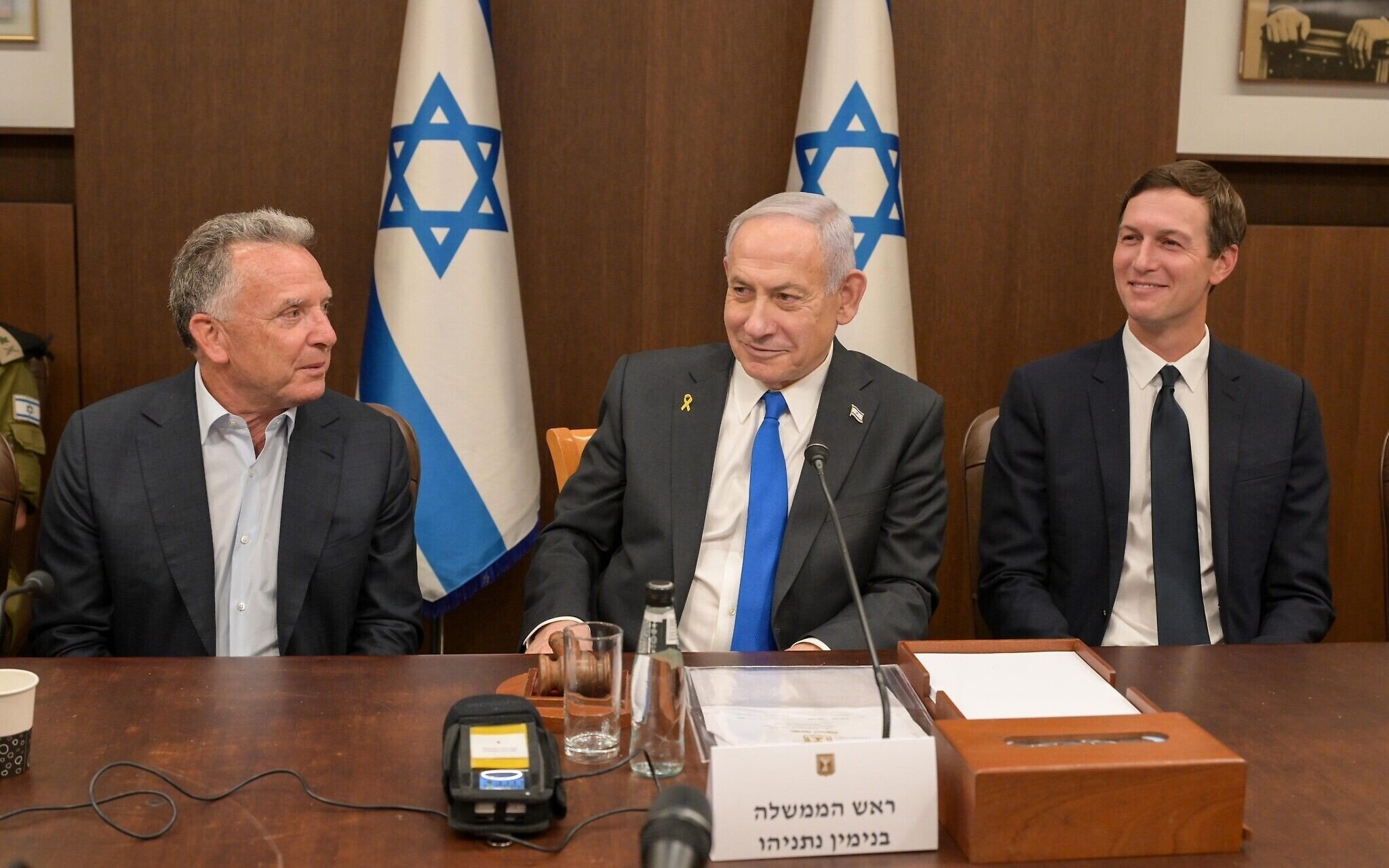
US envoys Steve Witkoff and Jared Kushner were in Israel on Saturday to meet with Prime Minister Benjamin Netanyahu to discuss efforts to advance Washington’s 20-point plan for ending the Gaza war, the White House said.
The US on Thursday announced plans for a “New Gaza” rebuilt from scratch, to include residential towers, data centers and seaside resorts, part of US President Donald Trump’s push to advance an Israel-Hamas ceasefire shaken by repeated violations.
US officials briefing reporters said the administration is working closely with Israel to recover the body of the last remaining hostage, Ran Gvili.
The Trump aides also plan to discuss with Netanyahu efforts to demilitarize Gaza and advance longterm peace, one of the US officials on the briefing said.
The Prime Minister’s Office confirmed Netanyahu met with Witkoff and Kushner, saying they discussed the second phase of the Gaza ceasefire, without further elaborating.
The head of a transitional Palestinian committee backed by the US to temporarily administer Gaza, Ali Shaath, said on Thursday that the Rafah border crossing — effectively the sole route in or out of Gaza for nearly all of the more than 2 million people who live there — would open next week.
The Gaza side of the crossing has been under Israeli military control since 2024.
Israel has resisted further easing the situation in the Strip before Gvili has been returned. Gvili’s family on Saturday expressed concern that pressure was being directed at Israel to move forward with the ceasefire plan, rather than on Hamas to return the hostage’s body.
“President [Donald] Trump himself said this week in Davos that Hamas knows where our son is. We wonder why the pressure is being directed at the wrong place. The pressure should not be on the Israeli government to continue to fulfill its part of the agreement while Hamas is deceiving the entire world and refusing to return the last kidnapped person, in accordance with the agreement it signed,” the family said in a statement.
The Gvili family called on Netanyahu to tell the US envoys that efforts should be made to return their son if they want to move forward with regional peace and the reconstruction of Gaza.
A US official and an Arab diplomat told The Times of Israel on Friday that the reopening of the Rafah Crossing was “imposed” on Israel. The Arab diplomat said mediators of the Gaza ceasefire — the US, Egypt, Qatar and Turkey — recognized that Israel wasn’t going to agree on its own to reopen the border gate between Egypt and Gaza. They decided to go ahead and announce Rafah’s reopening this week during the signing ceremony for the Board of Peace in Davos, Switzerland, the Arab diplomat said.
The issue was raised during Netanyahu’s meetings with Trump and his top aides in Florida last month, where Washington made clear that it expected Israel to reopen Rafah, a US official said, adding that the Israeli premier indicated that he would comply.
Even after the announcement in Davos, Netanyahu’s office has held off on confirming that Rafah will indeed reopen next week, instead issuing a statement to reporters attributed to an anonymous Israeli official who said that the security cabinet would discuss the issue at the beginning of the week, previewing a meeting whose conclusion appeared foregone.
Ahead of the border’s expected opening, sources briefed on the matter told Reuters Israel wants to restrict the number of Palestinians entering Gaza through the border crossing with Egypt to ensure that more are allowed out than in.
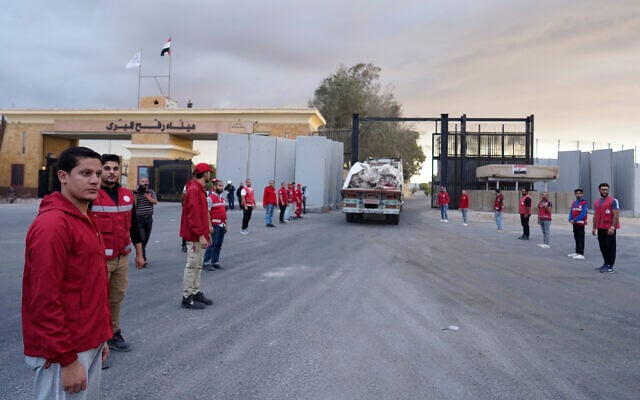
Kan news reported that Israel will operate a remote surveillance system at the crossing, be in charge of granting advanced approval to travelers coming in and out of the Gaza Strip, and be able to scan any computers or other electronic devices passing through.
While the Israel Defense Forces will not be physically present at the crossing, Israeli troops will be deployed nearby and operate their own checkpoint aimed at preventing weapons smuggling.
The crossing itself will be operated by officers from the European Union Border Assistance Mission, founded in 2005 to monitor the crossing, along with non-uniformed members of the Palestinian Authority’s intelligence service, Kan said. The same framework was used during the previous Israel-Hamas ceasefire in January 2025. Israel shuttered the crossing around two months later, and it has remained closed since.
The death toll in Gaza since October 7, 2023, now stands at 71,654, and the death toll since the October ceasefire at 481, according to data from Gaza’s Hamas-run health ministry on Saturday. The tolls cannot be independently verified and do not differentiate between civilians and combatants.
The war broke out when Hamas-led terrorists invaded Israel, killing some 1,200 people, mostly civilians, and kidnapping 251.
Earlier this month, Washington announced that the plan had now moved into the second phase, under which Israel is expected to withdraw troops further from Gaza, and Hamas is due to disarm and yield control of the territory’s administration.
Hamas has so far refused to give up its arms.
Times of Israel staff contributed to this report.