
The 21st century has proved to be the era of IP-driven blockbuster filmmaking, and that pretty much always comes with fan service. This is content deliberately (and, in the best of cases, carefully) added to movies purely to appeal to fans of the IP, even if such content doesn’t necessarily contribute to the story. At its best, fan service can feel like a meaningful addition to a well-made film, a genuinely loving gesture toward fans. At its worst, however, it can be beyond obnoxious.
With the overabundance of fan service that has plagued movies over the course of history, it should surprise no one that there are plenty of films which have used fan service awfully. Whether it’s because their use of such content feels messy, lazy, cheap, cash-grabby, or simply misguided, these films demonstrate that fan service executed thoughtlessly can totally ruin a movie.
10
‘The Amazing Spider-Man 2’ (2014)
After the disaster that was Spider-Man 3 (largely, if not perhaps even entirely, due to studio interference), Sony had to bring Sam Raimi and Toby Maguire‘s vision of the character to a tragic end. It didn’t take long for the studio to try their hands at the Web-Slinger’s story again, however. Enter Marc Webb‘s The Amazing Spider-Man, starring Andrew Garfield in the titular role. Though nowhere near the level of success of Raimi’s Spider-Man, the movie did well enough, so a sequel was inevitable. Sadly, The Amazing Spider-Man 2 would soon prove to be the biggest travesty that Spidey fans had been subjected to on the big screen thus far.
It’s one of the saddest superhero movies ever made, and even though that’s in no small part due to its narrative, it’s mostly because it’s just such a bad film. Chaotic and misguided to a fault, the movie is filled to the brim with fan service that was clearly crammed in there only to set up a bigger cinematic universe that never came to be. Building up film franchises as big as the MCU takes time, but Sony tried to speedrun it—and suffered the consequences.
9
‘Ralph Breaks the Internet’ (2018)


2012’s Wreck-It Ralph feels like a sincere, genuine love letter to video game history. That’s perhaps why it’s generally considered one of the best Disney movies of the 21st century. Expectations were high for its sequel, Ralph Breaks the Internet, which promised to expand the scope and thematic vision of the series tremendously. It was an ambitious prospect to bring Ralph and Vanellope to the worldwide web, and ultimately, those weren’t ambitions that paid off.
Ralph Breaks the Internet is a poorly-written mess, one that completely misunderstands what made its predecessor a success. It’s a vacuous, entirely soulless depiction of Internet culture that feels more like one big ad for Disney. Look, a stormtrooper! Look, the Disney princesses! Look, Oh My Disney! For people who love pointing and recognizing things, Ralph Breaks the Internet should be a blast. For those who prefer fan service with thought and intention put into it, it will be a miserably commercial-feeling experience.
8
‘Space Jam: A New Legacy’ (2021)

Starring Michael Jordan, 1996’s Space Jam was rather unsuccessful with critics, but it was a major box office hit. The same can’t be said for its sequel, Space Jam: A New Legacy, which barely managed to make back its budget and was universally disliked by critics and audiences alike. It’s one of the worst family movies of the last 5 years, this one starring LeBron James instead of Jordan.
If Ralph Breaks the Internet feels like a shameless ad for Disney, then there are simply no words that fully capture the shamelessness of how overt of an ad for Warner Bros.’ IP and HBO Max A New Legacy feels like. Sure, the Looney Tunes and LeBron are there, but make no mistake: They’re nothing but an excuse to lure people in. Everything that comes after is a cynical exercise in self-adorational brand worship full of “point and recognize” fan service without a meaningful purpose.
7
‘Alien: Covenant’ (2017)


Touted as a film that preceded the events of Ridley Scott‘s Alien but wasn’t directly connected to the original series, instead exploring a mythology of its own, Prometheus (also directed by Scott) was hugely divisive as soon as it came out. Many fans of the Alien franchise were expecting an equally scary and action-packed film, but what they got instead was an intellectual exercise that was far more interested in philosophizing and asking big Questions about life (with a capital Q).
The film’s sequel, Alien: Covenant, was also a prequel to Alien; but one significantly influenced by Prometheus‘ split reception. Here, Scott tried to appeal to fans of both Alien and Prometheus with fan service catered to both fanbases: Slower-paced philosophical questions for people who loved Prometheus, and scary Xenomorph scenes for people who loved Alien. The result? Neither fanbase was fully satisfied. When fan service isn’t fully designed to satisfy a specific group, it almost always fails.
6
‘Ready Player One’ (2018)

Steven Spielberg‘s 21st-century filmography has, for the most part, been considerably weaker than his 20th-century filmography. For proof, one needn’t look much further than Ready Player One, a film based on Ernest Cline‘s book of the same name. It’s a frustrating adaptation not because it’s awful, which it isn’t. It’s frustrating because it’s one of the most mediocre movies of all time.
The film is based on a book that’s a celebration of and homage to ’80s geek culture through and through; and like its source material, it was always going to be overflowing with fan service, pop culture references, and nostalgia-filled Easter eggs. One might have expected a director as talented as Spielberg to know exactly how to pull that off; but the fact that he didn’t makes Ready Player One all the more underwhelming. Saying that the fan service in this film lacks substance would be an understatement. It’s all completely shallow rapid-fire winks that seem to think that nostalgia is an acceptable replacement for good writing. It isn’t.
5
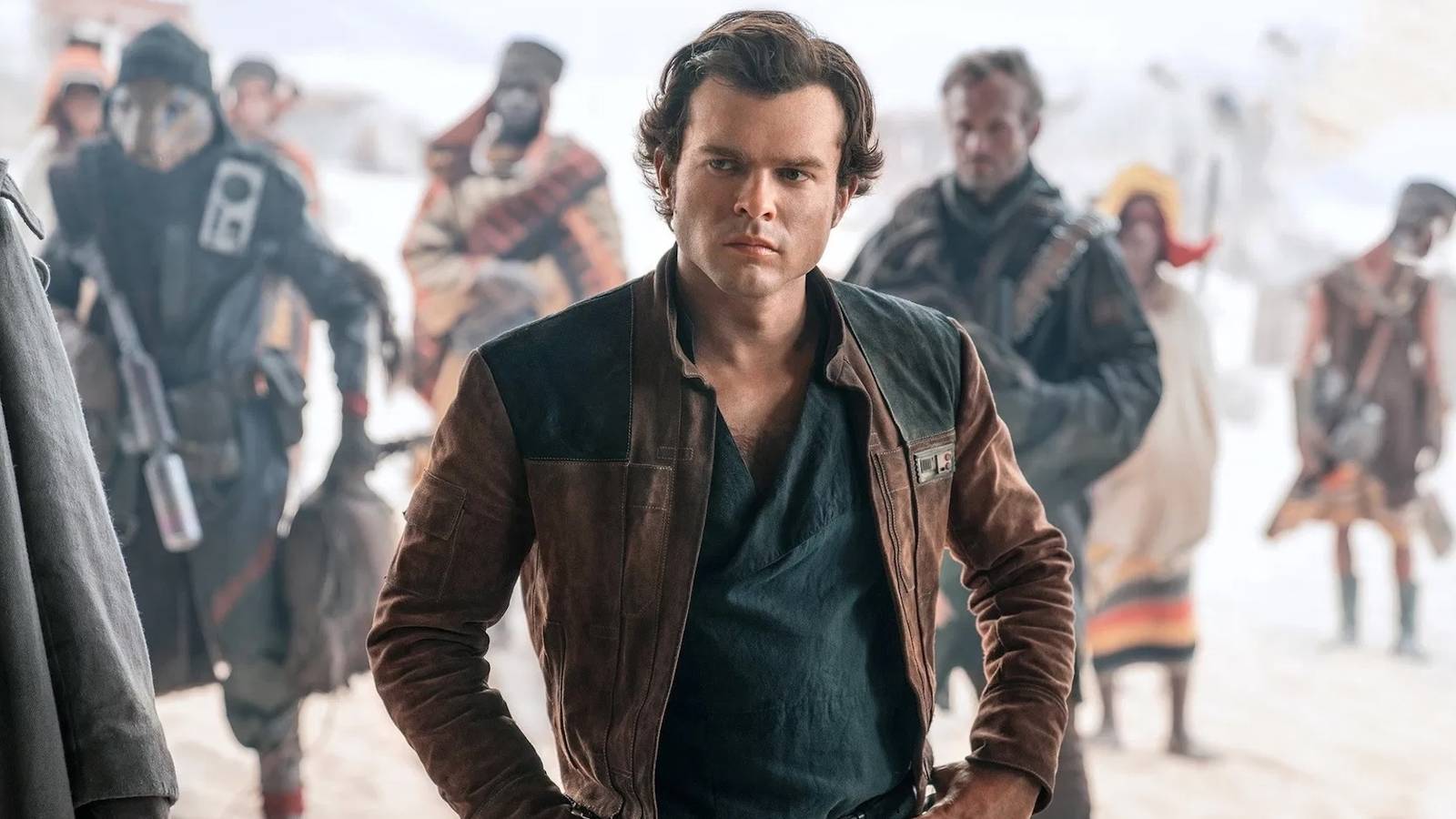
‘Solo: A Star Wars Story’ (2018)

It sucks when movies try to appeal to everyone. Ron Howard‘s Solo: A Star Wars Story does just that, and that’s the main reason why it fails. It’s actually a pretty solid space Western that gets far more hate than it deserves, but a meaningful addition to the Star Wars mythos it most definitely isn’t. The movie’s biggest problem is entirely encapsulated in a scene where an Imperial officer asks Han for his last name, and to Han’s response of “I don’t have people. I’m alone,” the officer gives him the last name “Solo.”
The film is full of those kinds of moments that definitely do add something to the franchise, but whether that “something” is meaningful or necessary is an entirely different conversation.
That kind of empty, “who asked for this?” kind of fan service is precisely why Solo was never allowed to fully come into its own as a standalone movie. The film is full of those kinds of moments that definitely do add something to the franchise, but whether that “something” is meaningful or necessary is an entirely different conversation. Solo‘s use of fan service doesn’t really feel like a loving addition to the Star Wars universe, but rather like a lazy way to justify the film’s very existence.
4
‘Batman v Superman: Dawn of Justice’ (2016)

After how wildly divisive Zack Snyder‘s vision of Superman and the DC universe was in 2013’s Man of Steel, fans were curious about what the director would do in the film’s ambitious sequel, Batman v Superman: Dawn of Justice. The answer, sadly, was “way too much.” Batman v Superman suffers as a result of its bloated story and the many way in which it overreaches, and those elements have a lot to do with the way Snyder employs fan service.
In terms of IMDb ratings, this is a pretty middle-of-the-road Superman movie, but that isn’t much of a compliment. This is another case of excessive “point and recognize” details that serve mostly to set up future installments in a Snyder-driven DCEU that infamously never materialized. As if any more proof were needed that fan service should, if not enhance a story, then at least allow it to breathe and stand on its own two feet.
3
‘Terminator Genisys’ (2015)

His debut, Piranha II: The Spawning, wasn’t exactly impressive; so, it was The Terminator that established visionary Canadian filmmaker James Cameron as a voice to look out for in the action genre. Followed up by the even-better Terminator 2: Judgment Day, the franchise then derailed and never really came back together the way fans would have liked. But never has the Terminator franchise been more of a hot mess than with Terminator Genisys.
In trying to pay homage to the two original films while adding some of its own fan-servicey spice, Genisys instead feels like Paramount is spitting in the face of fans. The worst kind of fan service is the one that makes films from franchises as well-established as this one feel more like fan fiction, and few examples of fan-service-filled films are a more glaring instance of such a phenomenon than this.
2
‘Star Wars: Episode IX — The Rise of Skywalker’ (2019)

Divisive and controversial though it may be, Disney’s Star Wars sequel trilogy undoubtedly has its fans; but you’d be hard-pressed to find anyone who genuinely likes the infamous disaster that is Episode IX — The Rise of Skywalker. Far and away one of the worst movies ever to gross over $1 billion dollars, this was the worst possible way to bring the legendary Skywalker Saga to a close.
From the moment Episode VII — The Force Awakens hit theaters, it became abundantly clear that J. J. Abrams wanted to construct a trilogy primarily on the basis of fan service. Along came Rian Johnson and completely obliterated those plans with the inflammatorily divisive Episode VIII — The Last Jedi. Disney’s attempts to pivot back to a fan-service-heavy film by bringing Abrams back on board backfired epically. All of The Rise of Skywalker‘s fan service feels cheap, lazy, cash-grabby, heavy-handed, and utterly silly. Palpatine returning (somehow), the Death Star sequence, the final battle—it’s all a masterclass in how not to employ fan service.
1
‘The Flash’ (2023)

Far and away one of the most disastrous superhero movies of all time, The Flash feels far more akin to a superhero flick you might have seen during the 20th century, back when the genre was far from being the generally high-quality genre it is today. A lot of that feeling, of course, comes from this having some of the worst CGI of any movie in history, but that isn’t the only reason.
Seeing Michael Keaton step back into the Batman cowl is cute and nostalgic, but oh so very clearly just a marketing tactic to get butts in seats. Then, there’s the film’s infamously ugly-looking third act, packed with haphazardly put-together moments of fan service that make this the single most laughably obnoxious fan service sequence in the history of cinema. The Flash would have been bad enough without these sorts of manipulative elements, but with them, it cements its place among the worst films of the decade so far.


The Flash
- Release Date
-
June 16, 2023
- Runtime
-
144 minutes
-

-

Sasha Calle
Kara Zor-El / Supergirl

Source link
-

-

-
-

-


