

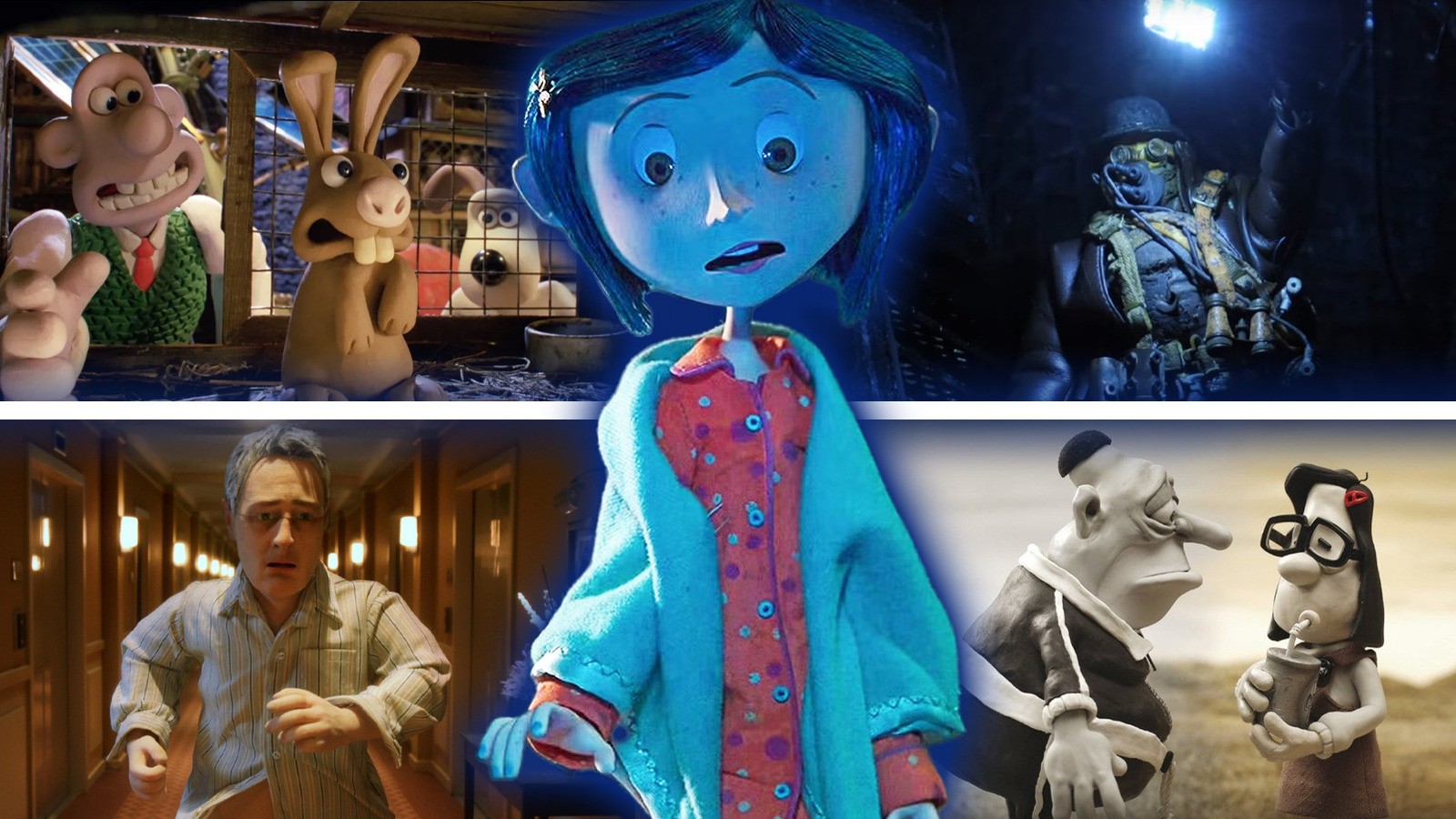
There’s something intrinsically human about stop-motion animation. It requires building small sets and figurines that must be meticulously positioned for 24 frames-per-second to give the feeling of cinematic movement. There’s something “real” on screen, but the audience knows these are just figurines being manipulated for our amusement. It’s largely why the medium works well for horror or horror-adjacent projects like “Coraline.” There’s an uncanny valley created that sticks with you long after the film’s ended.
Plus, stop-motion and claymation movies are a rare commodity. It can take years to make a single feature-length film, but upon completion, the results speak for themselves.
When looking at the best stop-motion films of all time, claymation or otherwise, we want to look at feature-length projects that predominantly utilize stop-motion for a majority of the runtime. Films like 1933’s”King Kong” and 1963’s “Jason and the Argonauts” were hugely influential in the medium, but they’re mostly live-action with some spectacular stop-motion components. That’s why these are the best stop-motion films of all time, where the art form is front and center.
15. Chicken Run
A prison escape movie using claymation chickens shouldn’t have worked as well as it does, but “Chicken Run, one of the best animated movies of the 2000s, is a blast. From Aardman Features, the studio behind “Wallace & Gromit,” the film sees a rooster Rocky (Mel Gibson) leading chickens on a daring escape before they’re all turned into pies.
The designs are a lot of fun, to the point where you don’t even mind how all the birds have human-looking teeth. Their waddling also makes for excellent physical comedy, but the highlight is the keen sense of British humor on display. One exchange sees Ginger (Julia Sawalha) proclaim, “We’ll either die free chickens or die trying.” Babs (Jane Horrocks) responds, “Are those the only choices?” It’s the epitome of dry British wit.
“Chicken Run” isn’t just funny. It’s a core feminist and revolutionary text for kids to realize that they’re stronger when working together to try to overthrow their oppressors.
14. James and the Giant Peach
Yes, “James and the Giant Peach” has live-action scenes to bookend the film. We see James (Paul Terry) in live-action with his sinister aunts, but when he embarks on an adventure with a collection of anthropomorphic insects, everything transitions into wondrous stop-motion. It’s like watching “The Wizard of Oz” where the medium shift is indicative of a change in perspective and how James’ whole world opens up.
Directed by stop-motion maestro Henry Selick, “James and the Giant Peach” is wonderfully bizarre. Many adaptations of Roald Dahl’s work are too, but the film doesn’t shy away from the original story’s darker components, like James’ parents getting eaten by a rhinoceros early in the film and then James confronting a rhino made of dark storm clouds later in the film that’s pure nightmare fuel.
There was talk years ago of Sam Mendes making a live-action “James and the Giant Peach,” and thank goodness that never materialized. Monstrous CGI-created insects just wouldn’t hold the kind of creepy charm one gets with stop-motion, and this is truly the best film version we could ever hope for out of that book.
13. Shaun the Sheep Movie
If you want to move your kids away from TikTok brainrot, then “Shaun the Sheep Movie” is the solution. Aardman Productions’ masterful film follows Shaun (Justin Fletcher) and the rest of his flock trying to find their farmer in the big city while avoiding animal control. But the film is mostly silent, so you really have to be paying attention, which you’ll want to do anyway for the hilarious slapstick comedy present throughout.
Younger kids will be brought in by the cute sheep, but they’ll want to stay the course thanks to having several gags a minute. It harkens back to the days of silent cinema, and it’s the perfect thing for retraining attention spans to focus on something for more than a few minutes. Thanks to the incredible stop-motion animation, there’s a universal, timeless quality to the film. It’s smart, charming, and the perfect way to introduce youngsters to the wonders of claymation movies.
12. Junk Head
The more unsettling and grotesque nature of stop-motion animation is on full display in the Japanese film, “Junk Head.” It takes place in a dystopian world where humans have become infertile, so a scientist goes into an underground world to see how the mutants living down there are able to reproduce. It’s a haunting story, especially as it raises questions as to what it means to be human, while we follow the scientist’s mind entering various mechanical bodies. But what makes the project all the more impressive might be the story of how it was made.
The film is largely the singular work of Takehide Hori, who didn’t have any filmmaking knowledge prior to pursuing “Junk Head.” Outside of around three other people, Hori did everything himself, including designing all of the characters and creatures. The film feels allegorical to the behind-the-scenes story, where one person is trying to accomplish the impossible.
11. My Life as a Zucchini
Stop-motion is a far cry from the polished animation found from mainstream studios. It looks and feels grittier, making it an ideal medium for darker children’s story like the aforementioned “James and the Giant Peach” or the French film “My Life as a Zucchini.”
The titular Zucchini (Gaspard Schlatter/Erick Abbate) winds up in a foster home after his mother’s death. Right from the start, grief and mourning are primary themes, but Zucchini manages to find kindred spirits with the other children, who all have problems of their own. In just 65 minutes, you’ll find something to connect to within your own life.
All of these themes are told through children’s perspectives, meaning they’re sometimes spoken about in crude terms, like when they’re trying to understand physical intimacy. But the stop-motion enhances these situations. The dolls have big, expressive eyes to truly express their sorrow, and forming empathy with these strange-looking kids shows how it’s possible to form connections with anyone.
10. ParaNorman
With AI slop dominating online spaces and major studios cutting corners at every turn, LAIKA is keeping stop-motion animation alive. The company made the perfect horror movie primer for kids with “ParaNorman.”
Norman (Kodi Smit-McPhee) can talk with the dead, and he feels more comfortable hanging out with them over the living. He’s also the only one who can stop an old witch’s curse from destroying his town. “ParaNorman” doesn’t shy away from its horror influences, and the zombies are genuinely haunting to look at, aided by the use of claymation.
However, “ParaNorman” flips horror tropes on their head. Over time, we learn that the zombies aren’t bad, and they’re actually victims themselves. The town flees from them and ostracizes the monster based on our preconceived notions, but something much more sinister rests within the town: prejudice. Learning not to judge a book by its cover may not be a particularly novel theme, but with “ParaNorman,” it’s certainly an entertaining one to relearn.
9. Guillermo del Toro’s Pinnochio
Disney’s live-action “Pinnochio” is one of its blandest reimaginings yet. The soul of the classic 1940 film is completely lost, as it’s more or less a beat for beat remake devoid of the animation’s charm. But that same year, Guillermo del Toro outdid Disney by making a stop-motion “Pinocchio” that finds new ways to tell the story we all already know.
The basic bones are there: Geppetto (David Bradley) wants a real son, and a supernatural presence gives one of his puppets life. However, del Toro’s “Pinnochio” takes some darker turns. His film is far more political, exploring the fascist rule over Italy.
Of course, fascism as a political system demands obedience and conformity. But this new take on “Pinocchio” is all about finding your own way in the world. Disney’s original “Pinocchio” was about being a good boy and following whims of your superiors. But del Toro’s iteration emphasizes the importance of carving your own path, even if it may run counter to what you’ve been taught. It’s the modern update of “Pinocchio” the world deserved rather than Disney’s memberberries.
8. Mary and Max
Despite the internet supposedly bringing the world closer than ever before, one can’t help but feel like isolation is more of an issue than ever. It’s becoming increasingly rare to discover genuine connections. Despite coming out in 2009, “Mary and Max” feels more important than ever in its examination of finding vital friendship in a cruel world.
Mary (Toni Collette) is a child without friends, so one day, she writes to a random man named Max (Philip Seymour Hoffman). Despite their age difference, they continue writing to one another over the years, chronicling their changing mindsets and bodies.
“Mary and Max” is especially noteworthy for its portrayal of autism spectrum disorder when Max finally gets a proper diagnosis to explain why he feels different from everyone else. It’s a truly beautiful portrayal, as Mary wants to cure Max’s autism, but Max insists he’s fine just the way he is. “Mary and Max” shows how you don’t have to be perfect to have friends; you just need to be willing to be there.
7. Fantastic Planet
Claymation movies tend to dominate the conversation around stop-motion animation, but anyone interested in the medium owes it to themselves to watch 1973’s “Fantastic Planet.” The film utilizes a cut-out style of animation where paper illustrations are moved frame by frame to create the illusion of movement. It’s a technique that dates to the early days of animation, but it’s at is best here, where the strange movements only serve to heighten the alien world and characters.
Social allegory rests at the heart of the film, as the technologically-advanced Draags (the giant blue aliens with red eyes) keep Oms (human-like entities) as pets. It’s the perfect showcase of how willing any species would be subjugating anyone else due to them looking different.
But “Fantastic Planet” takes the idea of “every frame a painting” quite literally. The alien world of Ygam is both glorious and terrifying to behold. Nothing is how it seems, and one can continue findings the film’s influence in current science-fiction like “Scavengers Reign.” It’s easily the best sci-fi film of the 1970s, and something like this feels impossible to make today.
6. Anomalisa
Identity and malaise are common attributes in the works of Charlie Kaufman. That’s no different in “Anomalisa,” where a middle-aged man finds himself confronted with the monotony of everyday life, to the point where virtually everyone looks exactly the same to him.
Stop-motion animation is an ideal medium for such a story, as that feeling of isolation becomes more pronounced with so many identical puppets coming into Michael Stone’s (David Thewlis) life. Even that term “puppet” becomes an apt one, as following the same routine day in and day out can make one begin to feel like everything is preordained with nothing special ever lasting too long.
Even when Michael meets someone who looks different, Lisa (Jennifer Jason Leigh), she begins looking and sounding just like everyone else. While “Anomalisa” is all about what happens when a person stops caring about anything, the ultimate irony is that creating any stop-motion film is a task of great care. A lot of time and energy went into this story about a man not wanting to put time and energy into anything.
5. Fantastic Mr. Fox
With his attention to detail and commitment to intricately crafted frames, stop-motion feels like the perfect medium for Wes Anderson. We finally saw what he could do with puppets in “Fantastic Mr. Fox,” which sees the long-tamed Mr. Fox (George Clooney) give into his animalistic instincts by breaking into three farms for one last big score.
Anderson blames himself for the box office failure of “Fantastic Mr. Fox,” making it too Anderson-ian for kids to fully enjoy. However, its those eccentricities that have allowed “Fantastic Mr. Fox” to stand the test of time. Kids can enjoy the silly gags and witty dialogue, but adults will find something to unpack with the idea of feeling like your best days are behind you (in addition to also enjoying the silly gags and witty dialogue).
More than anything, there’s something about “Fantastic Mr. Fox” that just feels cozy. Its autumnal color palette and emphasis on food also makes it a great Thanksgiving film to watch with the whole family.
4. Mad God
The realm of visual effects wouldn’t be the same without Phil Tippett, who developed practical effects for various “Star Wars” aliens and the prehistoric reptiles in the original “Jurassic Park.” It goes without saying that he knows how to bring all sorts of creatures to life, and despite “Mad God” sitting on a shelf for decades, he finally got around to completing and releasing it in 2021.
The plot is secondary to the visceral visual experience, as “Mad God” involves a mysterious figure traveling through the underworld. But around every corner lies hellish entities designed in the most grotesque manner possible. There’s a disgusting aesthetic to everything, from the landscapes to the creatures the figure encounters. It’s no wonder “Mad God” took 30 years to make with all the work that went into it.
Tippett embodies the true human touch of filmmaking. In the 2020s, that’s becoming a harder commodity to find, but “Mad God” shows what humans can achieve with their bare hands. “Mad God” is something you allow to wash all over you to hopefully spark your own creativity.
3. The Nightmare Before Christmas
No doubt many children’s first experience with claymation and stop-motion movies is “The Nightmare Before Christmas.” It’s become a perennial classic for all ages, as it’s the perfect film to throw in anytime between October 1 and December 25.
Despite his name often appearing on the title, Tim Burton declined directing “The Nightmare Before Christmas,” so Henry Selick is responsible for making us all wish we could live in Halloween Town. Jack Skellington (Chris Sarandon) faces an existential crisis from being bored over leading Halloween and decides to throw his own spin onto Christmas. With catchy musical numbers and surreal combinations between the joyful and the macabre, “Nightmare Before Christmas” became a calling card for theater kids with darker senses of humor.
It’s a little gothic, a little charming, and a little creepy all in one. The stop-motion quality enhances all of those descriptors in a way 2D animation just wouldn’t have been capable of.
2. Wallace & Gromit: The Curse of the Were-Rabbit
The “Wallace & Gromit” shorts introduced the absent-minded inventor Wallace (Peter Sallis) and his put-upon dog Gromit. When the two finally made the leap to a feature-length film, they didn’t disappoint with “The Curse of the Were-Rabbit.”
The film draws upon horror tropes of the 1930s and ’40s but inside of a kid-friendly package. Instead of some kind of monster threatening humans, there’s instead a monstrous rabbit who’s eating all of the prized vegetables around town. It’s about as simple of an entry level horror film for kids you can get. The claymation fills all of the characters with such life that you’ll instantly want to watch the rest of Wallace and Gromit’s adventures after finishing it.
Pop culture references are plentiful for adults to catch, and it’s something children can return to when they’re older to see what they missed the first time around. “Curse of the Were-Rabbit” is a masterclass in British humor with so many gags getting thrown at you every minute that it can be hard to keep track. But this is one film you won’t mind revisiting when you just want a pleasant afternoon with a spot of tea.
1. Coraline
Henry Selick is a master of stop-motion animation with previous works including “The Nightmare Before Christmas” and “James and the Giant Peach.” But his magnum opus is clearly “Coraline,” where puppetry, writing, lighting, and 3D effects all coalesce into an incredible work of art. It’s not just the best stop-motion movie of all time, it’s a calling card as to what’s possible within the very art form of cinema.
“Coraline” sees the titular girl (voiced by Dakota Fanning) uncover an alternate world where everything, including her parents, seem so much better. However, she soon realizes there are sinister machinations at play. Stop-motion and horror are strange bedfellows, and “Coraline” brings uncanny and unsettling creations to life, especially when it comes to the haunting Other Mother (Teri Hatcher).
The attention to detail on the puppets is outstanding, and it’s the first stop-motion film to incorporate stereoscopic 3D into the filmmaking process. As such, it looks spectacular when viewed in 3D, instead of being an afterthought. It looked unlike any other claymation movie when it first came out and holds up exceptionally well. It’s also a film designed to be revisited, as “Coraline” is all about the fear or growing up and how it’s really not all that bad. “Coraline” is a film you watch knowing it’ll stand the test of time and will continue being studied by screenwriters and animators forever.
Source link
