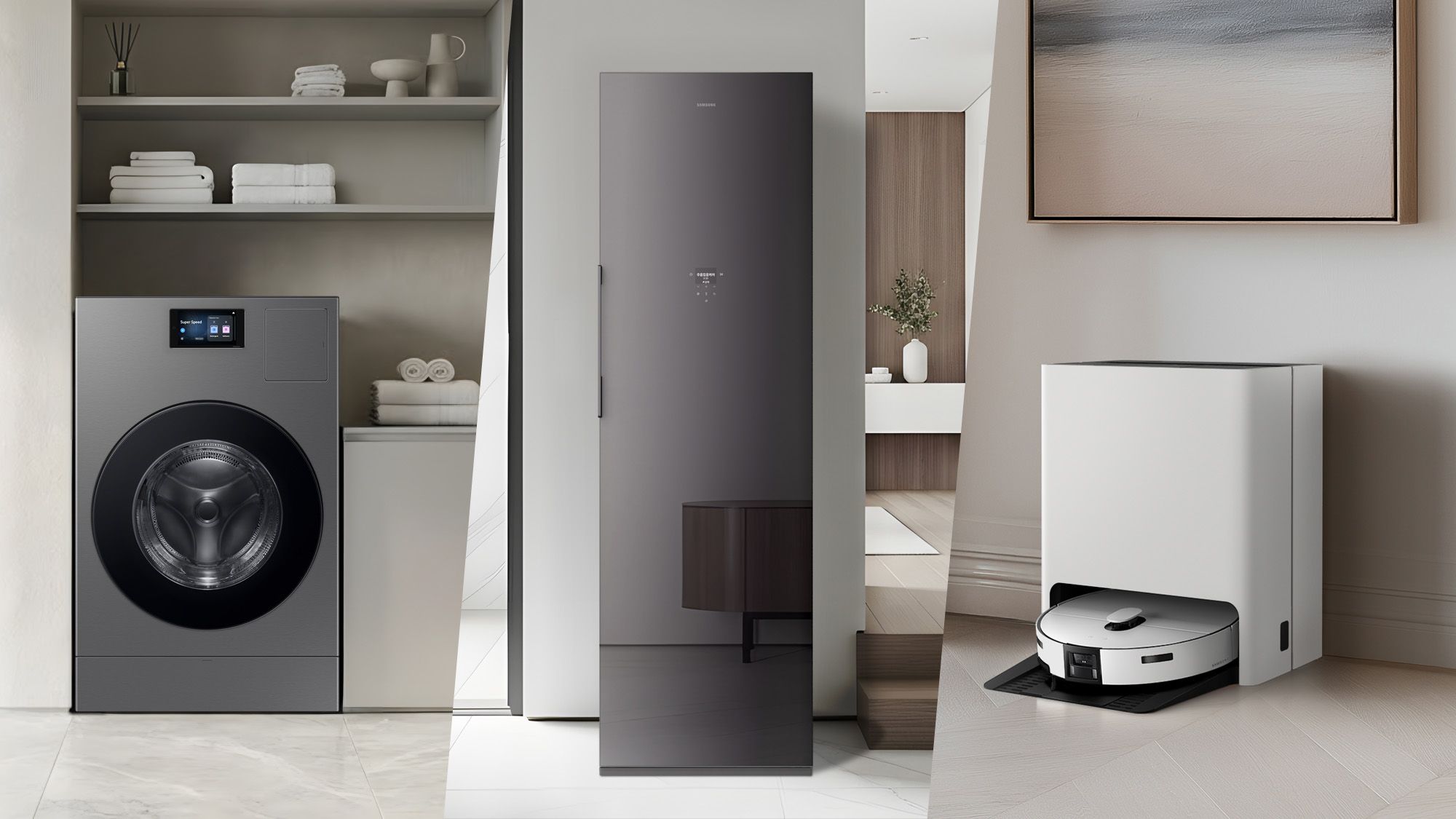
What will the home of the future look like? At CES, Samsung outlined how all of your appliances will talk to each other, and, thanks to AI, will help anticipate your needs, such as recommending you reorder that gallon of milk if it sees you’re running low.
Apart from its new appliances — including a new robot vacuum, washer/dryer combo, and an AirDresser — Samsung announced that it was incorporating Google Gemini into the company’s Family Hub refrigerators, so that its AI Vision will better be able to recognize foods you put in — and even be able to read labels.
Samsung’s vision
“Our appliances are no longer mere equipment or devices that perform functions, but actually have a deep understanding of the user, the user’s life, and the user’s living environment,” Park said. “This helps reduce the time, effort, and money they spend on household chores and assignments, and also helps users take care of their loved ones.”
“When you look at the process of cooking — before cooking, during cooking, and after cooking — we find that consumers experience the most stress in the “before cooking” stage, where they have to decide on the menu and decide how they’re going to use the food ingredients.
Digitpatrox at CES
Follow all of our CES 2026 live coverage for the biggest gadget news straight from Las Vegas. And be sure to follow Digitpatrox on TikTok for the coolest videos from the show.
“I think the biggest change that we are going to see is AI Vision built with Google Gemini for the Bespoke AI refrigerator Family Hub,” Park continued. “Before, our on-device system’s camera would have to try to match food items with the data that was contained in the database. But now, with this 2026 AI Vision, the AI Vision is looking at data that is stored in the cloud. It’s able to match the food items, and also it’s able to extract text and it can read labels. This helps us to greatly expand the scale as well as the scope of the food items that we can match and identify, making users’ lives more convenient.”
“So, with this generative AI-based AI Vision, we are able to more accurately update food lists and provide much more support to consumers. One example would be the Food Note feature. Based on the list of food ingredients a user has, the AI system will look at which type of food items were used the most during the past week, will come up with a history of these food items, and recommend repurchasing.”
“Also, the Bespoke AI refrigerator Family Hub is able to recommend popular recipe videos and actually convert those videos into text,” added Park. “You can store these recipes in SmartThings Food or actually send the recipe directly to your oven or induction or cooking appliance. This makes the entire cooking process much more easy and convenient and improves the user experience throughout the entire food preparation process.”
With Gemini now powering AI Vision, there’s going to be three AIs now on the Family Hub refrigerator: Alexa, Bixby, and now Gemini. How do you envision them working together, or are you worried that there might be confusion among consumers? — Tom’s Guide
You asked a very difficult question. With Samsung AI systems, basically we are currently pursuing a hybrid system. We are developing our own AI system, which is on-device-based, but we’re also working with outside partners and trying to utilize the best agentic AI that is out there in the market. Our goal is to provide consumers with the best service and try to meet their needs, regardless of where the AI or the technology is coming from. If it’s the best and it can actually meet the consumer needs, then that’s what we will opt for. So, we’re very open to different technologies as long as it satisfies and meets the needs of our consumers.
I think with the different agentic AIs, each might have their own sort of strength. Bixby knows Samsung products and functions the best. So, if you’re trying to control or use Samsung products, then Bixby would be the agentic AI to go to. With Family Hub, before we had the on-device-based food recognition system, but now that we have built it with Gemini, it’s helping consumers to discover many more food items. Because there are so many food items out there, Gemini might be a better agentic AI to do this task than Bixby. So, it’s about finding the AI or agentic AI that best suits or best meets the needs of the consumer and providing our consumers with the best possible service.
The pace at which AI is progressing is huge, and things are changing every six months or a year. How long can users keep a refrigerator? Can we still hold onto a refrigerator for seven or eight years? — The Telegraph, India
According to our policy, consumers can receive software updates for seven years. So, of course, hardware functions will also evolve and develop, but we are able to provide software updates for seven years, which helps consumers continue to use their products. Our software updates are based on the actual consumer usage data that we collect, and so we’re able to provide optimal functions or features for seven years with the software update. In order to utilize these features and enjoy the benefits, you don’t need to buy a new product. You just need to get updates online.
Does 2026 feel like a specific year where things will reach the next level? Or how do you see this year in the context of the smart kitchen? — Sydney Morning Herald
With the cloud-based system, not only are we able to recognize food items, but it’s also able to recognize text, bringing more benefits to consumers. When they use our AI Vision, I’m sure that they will really feel the tangible benefits in their daily lives, and they’ll be able to see that it’s an improvement from the past.
As technology evolves, the scope of the benefits that the technology provides to consumers continues to grow, especially with the food experience. We’re looking to provide the technological basis to allow more users to enjoy the benefits and enjoy our technology in many different types of scenarios and contexts. So, I think 2026 could be a tipping point because it will be a year when our consumers will be able to really tangibly feel the benefits and experience the benefits of our technology. This could lead to changes not only in the industry but also in consumer behavior as well.
What is the roadmap for say, if someone has a Samsung smartwatch and wants to create a diet plan with exercise, and then also include better choices when it comes to food preparation? What is the plan for integrating Samsung Health? — Tom’s Guide
I think I can probably share more details with you later on, but up until now, we’ve been focusing on the food services through our digital appliances. But moving forward, we’re also going to encompass mobile devices as well. So, it’s about combining not only food data but also health data like you mentioned. Internally, we’re trying to create a platform that brings together data regarding food as well as mobile health data. So, it would be integrated into sort of a single database where you have information about food, health, exercise, sleep patterns, and so forth. It’s about creating this sort of total platform and providing the best benefits to our consumers based on the different services.


Follow Digitpatrox on Google News and add us as a preferred source to get our up-to-date news, analysis, and reviews in your feeds.
More from Digitpatrox
-

-

-
-

-