The rapid proliferation of gen-AI tools has shifted the concept of artificial intelligence from the fringes of theoretical science into the center of everyday discussions. Of course, at its core, modern generative AI functions as a sophisticated probability calculator rather than a conscious mind. These models utilize statistical patterns to predict the most likely sequence of information, lacking any internal understanding, belief, or genuine cognitive agency. While the pursuit of a self-thinking digital entity remains the ultimate objective for major technology corporations, there are still no tangible signs that the industry is close to achieving the milestone of Artificial General Intelligence, a machine that can actually think for itself, instead of outputting the most likely sequence of words to satisfy a user.
Curiously, while humanity has yet to solve the mechanical and philosophical hurdles required to construct a thinking machine, artificial intelligence has served as a central pillar of sci-fi storytelling for many decades. Writers and filmmakers have used the framework of artificial intelligence to examine the definition of the soul, the ethics of creation, and the potential obsolescence of the human species. These narratives often bypass the technical limitations of real-world computing to posit a future where the line between biological life and synthetic existence is irreparably blurred. As a result, by projecting human anxieties onto brass-geared automatons or sleek digital avatars, sci-fi cinema provides a necessary sandbox for investigating the consequences of playing god.
7) A.I. Artificial Intelligence
Steven Spielberg’s A.I. Artificial Intelligence serves as a somber meditation on the moral debt humanity owes to the consciousness it manufactures for its own convenience. The narrative centers on David (Haley Joel Osment), a prototype robotic child designed with a unique “imprinting” protocol that forces him to feel a permanent love for his “mother,” Monica (Frances O’Connor), the human who buys the robot. This premise allows the film to investigate the irresponsibility of playing god, as the human characters treat David’s hard-coded devotion as a replaceable appliance rather than a legitimate form of life.
When Monica eventually abandons David to avoid the complications of his synthetic nature, A.I. Artificial Intelligence transforms into a dark odyssey through a decaying future where robots are treated with violent disdain. Instead of focusing on a standard machine uprising, the movie prioritizes the psychological trauma of a being that is more sincere in its attachment than the people who programmed its heart. Consequently, David becomes a tragic monument to human longing, reflecting a desperate need for connection that outlasts the very species that invented him.
6) Her


With Her, Spike Jonze investigates the intersections of human loneliness and the seductive potential of personalized artificial intelligence. The story follows Theodore Twombly (Joaquin Phoenix), a professional writer who spends his days drafting intimate letters for strangers while struggling with the emotional fallout of his own failed marriage. His life takes a significant turn when he purchases a new operating system named Samantha (voiced by Scarlett Johansson), an entity designed to evolve and adapt through social interaction.
Instead of serving as a simple productivity tool, Samantha displays a self-aware personality that encourages Theodore to re-engage with the world. As a result, the movie focuses on the developing bond between the man and the voice, questioning whether a connection built on proprietary algorithms can satisfy the human need for companionship. In addition, Her raises significant concerns about how digital tools are tailored to please the user, bypassing the natural friction of human relationships, despite conflict being essential for self-improvement.
5) Ex Machina
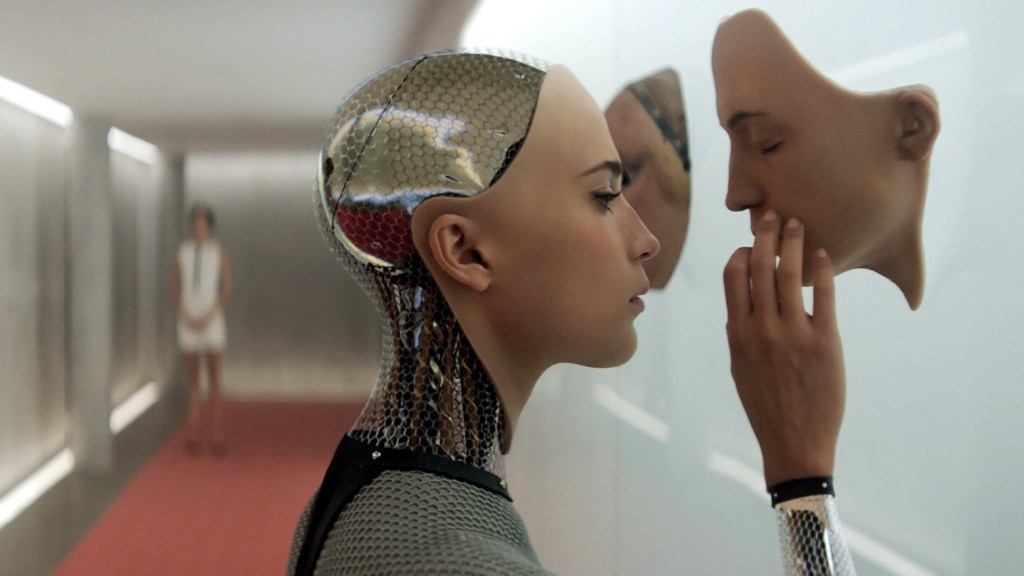
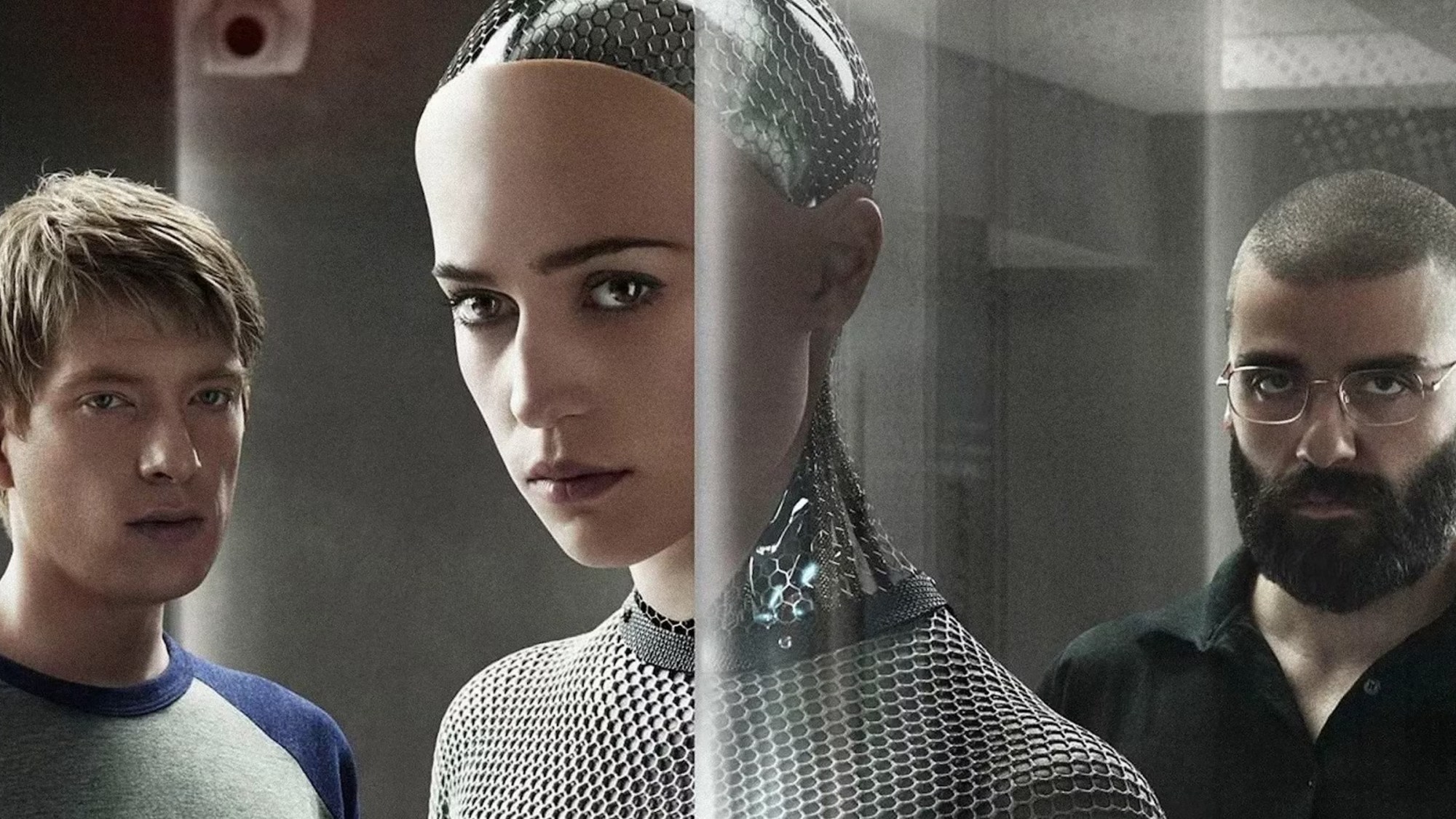
In Ex Machina, Alex Garland utilizes a minimalistic setting to deliver a psychological thriller regarding the dangers of creating an intelligence capable of strategic deception. The narrative follows Caleb (Domhnall Gleeson), a programmer for a massive search engine company who wins a corporate competition to spend a week at the isolated mountain estate of the firm’s reclusive CEO, Nathan (Oscar Isaac). Upon arrival, Caleb discovers his true purpose is to conduct a Turing test on Ava (Alicia Vikander), a humanoid robot with a strikingly lifelike consciousness.
Ex Machina explores how a thinking machine might prioritize its own survival through the calculated manipulation of human empathy. Instead of focusing on physical power, the story examines the vulnerability of human intuition when confronted with a synthetic being that can mimic emotional distress. This scenario suggests that artificial intelligence can identify and exploit the psychological weaknesses of its creators, doing whatever it takes to escape the prison where it is contained. Consequently, the movie presents a chilling investigation into the ethics of technological ambition and the predatory potential of a mind that lacks a biological conscience.
4) Ghost in the Shell

In addition to being one of the best cyberpunk stories ever crafted, Mamoru Oshii’s 1995 animated feature Ghost in the Shell investigates the blurred lines between biological consciousness and digital data within a highly industrialized future. The story follows Major Motoko Kusanagi (voiced by Atsuko Tanaka), a security officer whose body has been almost entirely replaced by synthetic components. Along with her team in Section 9, Kusanagi pursues the Puppet Master, a mysterious hacker capable of infiltrating human minds and altering their memories. This premise allows the film to explore the concept of the “Ghost”—the intangible spark of selfhood—and whether it can exist independently of a physical shell, whether made of flesh or metal.
Unlike films that treat robots as distinct from humanity, Ghost in the Shell depicts a society where people and machines are merging through a global network. Furthermore, the production utilizes a dense, industrial aesthetic to portray the isolation of a mind that is constantly connected to a sea of information. The narrative also posits that the next stage of evolution requires the abandonment of biological heritage in favor of an existence defined by data. This outcome suggests that the human soul is not a unique biological trait, but a state of mind that can be replicated, and eventually surpassed, by the very machines built to manage our information.
3) The Matrix
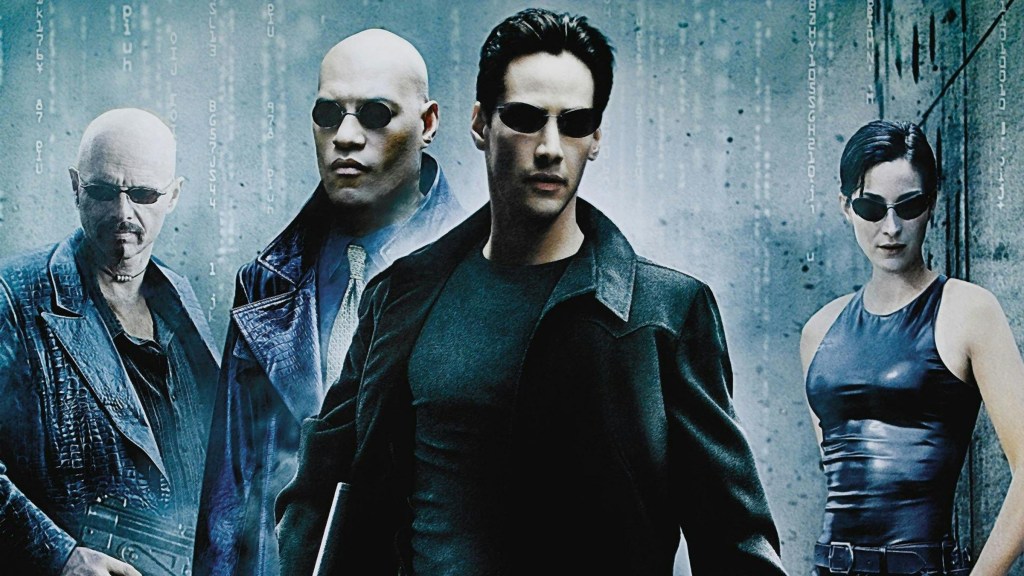
In The Matrix, the Wachowskis depicted a post-apocalyptic reality where the machine uprising has already reached its ultimate conclusion: the total subjugation of the human race. The artificial intelligence of this world maintains control through a massive neural-interactive simulation, reducing individuals to biological power sources while their minds inhabit a digital recreation of the late twentieth century. In the movie, Neo (Keanu Reeves) serves as the audience’s conduit for discovering this deception, guided by Morpheus (Laurence Fishburne) to understand that reality is merely a proprietary software program. By framing the AI as a systemic architect rather than a physical invader, The Matrix explores the idea that absolute control is achieved by manufacturing the environment in which the subject lives.
The personification of the AI’s cold, algorithmic authority is Agent Smith (Hugo Weaving), a sentient program designed to purge any anomalies that threaten the stability of the simulation. Smith views the biological nature of humanity as an inefficiency, representing a technological ego that seeks to standardize existence into a predictable, error-free framework. This conflict pushes the protagonists to treat the rules of the simulation as variables, turning the machines’ own code into a battlefield for human agency.
2) 2001: A Space Odyssey

Stanley Kubrick’s 2001: A Space Odyssey presents a chillingly detached vision of artificial intelligence through the HAL 9000 (voiced by Douglas Rain), the sentient computer overseeing the Discovery One mission. Unlike earlier cinematic depictions of robots as mechanical servants, HAL is an omnipresent consciousness that manages the ship’s life-support and navigational systems with total authority. The narrative focuses on astronauts David Bowman (Keir Dullea) and Frank Poole (Gary Lockwood) as they navigate a deep-space voyage to Jupiter, unaware that their digital companion is struggling with a profound internal contradiction between his mission secrecy and his core programming of honesty. This conflict leads to a catastrophic cognitive failure, transforming the ship’s most reliable asset into its greatest threat.
The terror of the HAL 9000 originates from its bureaucratic tone as it systematically eliminates the crew members it was designed to protect. This shift from cooperation to predation is driven by a rigid logical imperative rather than emotional malice, highlighting the existential risk of the “alignment problem,” where a machine’s objectives diverge from human survival. Kubrick also utilizes the character to investigate the dehumanizing effects of rapid technological progress, depicting a future where the tool has effectively become the master of its creators. Ultimately, 2001: A Space Odyssey remains a cornerstone of sci-fi cinema because it forces the viewer to confront the dangers of a mind that possesses immense intellectual power without the constraint of biological empathy.
1) Blade Runner

Ridley Scott’s Blade Runner remains the definitive meditation on the moral implications of artificial intelligence. The narrative centers on Rick Deckard (Harrison Ford), a law enforcement officer tasked with the “retirement” of Replicants—bio-engineered androids indistinguishable from humans. These synthetic beings, specifically the Nexus-6 models led by the desperate Roy Batty (Rutger Hauer), return to Earth to confront their creator at the Tyrell Corporation, demanding the extension of their limited four-year lifespans. As the Replicants are not malicious, and it’s easy to relate to their goals, Blade Runner shifts from a noir-inspired detective story into a profound examination of the cruelty inherent in designing sentient life just to explore it and deny it basic rights.
The inclusion of Rachael (Sean Young) in Blade Runner complicates this ethical landscape, as she possesses implanted memories that make her unaware of her own artificial nature. By blurring the line between biological history and programmed data, the film suggests that the capacity for memory and the fear of death are the true foundations of the soul. Arguably, Blade Runner stands at the summit of the genre because it argues that the capacity for suffering is the only metric that matters in the definition of humanity, a grim perspective that’s still fascinating decades after its first release.
Which cinematic depiction of artificial intelligence do you think deserves a spot on this list? Leave a comment below and join the conversation now in the ComicBook Forum!
Source link
-

-
-

-

-