

Most sci-fi aims to be striking and flashy, dealing in juicy concepts and big special effects. Grounded science fiction, by contrast, is more character-focused, with smaller stakes, more subtle speculative concepts, and usually a more metaphorical or allegorical approach. These movies typically take one speculative idea and anchor it firmly in human emotions.
With this in mind, this list ranks the very best sci-fi movies that take a more elliptical approach to storytelling. Rather than galaxies far, far away, the following films imagine futures that feel uncomfortably close and deal with emotions that feel painfully real. They prove that the genre doesn’t always need spaceships, laser battles, or world-ending spectacle; indeed, sci-fi can be just as engaging when it’s relatable.
10
‘Never Let Me Go’ (2010)
“Maybe none of us really understand what we’ve lived through, or feel we’ve had enough time.” Based on Kazuo Ishiguro’s novel, Never Let Me Go is science fiction almost by accident, its speculative premise revealed quietly and subtly. For most of its runtime, it just seems like a realist drama. The main characters are Kathy (Carey Mulligan), Ruth (Keira Knightley), and Tommy (Andrew Garfield), three children raised at an idyllic English boarding school who slowly come to understand that they exist solely to donate their organs until they “complete.” They are clones, medical backups for the wealthy.
Director Mark Romanek grounds this harrowing premise in muted performances, pastoral imagery, and everyday jealousy and longing. The sci-fi concept never overwhelms the characters’ emotions or psychology. By treating its future as bureaucratically normalized rather than spectacularly evil, Never Let Me Go becomes one of the most chillingly plausible visions of exploitation ever put on screen.
9
‘Gattaca’ (1997)

“There is no gene for the human spirit.” Gattaca imagines a near-future society where genetic engineering determines social status, employment, and personal worth. Vincent Freeman (Ethan Hawke), born naturally and therefore deemed genetically inferior, dreams of becoming an astronaut, a goal forbidden by his DNA. To pursue it, he assumes the identity of Jerome (Jude Law), a genetically “perfect” man whose own life has collapsed under the weight of expectation.
The science in Gattaca is deliberately modest: no fantastical mutations, no superpowers, just incremental advances in genetic screening taken to their logical extreme. The ideas it explores are already here, with talk increasing of “designer babies” and a potential future where the rich edit their genes, adding a biological dimension to inequality. Andrew Niccol’s restrained direction and the film’s elegant, retro-futuristic design reinforce the idea that progress can quietly erode humanity without ever announcing itself as evil.
8
‘Children of Men’ (2006)

“As the sound of the playgrounds faded, the despair set in.” Few dystopian movies are as smart or as entertaining as Children of Men. Alfonso Cuarón presents us with an unsettlingly plausible future: a world where humans have become infertile, and society has slowly collapsed under the weight of despair. Set in a militarized, xenophobic Britain, the story follows Theo (Clive Owen), a disillusioned bureaucrat tasked with escorting the first pregnant woman (Clare-Hope Ashitey) in nearly two decades to safety.
The infertility crisis is treated like climate change or political decay: catastrophic, omnipresent, and normalized. The themes are handled well, and the aesthetics are stylish and immersive throughout. Cuarón shoots the world with documentary immediacy (and some phenomenal long takes), embedding sci-fi ideas into refugee camps, urban decay, and state violence that feel ripped from contemporary headlines. The speculative hook fades into the background, leaving a brutally human survival story.
7
‘The Martian’ (2015)
“I’m gonna have to science the s—t out of this.” The Martian is grounded sci-fi in the most literal sense: it’s about staying alive on another planet using math, botany, and stubborn optimism. When astronaut Mark Watney (Matt Damon) is presumed dead and left behind on Mars, he must engineer solutions to survive until rescue becomes possible. The tension doesn’t come from alien threats or cosmic mysteries, but from realistic engineering problems: oxygen supply, food production, communication delays, and orbital mechanics.
NASA procedures, scientific method, and international cooperation are depicted with unusual care and respect. Watney himself refuses to catastrophize; his humor, problem-solving mindset, and resilience feel recognizably human. Damon is great in the role, pretty much carrying the whole movie single-handedly. All in all, The Martian is a solid, enjoyable movie about Mars that aims to be relatively realistic. Perhaps we’ll look back on it as being somewhat prophetic.

“The universe is a pretty big place. If it’s just us, seems like an awful waste of space.” Contact explores humanity’s first encounter with extraterrestrial intelligence. However, it bucks convention by avoiding the typical invasion plot and instead presenting the situation as a slow, bureaucratic, faith-testing process. In it, Jodie Foster is Dr. Ellie Arroway, a radio astronomer who dedicates her life to listening for signals from deep space. When a message is finally received, the discovery sparks global debate, political maneuvering, and religious conflict.
Contact is interesting in large part because it focuses on institutional responses rather than the expected sci-fi spectacle. Governments argue, scientists disagree, and faith leaders react with fear and wonder. First contact becomes a logistical, philosophical, and emotional crisis. In other words, the movie’s central question isn’t whether aliens exist, but how humanity would cope with proof that it isn’t alone. Perhaps this premise will one day be real rather than hypothetical.
5
‘Primer’ (2004)

“The important thing is not to believe me.” Primer might be the most rigorous and believable time-travel movie ever. It’s lean and complex, leaning into intelligent writing rather than CGI or special effects. It revolves around two engineers (played by David Sullivan and writer-director Shane Carruth) who accidentally invent a time machine in their garage while working on side projects. The machine operates with strict rules, physical limitations, and compounding consequences, which the protagonists try in vain to undo.
The movie itself is a puzzle-box, with too many subplots and intricate details to fully understand on the first viewing. It refuses easy exposition, forcing viewers to piece together timelines and motivations through dense dialogue and fragmented scenes. The science is treated as engineering, not magic, and the emotional fallout is quiet, messy, and deeply unsettling, rightly earning Primer a cult following.
4
‘Ex Machina’ (2014)

“One day, the AIs are going to look back on us the same way we look at fossil skeletons.” Ex Machina strips artificial intelligence down to its psychological core. The plot centers on Caleb (Domhnall Gleeson), a young programmer invited to test Ava (Alicia Vikander), a humanoid AI created by reclusive tech CEO Nathan (Oscar Isaac). However, the test isn’t really about whether Ava can think but rather whether she can manipulate, deceive, and desire freedom.
What makes the film grounded is how closely it mirrors real-world tech culture: private research, unchecked power, ego-driven innovation, and ethical blind spots disguised as progress. Sure, the plot is a little pulpy and more action-packed than real-world AI dangers would actually be, but the ideas it explores are certainly topical and well-executed. It makes for one of the most pointed movie statements on AI, a total rebuke to Spielberg‘s A.I. Artificial Intelligence.
3
‘Moon’ (2009)

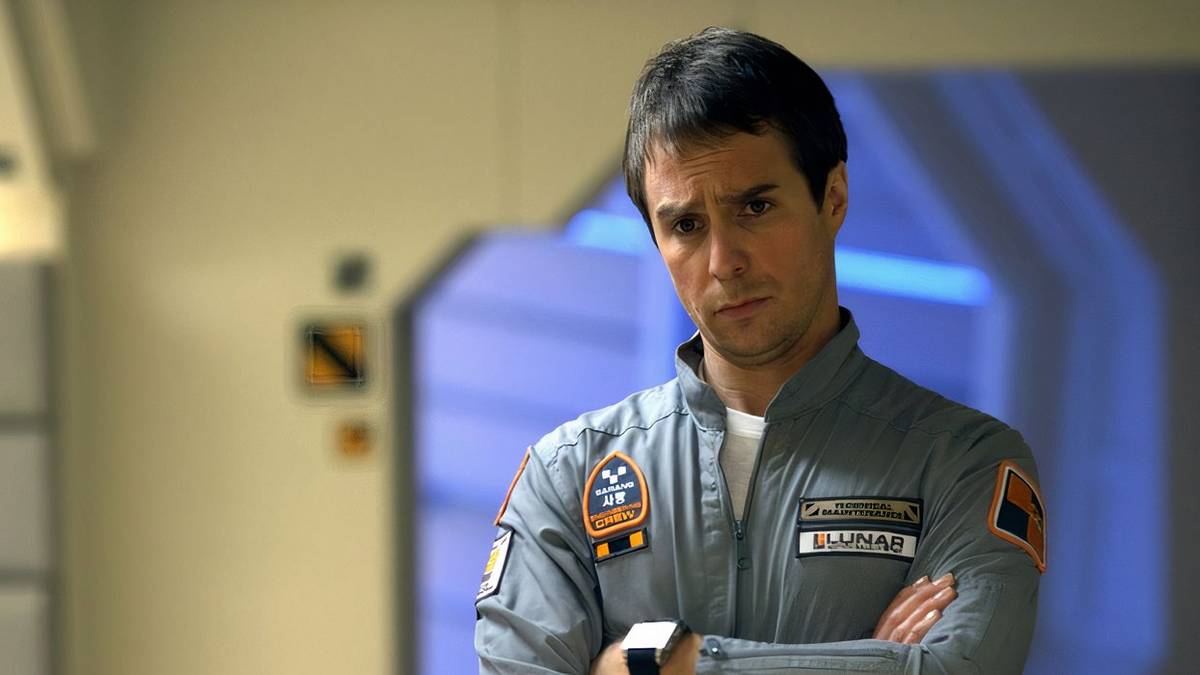
“We’re not programmed. We’re people.” Sam Rockwell turns in a wonderful performance (or two) in this one, playing an employee working alone on a lunar base, harvesting energy for Earth. While nearing the end of a three-year contract, Sam suffers an accident and begins to uncover disturbing truths about his mission and identity. The tale that follows uses isolation and deception rather than technology to generate its tension.
Moon is intimate and low-budget, and the science in it is fittingly minimal and functional: lunar operations, AI assistance, cloning as a corporate convenience rather than a grand experiment. However, Rockwell’s layered performance significantly elevates it, really capturing the character’s loneliness, confusion, and existential dread, as well as his initial naive hope that things are other than they seem. It all adds up to a low-key but touching sci-fi character study, one that makes remarkably effective use of its limited elements.
2
‘Her’ (2013)

“The heart’s not like a box that gets filled up. It expands in size the more you love.” The near-future depicted in Her is so gentle and plausible that it barely registers as sci-fi. Indeed, it increasingly resembles the present. Theodore (Joaquin Phoenix), a lonely writer, falls in love with Samantha (voiced by Scarlett Johansson), an advanced operating system designed to adapt and grow emotionally. There are no android bodies, no rogue AI rebellions, only software evolving faster than human attachment can keep up.
The technology in Her feels like a natural extension of voice assistants, social media, and emotional outsourcing. Already today, there are stories of lonely people forming unhealthy attachments with their AI companions. In other words, Her is sci-fi rooted in contemporary loneliness and real-world technology. It’s already proven itself to be prophetic, and its legacy as one of the all-time most powerful sci-fi movies is only set to grow with time.
1
‘Arrival’ (2016)

“If you could see your whole life from start to finish, would you change things?” Arrival is a first-contact film built on linguistics, patience, and emotional reckoning rather than panic or warfare. When alien vessels appear across the globe, linguist Louise Banks (Amy Adams) is tasked with learning how the visitors communicate, a process that reshapes her perception of time itself.
The film grounds this high-concept premise in academic realism, including translation theory. The institutions in it are likewise depicted plausibly. Governments react cautiously, and military escalation looms not from malice, but misunderstanding. Yet, what ultimately grounds Arrival is its emotional core. It ties cosmic discovery to grief, choice, and the human experience of time. Although there are extraterrestrials, the story is fundamentally personal, dealing with universal issues of love, loss, and how to persist knowing that pain is guaranteed. All in all, a 21st-century sci-fi masterpiece.

Arrival
- Release Date
-
November 11, 2016
Source link
