

Last month, Ryan Gosling addressed an audience about to see his new movie. “It’s not your job to keep cinemas open,” he told them. “It’s our job to make things that make it worth you coming out. This movie’s for you. Enjoy the trip!”
Small wonder they applauded. This is a strategy radically different to that adopted in the immediate aftermath of the pandemic, when studios believed the best way to get people to leave their homes and buy cinema tickets was to hector them to do so.
It proved a nasty error of judgment. Audiences voted with their feet, by putting on their slippers and turning on Netflix. Blockbusters bombed, and 40% of screens in the US closed.
A rear-view mirror problem – the advent of streaming – was suddenly in close-up. And the picture has remained critical ever since. Projections suggest that the box office might bounce back to pre-pandemic levels in 2030 – pending further disasters.
As for Gosling, he first adopted the tactic of flattering consumers – and taking responsibility for the future of his own industry – in the summer of 2023. Then, he was promoting Barbie, which made $1.4bn (£1.2bn) and became the highest-grossing film of that year. The highest-grossing opening of 2026 so far is Gosling’s new movie, Project Hail Mary, which took $141m over its first weekend, for a rolling total of $577m.
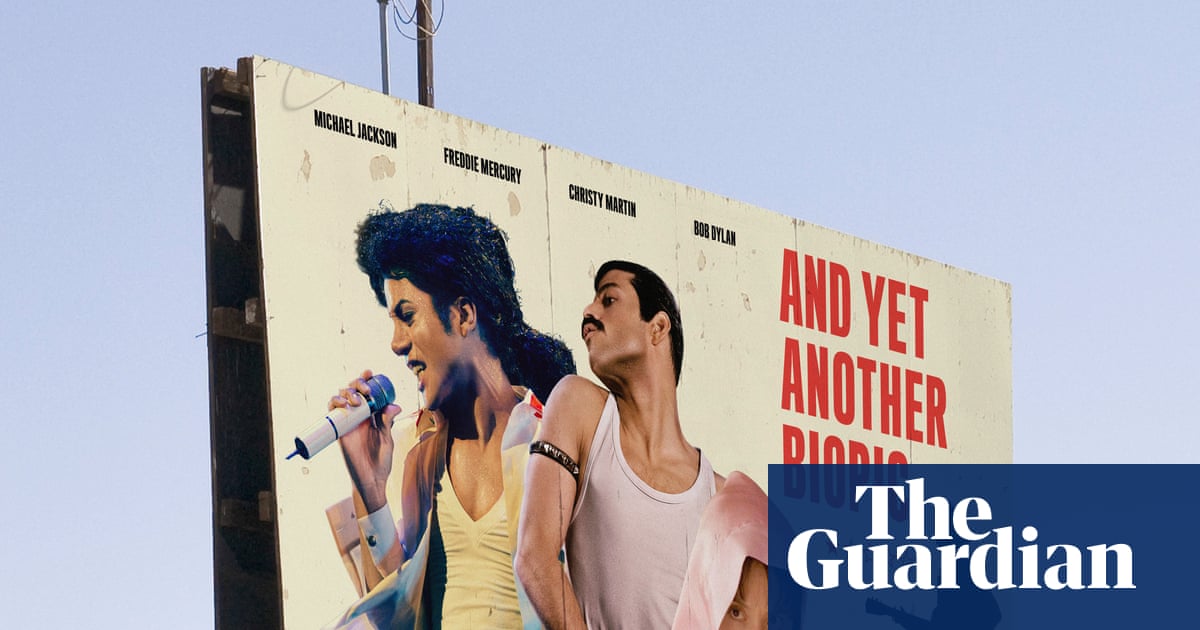
Yet Mary is now almost certain to be usurped by Michael, Antoine Fuqua’s biopic of Michael Jackson. The two films – and, indeed, Barbie – share some key DNA. Their sell relies on the idea they have been made for that nebulous entity, the fans – rather than, say, cineastes, and much less the critics. Going to see them is a treat. An event, even. So enjoy! And for God’s sake, don’t overthink it.
Michael is currently tracking to take $165m over its first three days. Less than half of that would come from the US, yet it’s still likely to secure the highest ever domestic opening for a music biopic, beating both Straight Outta Compton ($60m) and Bohemian Rhapsody ($51m). Michael shares a producer, Graham King, with the Freddie Mercury film, which wound up taking $911m, making it the biggest music biopic ever by a margin of more than $600m.
Michael is also – just to spin those box office records a little longer – the most expensive music biopic ever made, with a final budget of some $200m. Around $50m of that funded reshoots required after the producers realised a legal settlement with one of the men who had accused the singer of sexual assault meant they had to throw out the entire third act.
The original cut of the film dramatised the impact on Jackson of these allegations, which have since been spoken about with scepticism by Fuqua, who said “sometimes people do some nasty things for some money”. The movie similarly avoids the other allegations that have since emerged against Jackson, by opting to bring down the curtain in 1988.
All of that goes some way to explaining the dire slate of reviews posted for Michael upon its release: “A frustratingly shallow, inert picture,” wrote Peter Bradshaw in the Guardian; “insulting both to audience and subject,” wrote Alissa Wilkinson in the New York Times. There were many other pans besides.
But will any of that matter to audiences?
Given what else those buying tickets for Michael are choosing to ignore, a withering critic seems unlikely to give them pause.
*****
Michael is not just a watershed moment for the music biopic. Its likely fate – many predict a final take above $1bn – appears to give proof to some striking new realities about the current state of the industry. The key takeaway seems to be that when it comes to objectivity, integrity and veracity, audiences will always prioritise the chance to have a singsong.
“The fans want to go see somebody dance and hear the greatest hits and they don’t really give a damn whether or not the story resembles reality in any way,” says Steven Gaydos, former executive editor of Variety.
The director Kevin MacDonald – whose career has mixed both documentary (the Oscar-winning One Day in September, plus films about Whitney Houston, Mick Jagger, Bob Marley and John Lennon) and fiction (State of Play, Black Sea) – agrees. “Audiences don’t seem to care [about truth],” he says. “Many of these films are pure fan service. Which is fine as far as it goes. Maybe we were all naive for believing that popular artists were worth looking at seriously, critically?”
The broader the brushstrokes, he thinks, the more coshing the cliches and obvious the needle drops, the bigger the impact. “The audience for these films knows what they’ll get – and no matter how bland the telling is, the music will be reliably great.” He puts the success of Bohemian Rhapsody down to its recreation of the last 10 minutes of Live Aid.
“It was rapturous and utterly immersive – in a way I don’t remember the original performance on TV being. Ironically, cinemas are being kept open by the fact that music sounds so great in surround sound and Dolby Atmos.”
This truism helps explain why the music biopic is stuck in such a compromising loop. If what people want is a basic jukebox experience echoing stage shows such as MJ: the Musical ($319m in five years), the major concern for the producers is access to the hits. Without those – as Andre 3000’s Jimi Hendrix film ($600,000) and Johnny Flynn’s David Bowie biopic ($62,000) testify, not to mention the legendarily dreadful 2004 Michael Jackson biopic Man in the Mirror (debuted on VH1) – you might as well not bother.
These rights come at a cost, however. Whoever controls the songs also controls the story. Audiences appear fine with the trade-off. But what about the directors? “Even the most celebrated film-makers in Hollywood seem perfectly fine with doing authorised biographies,” says Gaydos. “Once you sign on with the family or the star themselves, you’re getting their version of reality. So they’re often just egregiously false.”
He points to a precursor in Martin Scorsese’s acclaimed Bob Dylan documentaries, in which the musician is most often quizzed not by Scorsese, but by his own lawyer, Jeff Rosen. The same Jeff Rosen served as a producer on A Complete Unknown, the recent Dylan biopic starring Timothée Chalamet.
Not that Dylan necessarily needed his oversight. “Bob read every line of that script,” says Gaydos. “The movie is 100% the Bob Dylan view of the Bob Dylan story. And artistically I think it suffers tremendously as a result.”
Commercially, however, the film was a hit: $141m at the box office, plus a lucrative-for-the-future introduction of Gen Z to the now 84-year-old Dylan. Its success led to the greenlighting of Bruce Springsteen biopic Deliver Me From Nowhere, which was also made with the close involvement of its subject.
But the algorithm isn’t infallible. Despite the heat of star Jeremy Allen White and a big promotional push by the Boss himself, the movie – which majored on the recording of 1982 album Nebraska in Springsteen’s bedroom – made just $45m ($10m less than its production budget).
“I don’t think the Springsteen movie failed because it was a whitewash,” says Gaydos. “It failed because it was a giant bore. Nobody seems to care that [A Complete Unknown’s] James Mangold or Martin Scorsese signed on to do movies that are basically authorised by the guy they’re making the movie about. But I think that’s a deadly trend.”
While broadcasters such as the BBC would not currently tolerate estate control, says MacDonald, the readiness of streamers to do so means the future looks bleak. “Most of those celebrity documentary films and series don’t require any kind of detachment. Estates and living celebrities are happy to take producer credits on films about themselves. It’s no secret. The whole idea that an artist should be looked at journalistically has gone the way of Top of the Pops.”
Plus, the spending power of such estates gives them leverage most film-makers can never match. “The saddest example of this was Ezra Edelman’s series about Prince, which he spent years working on, only for the estate to close it down because it portrayed Prince in a way that they felt was detrimental to their business.”
MacDonald himself made a series about Oprah Winfrey a few years ago, over which he and his producer had the final cut. “But Oprah decided she didn’t like the depiction and bought the entire film from the streamer who financed it.”
*****
For a full century, biopics were a byword for melodramatic trash. The first one, about Joan of Arc, appeared in 1900; the following 10 decades were littered with lurid and ludicrous compressions of celebrity lives – as well as a few good ones.
Still, the consensus in Hollywood and beyond was that the genre was a bit of a joke. That it would clearly be disingenuous to presume an accurate account could be squeezed into two hours. Anything thorny would be first to be pruned.
It took 100 years for a groundswell of film-makers to twig that inclusion of prickly incidents, the scattering of grit in the mix, might make for a movie that was both a crowdpleaser and credible.
In 2004, Jamie Foxx’s technically impeccable and emotionally complicated portrayal of Ray Charles won him the Academy Award for best actor. A year later, for Walk The Line, Reese Witherspoon’s June Carter Cash won best actress (though Joaquin Phoenix’s Johnny lost out to Philip Seymour Hoffman’s Truman Capote).
Between 2000 to 2019, 55% of leading actor and actress Oscars went to performances in a biopic. Over the past four years, the genre has been responsible for 63 Oscar nominations. Yet at the same time, hagiography has resurfaced as a pre-requisite for success.
Baz Luhrmann’s authorised Elvis (2022), which boasted endless bangers, made a villain out of Presley’s manager and was praised by his family, made $287m and scored eight Oscar nominations. Sofia Coppola’s unauthorised Priscilla (2023) however, which tarred Elvis, was disowned by his family and soundtracked by Coppola’s husband, received zero Oscar nominations and made $33m.
At the same time, an industry already beleaguered by streamers and laid low by Covid faced new challenges. Superhero interest plateaued. While once the brand recognition of a Marvel movie translated into guaranteed profits, Hollywood can no longer rely on lycra.
Live music has superseded them as the boom economy of the age. And as concert films such as James Cameron’s upcoming Billie Eilish 3D extravaganza, plus the megahit ($262m) movie version of Taylor Swift’s Eras tour prove, the film industry is only too eager to leech off the music business. Event cinema is essential, even if the event has little to do with cinema.
The saturation of social media, meanwhile, has meant everyday interest in the lives of celebrities has only got more intense, intimate and easy to manipulate. While one might have supposed the advent of the internet could render biopics redundant – if facts and archive footage are readily accessible, why bother making stuff up? In fact, being constantly supplied with new information about celebrities has only fuelled investment in them. Simultaneously, Instagram, TikTok and X have further acclimatised people to the idea that it’s de rigeur for pop stars to completely curate their own image – and to mercilessly monetise it.
For an industry over a barrel, it’s not an option to ignore any flotsam and jetsam that might turn out to be a life raft. “Biopics are just another variation on IP mining,” says Gaydos. And right now studios are ravenous for “anything that has a pre-sold quality to it – or, I would argue, pre-masticated”.
Films depicting the heady breakthroughs of music icons also boast a baked-in nostalgia – a comfort factor ever more appealing for audiences seeking to escape the news. “People just love basking in the memories of being 18,” says Gaydos. “And Hollywood has got really good at mining that desire to go back to your youth and remember what you wore and who you kissed. It’s not artistically very interesting or sound, but boy is it good business.”
Which brings us to Sam Mendes’s four Beatles movies – the first fictional depictions of the band to include the rights to use their songs. Both Ringo Starr and Paul McCartney are heavily involved in production, a complicity offset by the fact each instalment allows for a different man’s perspective. Accusations of whitewash and bias can be headed off well in advance.
Splitting the story such also means overall takings will either be diluted – or multiplied. Which is hard to gauge at this stage, although what happens this weekend will offer some pointers.
“There’s not a human being on earth that doesn’t know who Michael Jackson was,” says Gaydos, “and the same is true of the Beatles. If a film can promise to put 14 of their songs on the soundtrack, you’ve got a licence to print money.”
Source link