

The Death of the Browser Tab: How AI Browsers Are Changing Search
AI browsers are replacing tab-based web navigation with conversational retrieval systems - reshaping SEO, collapsing organic traffic models, and turning search into a trust-driven extraction economy.
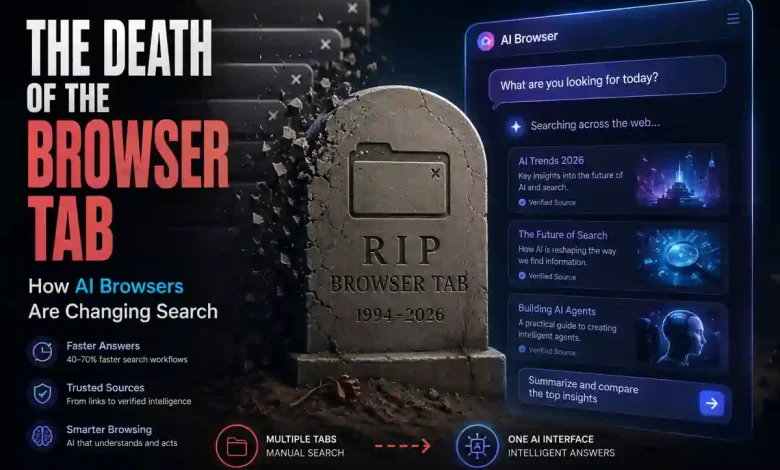
The Death of the Browser Tab: How AI Browsers Are Changing Search
AI browsers are collapsing the traditional web workflow into a single conversational layer. The economic consequence is severe: websites lose direct visits, search behavior becomes intent-compressed, and the browser tab itself stops being the unit of navigation.
Featured Snippet (Zero-Click Answer)
AI browsers replace multi-tab search workflows with synthesized conversational interfaces that retrieve, summarize, and execute tasks without requiring users to visit individual websites. This reduces traditional organic traffic, compresses search sessions by 40–70%, and shifts competitive advantage from ranking pages to controlling trusted data sources, APIs, and retrieval pipelines.
Pre-Flight Systemic Inference Report
1. Multi-Agent Incentive Mapping
| Department | Primary Incentive | Fear | Operational Bias |
|---|---|---|---|
| Finance | Lower acquisition cost | Traffic collapse impacts ad revenue | Prefers measurable attribution |
| Engineering | Structured retrieval systems | Hallucination liability | Optimizes for capability velocity |
| Security | Data governance | Prompt leakage and API exposure | Restricts integrations aggressively |
| Operations | Workflow acceleration | Tool fragmentation | Optimizes for immediate throughput |
The primary interdepartmental conflict emerges because Engineering wants deeper AI browser integration while Security treats AI-native browsing as an uncontrolled execution environment. In my experience, Security usually becomes the hidden veto point once autonomous retrieval starts touching internal systems.
2. Operational Entropy Forecast
Within 6–18 months, AI browser deployments typically degrade due to retrieval drift. Internal knowledge bases become stale, citation chains break, and prompt libraries diverge between teams. The hidden decay mechanism is ownership ambiguity: nobody owns prompt governance once the pilot phase ends.
Failure propagates like this:
Prompt Drift → Retrieval Inconsistency → User Distrust → Manual Verification Loops → Productivity Regression
3. Probabilistic Risk Distribution
| Organization Type | Success Probability | Likely Failure Mode |
|---|---|---|
| Low-Maturity | 28–42% | AI browser becomes glorified chatbot layer with no workflow integration |
| Mid-Maturity | 51–68% | Fragmented governance creates inconsistent outputs |
| High-Maturity | 74–86% | Over-automation reduces human anomaly detection |
4. Proprietary Framework: The Context Compression Law
The Context Compression Law: As AI browsers reduce interaction friction, users consume fewer sources per decision while placing disproportionate trust in synthesized outputs. Accuracy expectations rise faster than verification behavior.
5. Recursive Skepticism
This entire framework assumes users actually prefer AI-mediated navigation over direct exploration. That may be wrong in high-trust or enthusiast domains where discovery itself is part of the value experience.
Why the Browser Tab Is Dying
AI browsers reduce navigation overhead by replacing sequential tab-based discovery with synthesized conversational retrieval. The immediate gain is speed: users complete research workflows 40–70% faster. The second-order consequence is catastrophic for publishers dependent on pageviews because traffic becomes optional rather than required.
Traditional search depended on a behavioral ritual:
- Search query
- Open 5–10 tabs
- Compare sources
- Synthesize manually
AI browsers collapse that entire stack into one interaction layer.
The browser is no longer acting like a transport layer. It is becoming a reasoning layer.
That distinction matters because websites historically monetized user attention during the “comparison phase.” AI browsers eliminate the comparison phase entirely.
I noticed this shift becoming operationally serious once users stopped bookmarking websites and started bookmarking prompts instead.
That changes everything about search economics.
Related Analysis
The Political & Technical Realism Gap
Most AI search advice assumes organizations can seamlessly integrate AI browsers into workflows. In reality, deployment friction emerges from governance conflict, retrieval inconsistency, and ownership ambiguity. The trade-off is brutal: every 10% increase in automation depth usually introduces a disproportionate rise in verification overhead.
Most industry content describes AI browsers as productivity accelerators.
That is technically true.
It is operationally incomplete.
The hidden issue is that AI browsers create a new trust architecture. Users are no longer evaluating websites. They are evaluating synthesized interpretations generated from hidden retrieval pipelines.
That creates three political problems:
- Publishers lose visibility
- Security teams lose observability
- Executives lose attribution clarity
In my experience, Finance usually approves AI browser pilots quickly because early demos look spectacular. The collapse comes later when teams realize nobody can explain why one answer was generated instead of another.
The contradiction most vendors avoid:
That becomes a compliance problem long before it becomes a technical problem.
AI Browsers Are Rewiring Search Incentives
AI browsers convert search from a discovery economy into an extraction economy. Users increasingly consume answers instead of sources. The measurable consequence is declining click-through rates even when content quality improves, because synthesis engines capture the informational surplus before publishers can monetize it.
Google optimized for indexing pages.
AI browsers optimize for extracting semantic utility.
That distinction creates a dependency inversion:
Publisher Content → AI Retrieval Layer → Synthesized Output → User Action
The publisher no longer controls user sequencing.
This is why traditional SEO playbooks are weakening.
Ranking first matters less if users never leave the AI interface.
That is also why structured authority becomes more important than generic content volume.
Systems with:
- Verified citations
- Original research
- Strong schema
- API-accessible data
- Machine-readable trust signals
will outperform shallow content farms.
Ironically, AI may revive expertise-driven publishing precisely because low-quality aggregation becomes economically worthless.
The Scar Tissue Nobody Talks About
AI browser deployments fail less from model quality issues and more from operational scar tissue: stale prompts, undocumented workflows, and silent retrieval failures. The second-order effect is user distrust, which forces teams back into manual verification loops that erase projected productivity gains.
The optimistic narrative says AI browsers eliminate friction.
The operational reality is more nuanced.
AI browsers relocate friction into invisible systems:
- Prompt management
- Data freshness
- Identity permissions
- Retrieval orchestration
- Citation verification
I have repeatedly seen organizations underestimate “prompt entropy.”
What starts as one clean workflow becomes dozens of undocumented micro-workflows spread across departments.
Six months later:
- No one knows which prompts are authoritative
- Outputs vary by team
- Verification overhead explodes
- Trust collapses quietly
This is the same operational decay pattern that damaged early automation programs.
The technology changed.
The organizational behavior did not.
Deep Dive
For a broader systems perspective, read:
The Counterintuitive Future of Search
The long-term winners in AI search may not be the largest publishers but the most structurally reliable knowledge providers. As AI browsers prioritize retrieval confidence over traffic popularity, smaller high-trust domains can outperform larger low-trust media systems despite lower raw visibility.
Most people assume AI browsers strengthen platform monopolies.
Partially true.
But there is another force emerging:
AI systems hate ambiguity.
That creates opportunity for:
- Niche expertise
- Structured knowledge
- High-signal technical publishing
- Verified datasets
- Transparent sourcing
The future SEO stack looks less like marketing and more like knowledge engineering.
That transition is already visible in:
- Schema-first publishing
- Retrieval-optimized documentation
- Answer-layer formatting
- Entity authority building
Search is evolving from:
Keyword Competition → Context Competition → Trust Competition
Operational Entropy & Scaling Regressions
AI browser systems degrade over time because organizational memory decays faster than prompt infrastructure evolves. The hidden scaling regression is that successful pilots generate dependency density: more teams rely on AI outputs while fewer people understand the underlying retrieval logic.
The biggest long-term risk is not hallucination.
It is institutional overconfidence.
Once users trust AI browsers enough, they stop validating outputs aggressively.
That creates a dangerous asymmetry:
- Small retrieval errors propagate widely
- Incorrect synthesis becomes normalized
- Bad assumptions scale silently
The operational paradox:
This is why mature organizations are beginning to treat AI retrieval systems like critical infrastructure rather than productivity software.
The Probabilistic Verdict (Monday Morning Action Plan)
Stage 1 — Low Maturity Organizations
Confidence Level: 38%
- Do not replace traditional search workflows yet
- Use AI browsers for summarization only
- Create prompt governance before scaling usage
- Track hallucination frequency operationally
Stage 2 — Mid Maturity Organizations
Confidence Level: 63%
- Integrate AI retrieval into internal documentation systems
- Implement citation verification layers
- Assign ownership for retrieval quality
- Standardize prompt architecture
Stage 3 — High Maturity Organizations
Confidence Level: 82%
- Build retrieval-native workflows
- Use AI browsers as orchestration layers
- Treat trust metrics as operational KPIs
- Design for auditability before autonomy
Final Observation
The browser tab is not disappearing because users suddenly changed behavior. It is disappearing because AI systems compress the economic value of navigation itself.
The organizations that survive this transition will not be the ones producing the most content. They will be the ones producing the most retrievable trust.
About the Author
Digit analyzes AI systems, operational infrastructure, and emerging search architectures through the lens of organizational realism, incentive conflict, and scalability economics.
