

The End of Cognitive Debt: 7 Lessons from the AI Agent Revolution
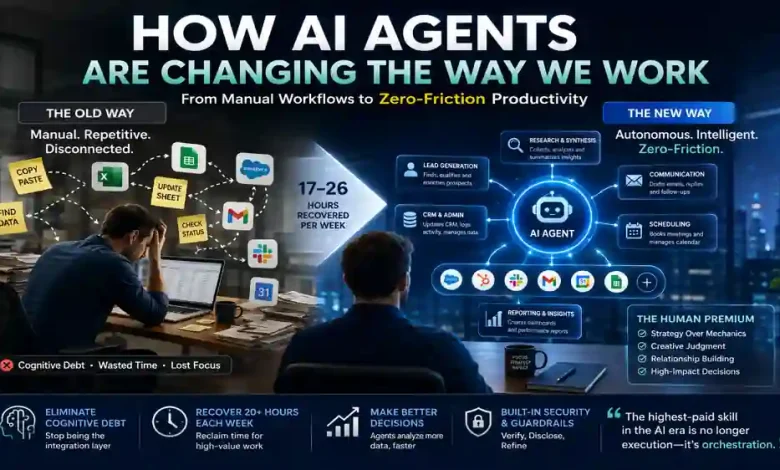
For a decade, we mistook administrative friction for “productivity.” We were wrong. Most knowledge work in the early 2020s was actually Cognitive Debt: the heavy mental tax of acting as the manual integration layer between disconnected software systems.
By 2026, the industry has clearly moved beyond the Chatbot Era. We have transitioned from reactive assistants that wait for a prompt to autonomous Digital Peers that perceive, plan, and execute. This transition marks the beginning of the Zero-Friction Economy.
In This Article
- The Middleware Crisis: Why humans were used as software “glue.”
- The 15% Shift: Data on autonomous workplace decisions.
- The USB for AI: Why the Model Context Protocol (MCP) is the hero of 2026.
- Browser Agents: Why the “Open Tab” workflow is dead.
- The Productivity Recovery Formula: Reclaiming 20 hours a week.
- The Human Premium: Your value in a zero-friction world.
1. Defining “Cognitive Debt”: The Invisible Productivity Killer
In the mid-2020s, the “fourteen open tabs” workflow—frantic copy-pasting and manual data re-entry—was the norm. This was digital blue-collar labor.
The biggest inefficiency of the last decade wasn’t bad software; it was the fact that humans became the integration layer. We were the bridge between the CRM and the spreadsheet. AI agents have settled this debt. We have moved from a “copy-paste” workflow to a “zero-friction” reality where the mechanics of work happen in the background. You can find more insights on this shift in our latest articles.
The Paradigm Shift
OLD: Human → CRM → Spreadsheet → Email → Slack → Calendar
NEW: Human → AI Agent → Unified Execution Layer
2. From Assistant to “Digital Peer”: The Decision Revolution
The paradigm has shifted from basic automation to sophisticated problem-solving. Recent industry reports indicate that while only 17% of organizations have fully deployed agents, those who have are seeing an inflection point: 15% of daily business decisions are now made autonomously by agentic systems.
“AI can enhance strategic decision-making while reducing costs associated with errors caused by biased judgment… The goal is not to replace professionals, but to increase their productive capacity.”
We are no longer managing software; we are leading digital teams. Platforms like Salesforce Agentforce prove that agentic AI is now the backbone of the enterprise. Explore these trends further in our AI resource center.
3. The “USB for AI”: Why MCP is the Hidden Hero
The maturation of the Model Context Protocol (MCP) is the architectural breakthrough of the decade. Think of MCP as a standardized universal remote control.
Previously, developers were trapped in a cycle of building brittle, custom integrations. Providers have revolutionized this via MCP implementations, granting AI agents instant access to over 9,000 apps and 30,000 pre-built actions. For the strategist, the ROI is finally clear: agents can now make high-level judgment calls without a single line of custom code. Explore related tools via our agentic workflow tags.
4. Browser Agents: Browsing is Now a Background Task
We no longer “surf” the web; agents “work” the web for us. The AI browser market is projected to reach $76.8 billion by 2034, expanding at a 32.8% CAGR from its 2024 baseline. These agents operate via a precise 5-step model: Intent Interpretation, Page Analysis, Action Planning, Execution with Adaptation, and Result Validation.
The Reality Check: Consider “Sarah,” a technical recruiter. In 2024, she spent six hours a day manually sourcing LinkedIn profiles. Today, she supervises a browser agent that scans 500+ profiles overnight, cross-references them with her internal database, and drafts personalized outreach. Sarah doesn’t “browse” anymore; she reviews the agent’s “shortlist” over morning coffee.
5. The 20-Hour Recovery: Reclaiming Your Week
By offloading administrative churn to AI peers, the average professional is recovering between 17 and 26 hours per week.
| Task Category | Manual Time (Traditional) | Agentic Time (2026) |
|---|---|---|
| Lead Gen & Prospecting | 10–15 Hours | Automated: Signal-Driven Loops |
| CRM Data Entry & Admin | 3–5 Hours | Automatic: Signature & Calendar Scanning |
| Research & Synthesis | 8–12 Hours | Synthesized: Automated Literature Matrices |
| Documentation | 4–6 Hours | Orchestrated: Transcription & Qualification Bots |
6. The “Human Premium”: Strategy Over Mechanics
As AI handles the “production mechanics,” a new differentiator has emerged: The Human Premium. This is the 20% of the workflow consisting of strategy, personality, and original thought.
The productivity software industry spent two decades optimizing interfaces for humans. AI agents are now optimizing interfaces away from humans entirely. In this world, your value is no longer measured by how well you navigate software, but by the strategic judgment you apply to the work your agents perform. Visit our strategic guides to learn more.
7. The Security Mandate: Lessons from the Field
With autonomy comes risk. In March 2026, researchers disclosed vulnerabilities detailing how Indirect Prompt Injection (IPI) attacks against agentic browsers could potentially trick AI into exfiltrating local files or stealing credentials. Despite rapid progress, agentic systems still struggle with reliability and “context drift” in high-stakes environments.
To maintain rigor, we now adhere to three mandatory guardrails:
- Verify: Never cite an AI summary without auditing the primary source.
- Disclose: Be transparent about exactly where AI agents were utilized.
- Refine: Use AI to handle the mechanics, but never outsource the core reasoning.
FAQ: Understanding the Agent Revolution
What is the difference between an AI assistant and an AI agent?
An assistant (like a basic chatbot) requires a prompt for every step. An agent is agentic: it can plan multiple steps, use external tools, and correct its own course until a goal is achieved.
What is “Cognitive Debt”?
It is the mental energy wasted on repetitive digital tasks—like moving data between apps—that adds no strategic value but is required to keep a business running.
Are AI agents replacing jobs?
Data shows agents are primarily replacing low-leverage labor—the manual tasks that historically prevented professionals from doing the actual work they were hired for.
Conclusion: The Rise of the High-Level Director
The revolution marks the death of the manual searcher and the birth of the “High-Level Director of Digital Intelligence.”
The defining skill of the next decade will not be typing faster, searching better, or mastering another SaaS dashboard. It will be the ability to direct autonomous systems with clarity, judgment, and taste. In the AI era, the highest-paid skill is no longer execution—it is orchestration.
Published: May 6, 2026
Authored by Digit
