

GTA 6 Isn’t Just a Game – It’s a Simulation System: How Rockstar Built It
Inside the streaming architecture, NPC systems, motion matching, and engineering constraints behind modern AAA open-world games.

GTA 6 Isn’t Just a Game – It’s a Simulation System: How Rockstar Probably Built It
The 5-Bullet Executive Reality Check
-
Open-world realism is mostly a memory management problem. Making a game look good is easy; keeping it from crashing while loading assets at 150mph requires an aggressive, predictive SSD pipeline.
-
NPC intelligence is really constraint engineering. Game characters do not use AGI. They run on rigid utility AI and pathfinding meshes. Remove the constraints, and the illusion shatters immediately.
-
AAA games fail at the seams between systems. A ten-year development cycle isn’t spent building 3D models. It is spent fixing the combinatorial explosions that happen when physics, weather, and AI logic collide in the same frame.
-
Animation is now a high-speed database query. Motion matching replaces robotic loops by constantly searching massive motion-capture datasets, but it creates brutal memory pressure.
-
AI is for production, not gameplay. Machine learning is heavily deployed internally for headless bug testing and animation cleanup, but it is kept entirely away from the live runtime environment.
The “Zero-Click” Answer:
GTA 6 relies on complex systems engineering, not generative AI. Photorealism is easy; stable simulation is hard. Rockstar likely uses an aggressively predictive streaming pipeline to beat SSD read windows, motion matching to query animation frames in real-time, and strict utility AI to prevent emergent behaviors from breaking the game’s core logic.
Disclaimer: Rockstar has not publicly documented every internal system behind GTA 6. This article combines publicly known AAA development techniques, technical constraints of modern game engines, and industry-standard architecture patterns to explain how a project at this scale is likely engineered.
The “Smart NPC” Delusion (Constraint Engineering)
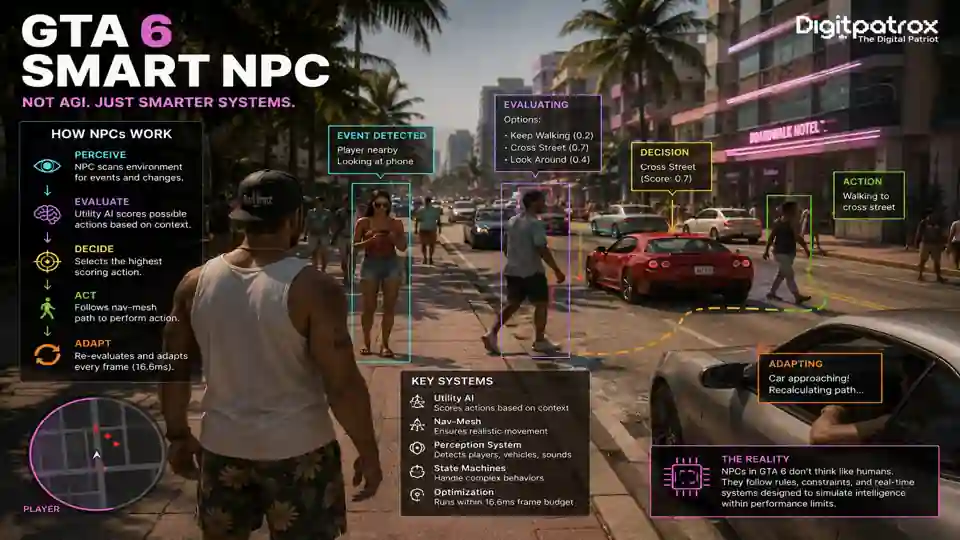
Players expect AGI-driven characters. The reality is heavily layered simulation systems. Modern game AI relies on behavior trees, utility AI scoring, and navigation meshes to simulate complex routines without breaking the frame-time budget.
Tradeoff: Predictable, deterministic behavior at the cost of true emergent conversational depth.
Here is where the gaming industry hype completely disconnects from technical reality. We keep seeing articles suggesting open-world NPCs will be powered by live large language models. In production, this is a fast track to broken code and unplayable frame rates.
At 60 FPS, the engine has roughly 16.6ms to complete all simulation, rendering, streaming, and animation tasks before the next frame deadline. If you look at how AI memory actually works, you know external API calls introduce hundreds of milliseconds of latency. You cannot wait half a second for an LLM to decide whether a pedestrian should dive out of the way of a speeding car.
Most NPC intelligence is actually pathfinding discipline. The developers rely on Utility AI-where every NPC scores its next action based on immediate environmental triggers-and map those decisions onto hard-coded navigation meshes (nav-meshes).
Remove nav-mesh constraints, and crowds instantly expose how fragile the simulation really is. NPCs will walk into traffic, stare blankly at brick walls, or stack on top of each other in a corner. It looks intelligent, but it is just constraint engineering. If you want to understand why AI agents fail in unpredictable environments, look at what happens when game developers accidentally delete a single polygon of an invisible nav-mesh.
The Streaming Nightmare: Racing the SSD Pipeline
You cannot load a massive open world into memory simultaneously. Modern engines use aggressive spatial partitioning, chunk loading, and occlusion systems, pulling data straight from the hardware’s SSD pipeline exactly when the camera views it.
Tradeoff: Eliminates loading screens but demands relentless optimization of memory allocators to prevent stuttering.
Think of a massive open world less like a giant loaded map and more like an aggressively predictive conveyor belt. The engine constantly guesses where the player will be three seconds ahead and races the hardware to get there first.
Moving a camera through a highly detailed world at 150mph without stuttering is a massive infrastructure challenge. You simply do not have the RAM to load a state-sized map. The fix is brutal but effective: split the world into chunks and aggressively stream them in and out of memory. The engine tracks the player’s vector, pulling high-resolution textures into memory for the chunk you are entering, while violently dumping the chunk you just left to free up space.
This is where the engineering gets ugly. If the streaming pipeline misses its SSD read window by even 8 milliseconds while you whip a supercar into a dense downtown intersection, the engine panics. It has to temporarily substitute low-detail collision proxies just to keep the physics calculations alive. That’s how cars randomly clip through curbs, or a pedestrian suddenly snaps into a generic animation state.
Simultaneously, occlusion systems are desperately trying to cull anything you can’t see to save compute. But if the occlusion system becomes too aggressive, entire buildings can disappear during high-speed camera rotation. Developers constantly fight an ugly tradeoff between visual stability and frame-time survival. Modern game engines are orchestration layers disguised as entertainment. The limitation isn’t the graphics processor; it is the raw I/O throughput of the console’s memory bus.
Animation as a Database (Motion Matching)
Standard keyframe animation loops look robotic. AAA studios now use motion matching, constantly querying massive motion-capture databases to blend the perfect frame based on player velocity and inverse kinematics.
Tradeoff: Hyper-realistic, fluid movement that introduces brutal new memory pressure.
Older open-world games feel stiff because they use traditional state machines. The game waits for a “running” animation loop to finish before it can start a “stopping” animation.
Modern AAA studios treat animation as a high-speed search problem. Using Motion Matching, the engine constantly scans an enormous database of raw motion-capture data. It calculates the player’s controller input, character momentum, and the physical environment, then grabs the specific frame of animation that fits perfectly.
Motion matching solves the robotic transition problem, but it introduces a massive operational scar: severe memory pressure. The engine now has to search huge datasets every single frame. You get grounded, weighty movement, but you sacrifice precious RAM that the environment team desperately wants for higher-resolution road textures. It is exactly the same tradeoff engineers face when building rag systems with vector databases: speed versus storage optimization.
Why It Took Ten Years: Combinatorial Explosions

Modern AAA development is no longer a content creation problem; it is a systems engineering problem. When procedural weather, traffic routing, and crowd generation interact, the number of potential edge cases scales exponentially.
Tradeoff: Deeply immersive, persistent world states that require automated QA testing to survive.
This is the non-obvious truth that players ignore: AAA games fail at the seams between systems.
A standalone dynamic weather system works perfectly. A standalone traffic AI works perfectly. A physics-based bullet trajectory system works perfectly. Most catastrophic bugs emerge when independently stable systems begin interacting in states the developers never explicitly tested.
When a player shoots a tire in the rain, causing a physics-based skid, which forces the traffic AI to drastically reroute, which accidentally blocks an NPC needed for a scripted mission… the game crashes. The volume of combinatorial interactions in a highly persistent world creates a QA explosion that humans cannot manually test. Without robust automation frameworks and rigorous telemetry logging, fixing one edge case usually breaks three others.
Machine-Assisted Production
Rockstar isn’t using generative AI for live gameplay, but modern production pipelines rely heavily on machine learning for internal tooling.
Tradeoff: Speeds up the massive asset pipeline but requires dedicated engineering resources to maintain the internal AI tools.
While there is no AGI in the game itself, the production pipeline is deeply machine-assisted. Instead of manual QA testers running into walls for 40 hours a week, studios deploy headless AI bots that run millions of simulated hours to find collision errors and memory leaks. It’s automated drudgery, not digital sentience. Machine learning models run passes on raw motion capture data to clean up optical marker jitter before a human animator ever touches it.
If you are an engineering team looking to protect complex software layers from unexpected degradation, managing this kind of automated infrastructure requires deep visibility into automated tasks-similar to what enterprise environments face when trying to monitor complex AI agents and systems in production.
FAQ
Are the NPCs in modern open-world games powered by large language models?
No. LLMs introduce too much latency and unpredictability. Game NPCs use deterministic systems like behavior trees and utility AI to ensure consistent performance.
How does the engine load such massive maps?
Through asset streaming and spatial partitioning. The game only loads the specific geographic chunk you are entering into memory, pulling data directly from the SSD and dumping what is behind you.
What is Motion Matching?
An animation system that abandons rigid, predefined loops in favor of searching a massive database of motion-capture clips to find the exact frame that matches the character’s current physical momentum.
Why do AAA games take so much longer to build now?
Because they are systems engineering problems. The graphical assets take time, but the bulk of the timeline is spent fixing the combinatorial bugs that occur when dynamic weather, AI, and physics systems overlap.
How is AI actually used in game development?
Primarily for internal production workflows. Machine learning assists in cleaning up raw animation data, tagging localized dialogue databases, and running automated, headless bug testing.
