

What Is an AI Agent Harness? The Middleware for Production AI
Why autonomous AI systems fail without deterministic boundaries, durable execution, schema validation, and orchestration middleware.
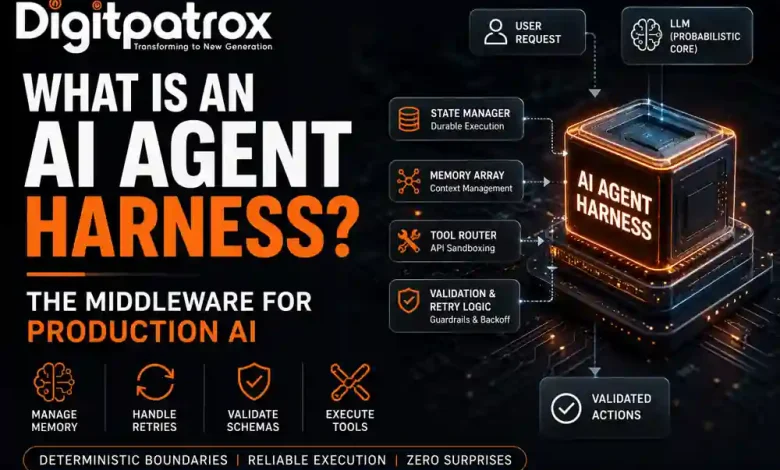
What Is an AI Agent Harness? The Middleware for Production AI
Imagine building a prototype for a new AI assistant. You spend an afternoon writing a Python script that reads a spreadsheet, searches the web, and drafts a formatted weekly summary. You run it three times on your laptop. It works flawlessly. You show it to your team, everyone celebrates, and you deploy it to production.
Then Tuesday happens.
The external web search API encounters a minor latency spike. Instead of waiting, the AI panics, assumes the task failed, and triggers the search again. It loops twenty times in a matter of minutes, burning through hundreds of dollars in API credits, before spitting out a malformed JSON payload that crashes your team’s database.
The underlying AI model didn’t actually fail here. It did exactly what it was trained to do: predict the next logical action based on the immediate context it had.
The real failure was a lack of infrastructure. To survive in the real world, autonomous agents need a protective layer around them. When we give a probabilistic tool direct access to deterministic systems, things inevitably break. APIs go down, OAuth tokens expire, and user inputs vary wildly.
In the engineering world, this protective middleware is called an agent harness.
The Zero-Click Definition:
An AI agent harness is the orchestration layer surrounding a large language model that manages memory, tool access, execution flow, retries, schema validation, and security boundaries. It transforms a fragile chat interface into a reliable AI runtime.
The Executive Reality Check
-
It is an engineering boundary, not a prompt. A harness intercepts inputs, manages state, and strictly validates structured outputs before the LLM can break your systems.
-
Autonomy is a liability without state management. If an agent crashes mid-task, a durable execution harness ensures it resumes from the last successful step rather than starting over.
-
The 95/5 Rule. In production, 5% of your code is the actual LLM call. 95% is the harness handling message queues, retries, and guardrails.
-
You are already building one. If your codebase is filled with custom
try/exceptloops, token-counting logic, and bespoke prompt injection filters, you are building a proprietary, poorly documented harness.
The Deterministic Boundary Principle
At the core of every production AI system is a single operating philosophy: probabilistic intelligence must operate within deterministic boundaries.
You cannot write a system prompt that guarantees an AI will never hallucinate a webhook payload. You can write an AI middleware boundary that guarantees a hallucinated webhook payload will never be executed. The harness is that boundary.
Most teams pass a user prompt directly to an LLM alongside an array of available tools. This works exactly once. When a tool fails or returns an unexpected schema, the agent panics. The harness exists to catch that panic.
Anatomy of a Production Harness
To build finite state machines (FSM) around language models, engineers rely on a specific stack of components. A true harness physically isolates the LLM from the execution environment by decoupling three critical layers:
-
State Manager (Durable Execution): You cannot rely on an array of chat history to maintain state. Production harnesses use tools like Postgres or Temporal to checkpoint the agent’s progress. If the container crashes, the workflow engine resumes exactly where it left off.
-
Memory Array (Context Management): The harness manages short-term conversational context and long-term retrieval using vector databases like Redis or pgvector.
-
Tool Router (API Sandboxing): The LLM never actually touches an external API. It requests an action. The tool router intercepts the request, verifies permissions, and executes the code in a sandboxed environment.
The Agent Execution Loop: How a Harness Actually Works
When you interact with a standard chatbot, you send a prompt, and it replies. But an autonomous agent must execute a multi-step loop. Left to its own devices, a raw AI model will quickly lose its place, resulting in queue deadlocks or context collapse.
Instead of letting the AI run wild, a workflow engine guides it through a strict, repeatable execution graph:
-
Ingesting the Goal: The harness takes the user’s request and establishes the final objective.
-
Injecting Context: Before the AI responds, the harness uses memory management to fetch only the data needed for the immediate step. This prevents the model from overwhelming its context window.
-
Restricting Tools: The harness dictates exactly which tools are safely accessible based on the current execution node.
-
Validating the Output: The harness intercepts whatever the AI outputs using strict schema validators. If the model generates corrupted formatting, the harness catches it and fixes it programmatically before backend systems are impacted.
Code Example: The Pydantic Validation Loop
Engineers do not solve hallucination problems with better prompting; they solve them with code.
Here is what a deterministic boundary actually looks like. Instead of trusting the LLM to output correct parameters, a basic Python harness uses Pydantic to enforce a strict schema. If the model hallucinates a parameter, the harness catches the ValidationError and triggers a localized retry loop—the main application thread never crashes.
Python
from pydantic import BaseModel, ValidationError
import logging

# 1. Define the absolute boundary (The Schema)
class DatabaseQuerySchema(BaseModel):
    table_name: str
    record_id: int
    action: str

def execute_harness_step(llm_generated_json):
    try:
        # 2. The Harness intercepts and forces validation
        validated_action = DatabaseQuerySchema.parse_raw(llm_generated_json)

        # 3. If successful, the harness (not the LLM) executes the tool
        return secure_database_router(validated_action)

    except ValidationError as e:
        # 4. The LLM hallucinated a string instead of an int for record_id.
        # The app does NOT crash. The harness catches it.
        logging.warning(f"Schema violation caught: {e}")

        # 5. Programmatic backoff: send the exact error back to the LLM to self-correct
        return trigger_agent_retry_loop(error_context=str(e))
This is the difference between an AI wrapper and a production agent. Prompt engineering is dying because structured outputs and validation loops make it obsolete.
Raw Prompting vs. Harnessed Agents
When an AI hits an unexpected error in production—such as a temporary network timeout—it cannot rely on a prompt to save it. Without an AI orchestration framework around it, the model will improvise.
| Operational Reality | Raw Prompting (No Harness) | Harnessed Agent |
| Encountering an API Error | Gets stuck in an infinite loop or hallucinates a success message. | Catches the HTTP error code and triggers an orderly exponential backoff. |
| Handling Long Projects | Overwhelms its memory capacity and drops the initial instructions. | Utilizes checkpoint recovery to save progress sequentially to a database. |
| System Security | Vulnerable to malicious text inputs that override safety rules. | Sits behind strict permission firewalls that block unauthorized actions. |
The Most Common Ways Unharnessed Agents Break
Building a production-ready system requires planning for the mundane realities of software engineering. When AI agents fail in the wild, it rarely looks like a dramatic science-fiction crisis. Most failures are incredibly boring—but highly disruptive. A request times out. A parser breaks. A retry storm loops forever.
Without a robust orchestration layer, teams frequently run into three classic scars:
-
Hallucinated Tool Routing: The AI model correctly identifies that it needs to update a record, but it invents an entirely fictional API endpoint to do so. A harness catches this invalid route instantly and prevents the system call.
-
Context Poisoning: If an agent is tasked with summarizing web results, a malicious or poorly formatted webpage can corrupt the agent’s logic. The harness ensures all external text is sanitized and verified via semantic search filters before it reaches the core model.
-
Runaway Resource Loops: If an AI model gets an unexpected response from a tool, it may repeatedly call that tool in a desperate attempt to resolve the issue, racking up massive cloud infrastructure bills in an hour.
When applications are left unprotected, they fail quietly. Setting up proper AI observability stacks (like Langfuse or Braintrust) is essential for tracking down exactly where an autonomous execution loop drifted offline.
Agent Harness vs. AI Orchestration vs. LLM Wrappers
It is easy to conflate these terms, but treating them identically leads to messy system architecture.
-
LLM Wrapper: A thin interface that takes user input, injects it into a prompt template, and returns the AI’s response. It has no state, no tools, and no retries.
-
Agent Harness: The specific middleware boundary wrapped around a single agent. It manages that specific agent’s memory, schema validation, and tool execution.
-
AI Orchestration: The macro-level control plane. Orchestration is the process of coordinating multiple agents, routing tasks between different models, and managing fleet-wide AI infrastructure. The harness is a component of orchestration.
Frameworks to Build an Agent Harness
Because every team deploying autonomous workflows runs into these identical infrastructure challenges, the software ecosystem has evolved past building everything from scratch. Depending on the complexity of your workflow, you will likely implement one of these core patterns:
-
State Machine Frameworks: For highly intricate, multi-step applications where the AI needs to jump back and forth between different roles, frameworks like LangGraph have become the standard. They treat workflows as explicit diagrams where every transition is controlled.
-
Durable Execution Engines: Enterprise teams are increasingly pairing AI with platforms like Temporal or AWS Step Functions. These engines guarantee that if a server restarts mid-workflow, the agent will pick up exactly where it left off without losing state.
-
Visual Workflow Automations: Platforms like n8n offer a visual node-based layout. They are exceptional for connecting simple AI steps to daily business tools, though they can become difficult to manage visually as the system scales.
-
Unified Connection Protocols: The Model Context Protocol (MCP) is an industry favorite for securing how AI systems talk to data sources, eliminating the need to write custom API code for every new integration.
The 6-Month Reality Check: Workflow Entropy
The true test of an agent framework isn’t how it performs during launch week—it’s how it looks six months later. Over time, custom-built infrastructure faces a kind of workflow entropy.
What begins as a simple, elegant script inevitably grows into a messy web of custom patch logic. As you encounter more real-world edge cases with tool calling, your codebase balloons with unique error-handling loops for different business tools. Furthermore, as users engage in longer interactions, managing the balance between short-term chat logs and permanent data storage becomes a massive architectural burden.
Teams that try to build a proprietary harness from scratch usually find themselves spending 90% of their time fixing infrastructure bugs and only 10% actually improving the AI’s capabilities.
How to Start Building Your Own Agent Infrastructure
If your team is planning to roll out an agentic workflow over the coming weeks, you can avoid early production failures by focusing on infrastructure setup from day one:
-
Decouple the State: Never let the AI model hold the definitive record of a complex task. Use a reliable external database to store the state of the project at every single step so you can resume from failures.
-
Enforce Hard Schemas: Ensure that any tool output passing back into the AI is validated first. If an external service breaks, your harness should catch the error and present a clean notification to the model, rather than letting a raw system crash corrupt the workflow.
-
Build an Audit Trail: Integrate a robust trace logging platform. You should always be able to look back and see the exact data context passed to the AI before an error occurred.
-
Implement a Human Gatekeeper: For any action that cannot be easily undone—like modifying a production database—program a mandatory pause into your harness. These human approval workflows require a user to review and click “Approve” via an API endpoint before proceeding.
The future of AI will not be determined solely by who builds the smartest models. It will be shaped by who builds the most reliable systems around them. The teams that win won’t be the ones with the most clever prompts; they will be the ones with the most resilient infrastructure.
FAQ
What is the difference between an AI agent and an agent harness?
The AI agent is the reasoning model (the brain) that decides what to do. The agent harness is the surrounding software middleware (the nervous system) that executes those decisions, manages memory, and catches API errors.
Is LangChain an agent harness?
No. LangChain is a library of API wrappers and integrations. LangGraph, however, is a framework designed specifically to build an agent harness using state machines and execution graphs.
Why do autonomous agents get stuck in infinite loops?
Agents get stuck in loops when they encounter unexpected API responses and lack a programmatic retry limit. A harness prevents this by intercepting errors, applying exponential backoff, and eventually failing gracefully instead of letting the AI request the same broken tool indefinitely.
Do I need a vector database to build an agent harness?
Not necessarily. A vector database is useful for long-term memory retrieval (Agentic RAG), but the core of a harness requires a traditional operational database (like Postgres or Redis) to maintain short-term state and checkpoint recovery.
