

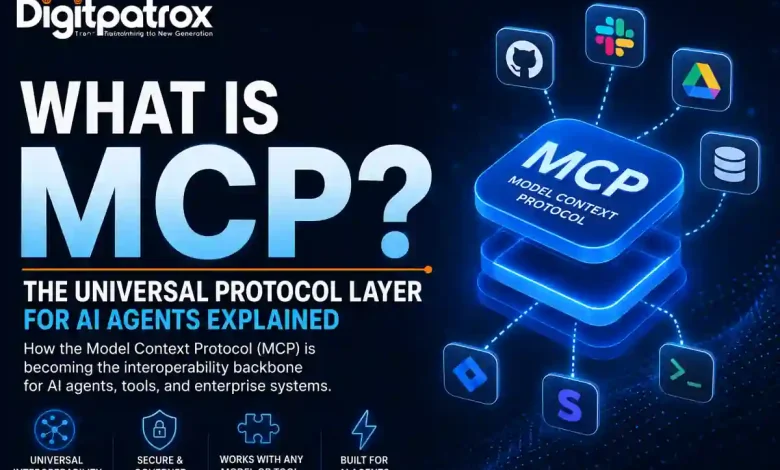
What Is MCP? The Universal Protocol Layer for AI Agents Explained
Last Updated: May 10, 2026
The Model Context Protocol (MCP) is rapidly becoming foundational agentic infrastructure, serving as the universal interoperability layer for AI agents in much the same way APIs standardized communication for cloud software.
AI agents fail in production because the tools they need to use are locked behind a “Deterministic Wall.” Traditional APIs were built for software developers who write static, predictable code. They were never designed for autonomous AI agents that operate through probabilistic reasoning and dynamic discovery.
This mismatch has created an Integration Crisis: the more tools you give an agent, the more likely it is to suffer from “context bloat” or integration failure. MCP solves this by standardizing agent-to-tool communication.
The Core Shift
- APIs were built for software.
- MCP was built for AI agents.
The protocol layer is becoming the missing infrastructure between LLM reasoning and real-world execution.
Table of Contents
- What Is MCP?
- How MCP Architecture Works
- MCP vs OpenAI Function Calling
- MCP vs REST APIs vs GraphQL
- MCP vs APIs: Why Traditional Integrations Break
- Why MCP Matters for AI Agents
- Security & Production Reality
- MCP vs LangChain vs LangGraph
- The Future of the Protocol Layer
- FAQs
1. What Is MCP?
The Model Context Protocol (MCP) is a standardized middleware abstraction layer that sits between AI models and enterprise systems. It uses JSON-RPC 2.0 to allow models to dynamically discover data resources and execute tools without requiring developers to write unique “glue code” for every integration.
This reduces the Integration Tax on the modern AI operating system by over 50%.
MCP standardizes AI tool calling across various models (Claude, GPT, Llama) and external environments. MCP is increasingly being adopted as a standard for AI interoperability, AI middleware, and multi-agent communication.
Many developers now describe MCP as the “USB-C layer for AI systems” because it allows different models, tools, and enterprise platforms to communicate through a shared protocol.
By using a universal protocol layer, any MCP-compliant agent can immediately understand and interact with any MCP-compliant server, regardless of the underlying LLM.
This shift is essential for reducing the technical friction inherent in agent engineering.
2. How MCP Architecture Works
The architecture of this agentic infrastructure is built on a clean separation of concerns:
- The MCP Host: The application environment (e.g., the specialized Claude workflow or a coding IDE).
- The MCP Client: The component that maintains the connection and translates protocol messages for the model.
- The MCP Server: A lightweight service exposing Tools (executable functions) and Resources (static data).
Common MCP Server Examples
Some of the most widely used MCP servers currently expose tools for:
- GitHub repositories
- Slack workspaces
- PostgreSQL databases
- Google Drive
- Jira
- Stripe
- Local file systems
Instead of writing four separate custom API wrappers, the developer implements a standardized MCP server.
This allows the agent to navigate these systems with the same fluid interoperability found in modern coding assistants.
3. MCP vs OpenAI Function Calling
A common point of confusion is how MCP differs from standard function calling models.
- Model Specificity: Function calling is typically model-specific (e.g., GPT-4o optimized). MCP is model-agnostic, working across Claude, GPT, and even local LLMs.
- Infrastructure vs. Execution: Function calling defines how a model outputs a tool request. MCP defines the interoperability infrastructure for where those tools live and how they are discovered across a network.
Function calling solves structured tool execution. MCP solves cross-system interoperability.
4. MCP vs REST APIs vs GraphQL
MCP is not replacing REST APIs or GraphQL. Instead, it acts as an orchestration and discovery layer on top of them.
| System | Primary Purpose |
|---|---|
| REST API | Standardized application communication |
| GraphQL | Flexible data querying |
| MCP | Agent-native interoperability |
In practice, MCP servers often expose existing REST or GraphQL APIs underneath the protocol layer.
The difference is that the AI agent no longer needs hardcoded integration logic to use them.
5. MCP vs APIs: Why Traditional Integrations Break
Traditional APIs fail the “Agent Test” because they require manual documentation and rigid code paths.
If the API schema changes, the agent breaks.
| Feature | Traditional APIs | Model Context Protocol (MCP) |
|---|---|---|
| Primary User | Human Developer (Static) | AI Agent (Dynamic) |
| Discovery | Manual / Swagger Docs | Dynamic Runtime Discovery |
| Integration | Bespoke (1:1) | Universal (1:Many) |
| Optimization | Network Throughput | Context & Token Efficiency |
Contrarian Truth: MCP does not solve AI reliability on its own. It only standardizes how agents access tools.
Achieving true operational excellence still requires rigorous AI reliability engineering to manage the probabilistic nature of LLM outputs.
6. Why MCP Matters for AI Agents
AI agents often fail due to fragmented toolsets and middleware sprawl.
As we transition toward an AI agent revolution, the protocol layer becomes the critical link.
MCP is increasingly being positioned as the interoperability backbone for multi-agent systems and AI operating systems.
Without it, agents suffer from schema inconsistency — where the model doesn’t quite know the exact format an API expects, leading to repeated failures and high latent costs.
By providing a universal middleware layer, MCP allows developers to focus on stateful orchestration rather than building custom connectors for every legacy database.
7. Security & Production Reality
While MCP simplifies interoperability, production deployment introduces new operational challenges that demand a focus on AI cybersecurity:
- Context Poisoning: If an MCP server returns malicious data, it can hijack the agent’s reasoning.
- Protocol Governance: Large organizations are increasingly deploying centralized “MCP Gateways” that act as policy enforcement layers between AI agents and enterprise tools.
- Version Mismatch: Protocol version mismatches between clients and servers may create silent context failures.
- Permission Scoping: Unlike humans, agents move at machine speed. A poorly scoped MCP server could allow an agent to wipe a database in seconds.
Production deployments require strict authentication (OAuth 2.1), audit logging, and mandatory Human-in-the-Loop checkpoints for high-stakes actions.
For enterprise deployments, this overlaps heavily with AI cybersecurity.
8. MCP vs LangChain vs LangGraph
MCP, LangChain, and LangGraph solve different layers of the AI stack:
| Layer | Primary Purpose |
|---|---|
| MCP | Universal interoperability protocol |
| LangChain | Tool and workflow abstraction |
| LangGraph | Stateful orchestration runtime |
In practice, modern AI systems increasingly combine all three:
- MCP for connecting tools
- LangChain for composing logic
- LangGraph for long-running agent execution
This convergence is shaping the next generation of enterprise-grade AI operating systems.
9. The Future of the Protocol Layer
The transition toward Linux Foundation governance positions MCP as neutral AI infrastructure.
This architectural shift marks the beginning of the death of SaaS as a UI-first experience, replacing it with back-end interoperability ecosystems.
Example Enterprise AI Stack
User Request
↓
LLM (Claude / GPT / Gemini)
↓
LangGraph (Stateful Orchestration Layer)
↓
MCP Client
↓
MCP Gateway
↓
MCP Servers
↓
Enterprise Systems (Slack, GitHub, Databases, Stripe)
For broader enterprise workflows, many are using n8n to bridge MCP servers with existing automation.
The companies building durable AI systems in 2026 are no longer optimizing prompts. They are optimizing orchestration, interoperability, and recovery.
In the agentic era, the competitive advantage is shifting from software interfaces to protocol infrastructure.
10. FAQs
What is MCP in simple terms?
It is a universal translator that lets AI agents talk to any app or database without needing a custom-built connector for each one.
Is MCP better than an API?
It doesn’t replace APIs; it wraps them. It makes APIs “agent-friendly” by standardizing how their capabilities are described to a model.
Which platforms support MCP?
Currently, Claude Desktop and various IDEs are early adopters.
Many enterprise teams use n8n or custom gateways to bridge the gap between protocol and production.
How does it handle security?
MCP supports standard security protocols like SSE (Server-Sent Events), but the developer must still enforce scoped permissions and monitor for agent decay.
Does it work with OpenAI models?
Yes. While built by Anthropic, it is an open standard. Any model can act as an MCP host if the client-side implementation is present.
MCP may ultimately become the foundational protocol layer that transforms AI agents from isolated chatbots into interoperable operating systems capable of coordinating work across the modern software stack.
