
Three papers in JCAP report the final data release from the Atacama Cosmology Telescope, unveiling a new map of the early “infant” Universe, confirming the “Hubble tension,” and ruling out several extended cosmological models.
There is often a sense of mixed emotions when a long scientific project concludes. For the Atacama Cosmology Telescope (ACT), that journey spanned nearly two decades, and its observing campaign has now officially ended.
But while the telescope has completed its mission, the scientific story is far from over. Its final data release opens new opportunities for researchers around the world.
Final data sharpen the cosmic picture
Three new papers published in the Journal of Cosmology and Astroparticle Physics by the ACT Collaboration present the sixth and final major ACT data release. This installment, described as the most significant yet, delivers refined measurements that deepen our understanding of how the Universe evolved and what it looks like today.
Among the most important findings is a strengthened measurement of the Hubble constant, which describes the current rate of cosmic expansion and is often called the Universe’s “speedometer.” ACT confirms that the value derived from observations of the distant Universe remains significantly different from the value obtained from nearby galaxies. This persistent mismatch reinforces the so-called Hubble tension, a discrepancy that challenges the standard model used to describe the cosmos.

ACT’s results also place tight constraints on many proposed “extended models,” theoretical alternatives designed to resolve that tension. By ruling out a large number of these possibilities, the new data narrow the field of viable explanations. While this limits theoretical flexibility, it also provides clarity by eliminating options that do not match observations.
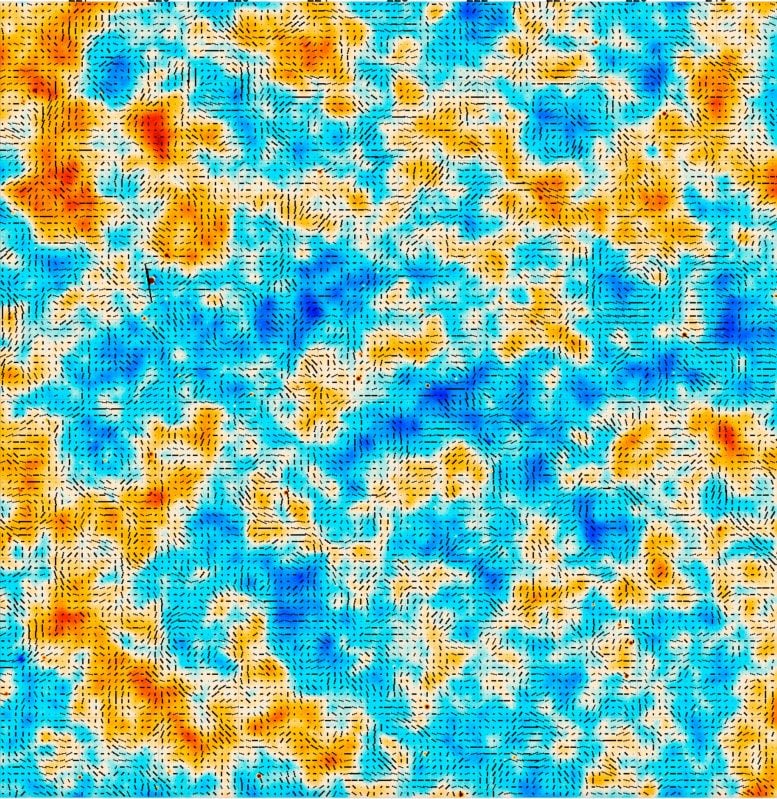
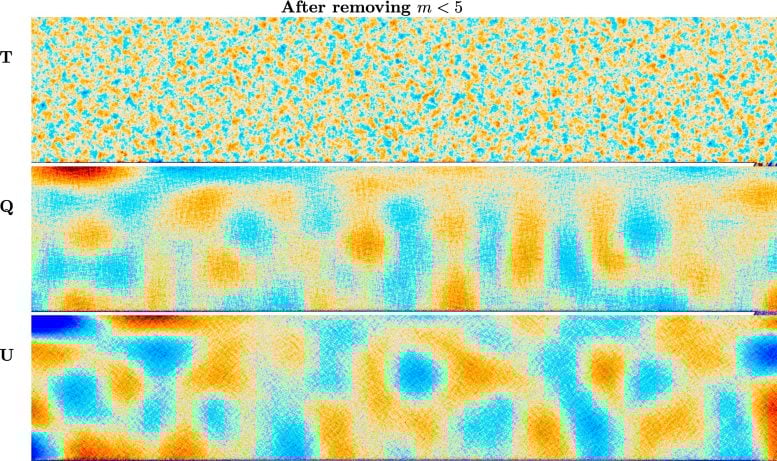
In addition, ACT has produced new polarization maps of the cosmic microwave background, often described as the Universe’s “fossil light.” These maps complement the temperature measurements made by the Planck satellite but at substantially higher resolution. “When we compare them, it’s a bit like cleaning your glasses,” says Erminia Calabrese, cosmologist at Cardiff University and coordinator of one of the three papers.
The sixth ACT data release first appeared as a preprint in March, and the collaboration’s three peer-reviewed papers have now been formally published in JCAP. ACT is operated by an international consortium of more than 100 researchers who jointly authored these studies.

Planck and ACT: Complementary views of the CMB
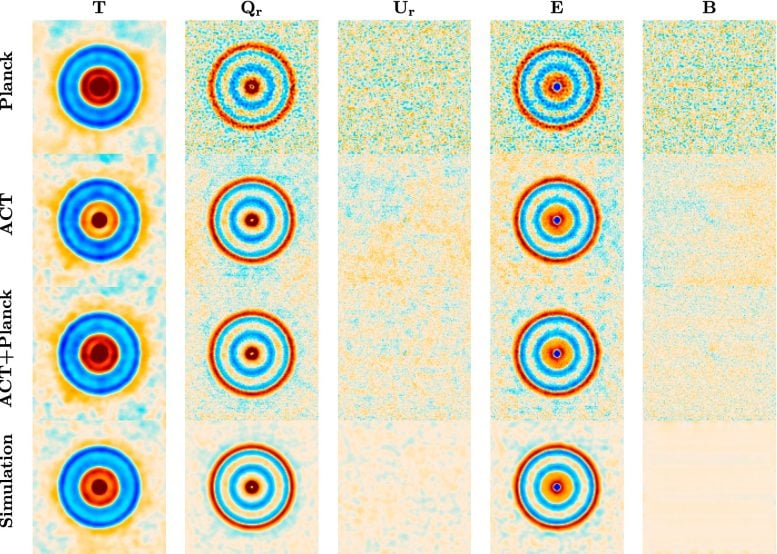
“It’s the first time that a new experiment has reached the same level of observational capability as Planck,” explains Thibaut Louis (Université Paris-Saclay and CNRS/IN2P3), lead author of one of the newly published papers.
The European Space Agency’s Planck satellite, launched in 2009, mapped the cosmic microwave background (CMB) with exceptional precision. This ancient radiation, emitted shortly after the Big Bang, allows scientists to determine the Universe’s age, composition, and large-scale geometry.
Although Planck transformed cosmology, some aspects of the CMB remained less explored. ACT, located at about 5,000 meters above sea level in Chile’s Atacama Desert, was designed to complement those measurements. While Planck focused primarily on temperature variations in the CMB, ACT’s latest release emphasizes detailed measurements of polarization, offering new insights into the early Universe.

Cosmological tension confirmed
One of ACT’s headline results is the confirmation of the Hubble tension, one of the most debated issues in modern cosmology.
Astronomers can estimate the expansion rate of the Universe in two main ways. One method relies on observations of the CMB, which probes conditions in the distant past. The other uses measurements of relatively nearby astronomical objects. The problem is that these approaches yield different answers. “Our new results demonstrate that the Hubble constant inferred from the ACT CMB data agrees with that from Planck – not only from the temperature data, but also from the polarization, making the Hubble discrepancy even more robust,” explains Colin Hill, cosmologist at Columbia University and co-lead of one of the papers.
Rather than resolving the tension, ACT strengthens the evidence that it is real. If measurements of nearby galaxies remain unchanged, the discrepancy suggests that something in the ΛCDM model, the current standard framework of cosmology, may need revision.
Extended models “fail the test”
In response to the Hubble tension, researchers have proposed numerous extended versions of the standard cosmological model. Many of these modifications attempt to tweak early Universe physics or introduce new components to bring distant and local measurements into agreement.
One of the newly published ACT papers, led by Calabrese, systematically tested roughly thirty of these extended models against the latest data.

The outcome was decisive. “They’re gone,” she says. “We assessed them completely independently. We weren’t trying to knock them down, only to study them. And the result is clear: the new observations, at new scales and in polarization, have virtually removed the scope for this kind of exercise.”
While eliminating theoretical possibilities may seem discouraging, it serves an important purpose. By ruling out models that fail observational tests, researchers can focus on more promising directions instead of revisiting ideas that no longer hold up.
Higher resolution reveals early universe
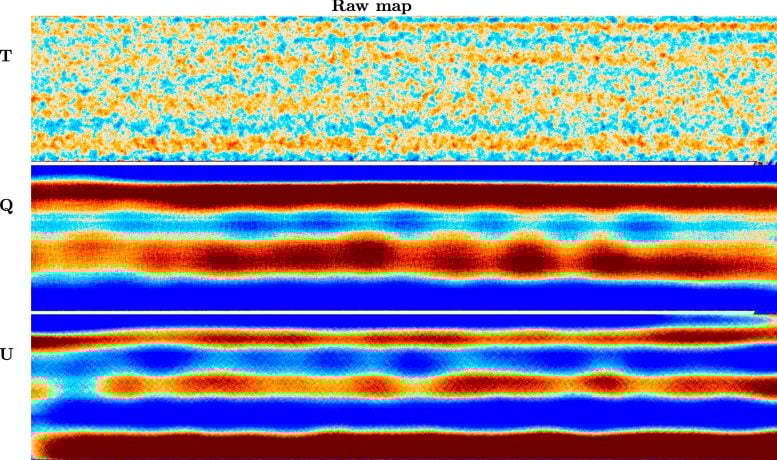
ACT’s final data release delivers a sharper view of the early Universe than previously available from Planck alone. “This is mainly because ACT has a larger diameter — six meters compared to Planck’s one and a half meters — and sharpness increases with mirror size,” explains Sigurd Naess of the University of Oslo, one of the paper leads. “But it’s also because ACT’s images of the polarized light are much more sensitive than Planck’s.” One of the three new papers presents these detailed polarization maps, while another translates them into angular power spectra that are central to cosmological analysis.
Importantly, ACT does not replace Planck’s results. Instead, the two datasets work together. As Louis notes, “the real importance of the new data is that they are complementary to the previous ones and together contribute to an extremely rich composite picture.”
Although ACT’s observations have concluded, its final data release marks the beginning of a new phase for the scientific community. “We want the community to keep using and exploring these data,” says Calabrese. “We’ve provided the first interpretation, in which we have great expertise after years of work on this instrument. Now we’re delighted to hand the data over to the community for future and ongoing explorations.”
References:
“The Atacama Cosmology Telescope: DR6 Maps” by Sigurd Naess et al., 18 March 2025, arXiv.
DOI: 10.48550/arXiv.2503.14451
“The Atacama Cosmology Telescope: DR6 Power Spectra, Likelihoods and ΛCDM Parameters” by Thibaut Louis et al., 18 March 2025, arXiv.
DOI: 10.48550/arXiv.2503.14452
“The Atacama Cosmology Telescope: DR6 Constraints on Extended Cosmological Models” by Erminia Calabrese et al., 18 March 2025, arXiv.
DOI: 10.48550/arXiv.2503.14454
Never miss a breakthrough: Join the SciTechDaily newsletter.
Follow us on Google and Google News.
Source link
-
-

-
-

-


