It started during the COVID-19 pandemic, when many people across the United States were unsure how to stay safe and whether to get vaccinated. Hesitancy was especially pronounced in communities of color because of experiences of discrimination and historical injustices like the Tuskegee Study, which intentionally withheld treatment from Black men diagnosed with syphilis.
In that moment, building trust in vaccines and other public health measures required a radically different approach. In Anne Arundel County, one of 24 counties in Maryland, the answer was establishing a group of “health ambassadors,” community members trained in basic public health principles and strategies to reduce the spread of infectious diseases. They distributed COVID-19 test kits and masks, and shared information on how to protect oneself.
“The community health ambassadors were our critical partners and boots on the ground,” says Donna Perkins, Director of the Office of Assessment and Planning at the Anne Arundel County Department of Health in Maryland. “They came from community and faith-based organizations that serve the residents of our county. They were frontline public health workers and trusted voices in our local neighborhoods.” The program, housed within the department’s health equity and racial justice arm and with its own Facebook page, aims to reduce health disparities.
The model proved so effective that the county decided to expand it beyond the pandemic. “Once vaccination uptake increased and COVID became a day-to-day issue, most jurisdictions scaled back this program, but we did the opposite and leaned in,” explains Perkins. “We needed these local partners to achieve our vision of healthy residents in healthy communities. So, we went in a different direction and began to add to their knowledge base.”
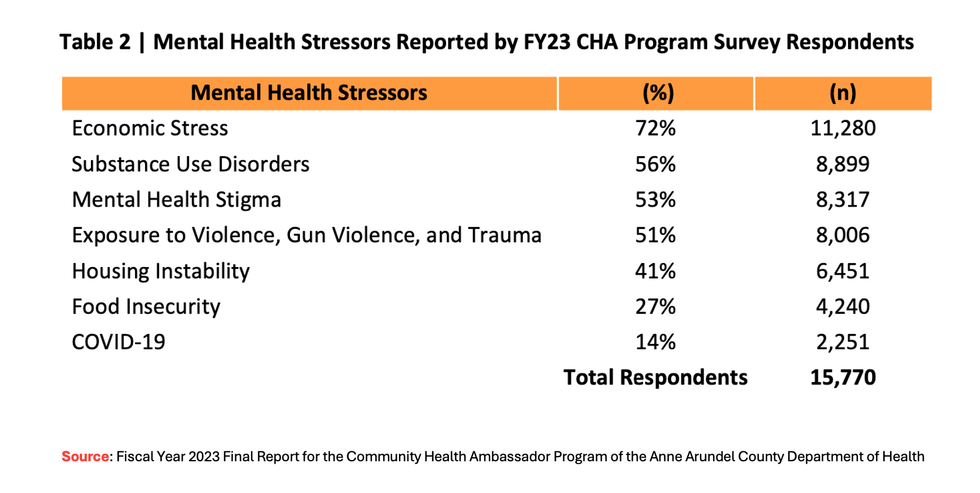
Those trainings were shaped by a 2023 survey conducted by the health ambassadors, which reached roughly 16,000 Anne Arundel County residents. When respondents were asked to identify the stressors affecting mental health in their community or family, economic insecurity ranked highest. The finding underscores the county’s stark wealth disparities. Anne Arundel County is home to Maryland’s capital, Annapolis, known as the nation’s sailing capital. Still, it is also home to many residents who face persistent financial strain, food insecurity, and housing instability.

One in six residents in Maryland is foreign-born. This is equivalent to roughly 17 percent of the state’s 6.2 million population. Mental health may not be the first concern for many immigrants, yet the stressors they face have a direct impact on their well-being and coping strategies. Language barriers add to the challenges, especially for older adults.
Yolanda Iglesias is a community health ambassador with the Centro de Ayuda in Annapolis. This organization seeks to empower immigrants with the knowledge and tools to thrive in Maryland. Centro de Ayuda is a current partner of the Anne Arundel County Department of Health. Trained as a social worker, Iglesias worked for twenty-five years in carceral settings in Spain before taking up the role of community health ambassador.
As an immigrant herself, she says, “I now understand better what it means to be an immigrant here. Many of our clients have language barriers and don’t know what resources are available to them. Immigrants face many problems, especially if they have children and a family, and it can be overwhelming. As an immigrant, you must take care of your mental health. The tendency is to worry about everyone else and to forget yourself.”
Research shows that Latinos, Blacks, and Asians are less likely to seek mental health treatment because of cultural attitudes. “In our community, stigma is a barrier for getting help for mental health problems,” says Gabriel Rodríguez, Executive Director of the Centro de Ayuda. “Hispanic people often associate mental health with someone who is crazy. People tell us, we are not crazy! What they don’t realize is that the body has a material component and one that is not. You need to take care of both, or you will collapse. It is about self-care.”
Community health ambassadors like Iglesias identify residents who may be struggling with mental health issues and connect them to services and resources. Partnerships are central to Centro de Ayuda’s work. “Our mission is to empower immigrants so they can become self-sufficient. We collaborate with public schools and the courts. They refer people to us. We have been around for 25 years and are well known in the community.”
Trust is the foundation. “The health ambassadors are embedded in the communities they serve. They nurture and sustain authentic relationships with community members,” says Perkins. The county trains them in behavioral health, community safety, and weather preparedness, all issues rooted in the lived experience of local residents.
Centro de Ayuda also trains ambassadors to address substance abuse and reverse an opioid overdose, which are common concerns among the families it serves. Other programs offered include family services, legal clinics, English as a Second Language classes, and an English curriculum to prepare for the U.S. citizenship test.
Asked whether the current immigration policies are worsening the mental health of his clients, Rodríguez responds, “Yes, all of this has caused great anxiety among immigrant communities, but I think it was worse at the beginning. Now that parents are sending their children to school and some things are going back to normal, we must remain flexible. People continue to be afraid.”
Rodríguez says the immigration policies of the current administration still shape the mood in the community. He stresses that the ambassadors’ work is grounded in restoring a sense of dignity in an environment where many feel scrutinized or unwelcome.
“At the end of the day, we are dealing with human beings. I do not like to refer to people as illegals. I think it is better to say undocumented.” For him, understanding the emotional weight of these policies also requires understanding what pushed people to migrate in the first place.
“Many immigrants come to the U.S. from tyrannical regimes. Their journey here is very dangerous. There is a 50% chance they make it and a 50% chance they do not. I wonder what people who live comfortable lives would do if they were in a similar position as many of these migrants. It begs the question: what prompted them to undertake this perilous journey? Put yourself in their shoes.”
Beatrice Spadacini is a freelance journalist for the Fulcrum. Spadacini writes about social justice and public health.
Hugo Balta is the executive editor of the Fulcrum. He is also the publisher of the Latino news Network.
The 50 is a four-year multimedia initiative led by The Fulcrum, traveling to communities in every state to uncover what motivated Americans to vote in the 2024 presidential election. Through in-depth storytelling, the project examines how the Donald Trump administration is responding to those hopes and concerns—and highlights civic-focused organizations that inform, educate, and empower the public to take action.
We invite you to watch the groundbreaking hour-long special, The 50: Voices of a Nation, that takes viewers across the country to hear directly from communities about how life is unfolding under the Trump administration. The television program is a partnership with The Fulcrum and CAN-TV.

Source link
-

-

-

-

-