
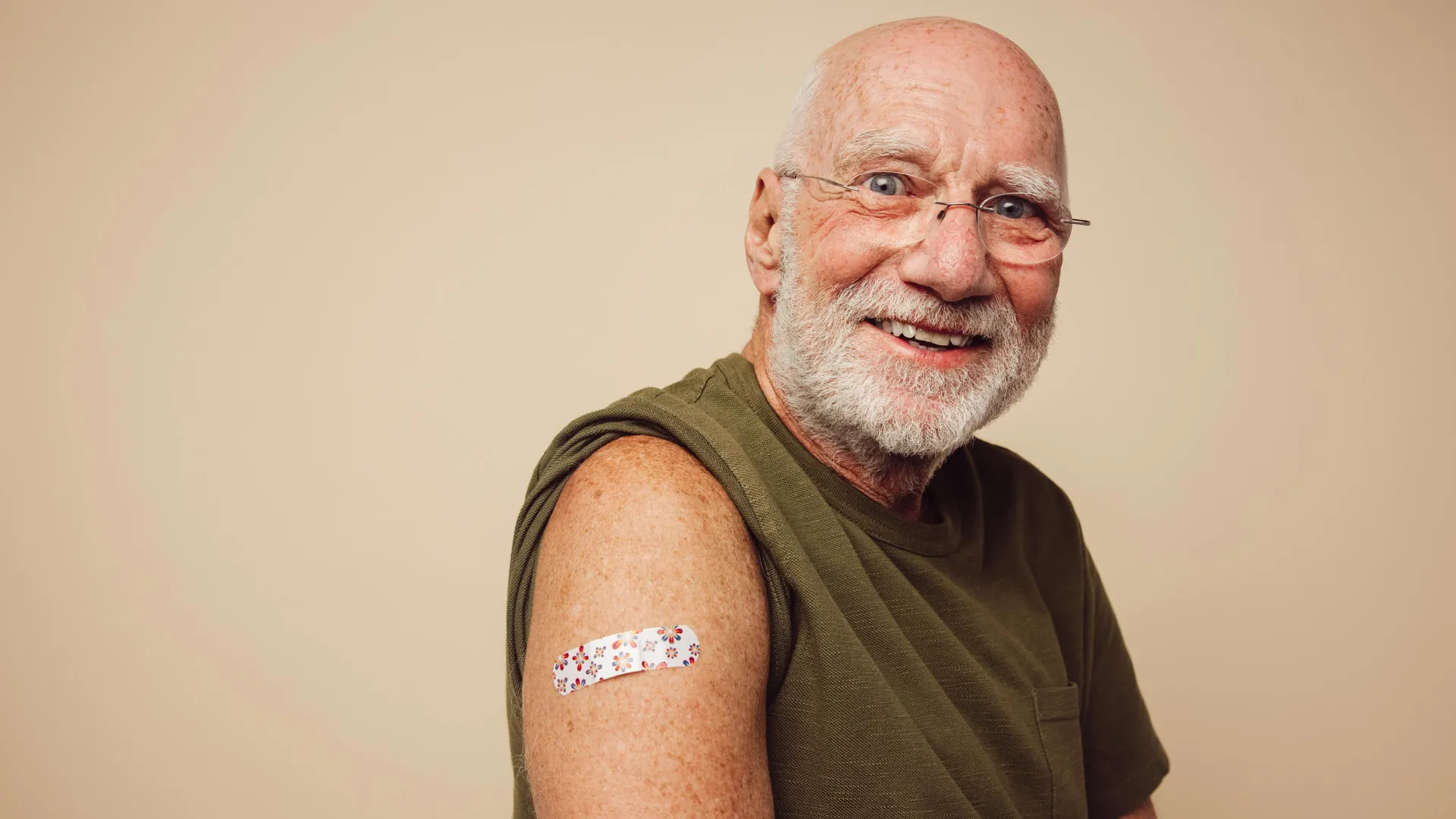
An unusual vaccination rule in Wales has given scientists some of the clearest evidence so far that a vaccine might help protect against dementia. In a new study led by Stanford Medicine, researchers examined health records from older adults in Wales and found that people who received the shingles vaccine were 20% less likely to be diagnosed with dementia over the following seven years than those who did not receive the shot.
The results, published April 2 in Nature, support a growing idea that certain viruses that affect the nervous system may raise the chance of developing dementia. If these findings continue to hold up in future work, they suggest that a practical way to help prevent dementia could already exist.
A second analysis from the same team, published Dec. 2 in Cell, pointed to another potential benefit. In that study, the researchers reported that the vaccine might also help people who already have dementia by slowing how quickly the condition worsens.
Shingles virus, chicken pox and lifelong infection
Shingles is a viral disease that causes a painful, blistering rash. It is triggered by the same virus that leads to chicken pox — varicella-zoster. When someone gets chicken pox, usually in childhood, the virus does not fully leave the body. Instead, it stays inactive inside nerve cells for life. In later years, especially in older adults or in people whose immune systems are weakened, this dormant virus can reactivate and cause shingles.
Dementia, brain changes and the viral hypothesis
Dementia currently affects more than 55 million people worldwide, and about 10 million new cases are diagnosed every year. For many years, most dementia research has centered on abnormal protein build-up in the brain, including plaques and tangles that are characteristic of Alzheimer’s disease, the most common type of dementia. However, these efforts have not yet produced successful ways to prevent or halt the disease, so some scientists have turned their attention to other possible drivers, including infections by specific viruses that may damage the brain over time.
Earlier observational studies using health records had hinted that people who received the shingles vaccine were less likely to develop dementia. However, those studies had a serious limitation. People who choose to get vaccinated are often more health conscious in many ways that are hard to measure. They may eat differently, exercise more or engage with health care more regularly. Those lifestyle differences are known to influence dementia risk but are not recorded in medical databases.
“All these associational studies suffer from the basic problem that people who go get vaccinated have different health behaviors than those who don’t,” said Pascal Geldsetzer, MD, PhD, assistant professor of medicine and senior author of the new study. “In general, they’re seen as not being solid enough evidence to make any recommendations on.”
A rare natural experiment in Wales
About two years ago, Geldsetzer noticed an unusual opportunity in the way Wales had rolled out its shingles vaccination program. The setup functioned as what researchers call a “natural experiment,” and it appeared to avoid much of the bias seen in earlier work. At that time, the country used a version of the shingles vaccine that contained a live-attenuated, or weakened, form of the virus.
The national program began on Sept. 1, 2013. Under the policy, anyone who was 79 years old on that date could receive the vaccine during the following year. (People who were 78 would become eligible the next year for one year, and so on.) People who were 80 or older on Sept. 1, 2013, were out of luck — they would never become eligible for the vaccine.
Because eligibility depended only on age at a specific cut-off date, the difference between being just under or just over the age threshold had a major impact on who could get the shot. That allowed researchers to compare people who turned 80 shortly before Sept. 1, 2013, with those who turned 80 shortly after, and to see how being eligible for the vaccine changed long-term outcomes.
According to Geldsetzer, the detailed health records available in Wales made these circumstances about as close as possible to a randomized controlled trial without actually running one.
Comparing nearly identical groups
To take advantage of this setup, the team analyzed the health records of more than 280,000 older adults between 71 and 88 years old who did not have dementia at the beginning of the vaccination program. They then concentrated their analysis on people whose birthdays placed them just on either side of the eligibility line, comparing those who turned 80 in the week before Sept. 1 to those who turned 80 in the week after.
“We know that if you take a thousand people at random born in one week and a thousand people at random, born a week later, there shouldn’t be anything different about them on average,” Geldsetzer said. “They are similar to each other apart from this tiny difference in age.”
The researchers reasoned that about the same share of people in both groups would have wanted the shingles shot. The crucial difference was that only the slightly younger group, those not yet 80 on Sept. 1, 2013, were permitted to receive it under the rules.
“What makes the study so powerful is that it’s essentially like a randomized trial with a control group — those a little bit too old to be eligible for the vaccine — and an intervention group — those just young enough to be eligible,” Geldsetzer said.
Measuring protection against shingles and dementia
The team then tracked health outcomes for the next seven years, comparing people of similar ages who had been eligible or ineligible for the vaccine. By combining that information with actual vaccination rates, they could estimate the effect of receiving the shot. About half of the people who were eligible went on to be vaccinated, while almost none of those who were not eligible received it.
As expected, the vaccine lowered the rate of shingles over the seven-year follow-up by about 37% among those who were vaccinated, in line with clinical trial data. (The live-attenuated vaccine’s effectiveness wanes over time.)
By 2020, when the individuals being studied were around 86 and 87 years old, one in eight had developed dementia. Among those who received the shingles shot, however, the likelihood of a dementia diagnosis was 20% lower compared with those who did not receive it.
“It was a really striking finding,” Geldsetzer said. “This huge protective signal was there, any which way you looked at the data.”
Ruling out other explanations
The researchers then searched for other factors that might explain the difference in dementia rates. They found that the two groups were extremely similar in all the characteristics they could measure. Education levels were the same for eligible and ineligible people. Those who were eligible for the shingles vaccine were not more likely to receive other vaccines or preventive therapies, and they were not less likely to have common illnesses such as diabetes, heart disease or cancer.
The only clear difference between the groups was the lower number of dementia diagnoses in those who had access to the shingles shot.
“Because of the unique way in which the vaccine was rolled out, bias in the analysis is much less likely than would usually be the case,” Geldsetzer said.
Even so, the team tested the data in a variety of alternative ways, such as examining different age windows or focusing only on deaths that listed dementia as a cause. No matter how they sliced the information, the relationship between vaccination and lower dementia risk remained.
“The signal in our data was so strong, so clear and so persistent,” he said.
Benefits from early decline to advanced dementia
The researchers next asked whether the apparent benefits of the vaccine were limited to preventing dementia, or whether they also extended to people who already showed signs of cognitive problems. Using the same natural experiment structure, they examined a broader range of outcomes, from mild cognitive changes to late-stage dementia.
Many cases of dementia are preceded by a period of mild cognitive impairment — characterized by deficits in memory and cognitive skills that do not interfere with independent living, Geldsetzer said.
The team observed that people who had received the shingles vaccine were less likely to receive a diagnosis of mild cognitive impairment during a nine-year follow-up period than those who remained unvaccinated.
They also looked at people who already had dementia at the start of the Welsh vaccination program. In this group, the results were especially striking. Individuals with dementia who received the shingles shot were significantly less likely to die from dementia in the next nine years (as indicated on their death certificates) than those who did not receive the vaccine, suggesting that the disease may have progressed more slowly in the vaccinated group.
In total, nearly half of the 7,049 Welsh seniors who had dementia when the program began died from dementia during follow-up. Among those with dementia who received the vaccine, only about 30% died from dementia.
“The most exciting part is that this really suggests the shingles vaccine doesn’t have only preventive, delaying benefits for dementia, but also therapeutic potential for those who already have dementia,” Geldsetzer said.
Stronger effects in women raise new questions
Another notable pattern emerged when the researchers compared outcomes by sex. The protective effect of the shingles vaccine against dementia appeared to be much stronger in women than in men. Geldsetzer noted that this might reflect biological differences in immune responses or differences in how dementia develops in men and women. On average, women tend to develop higher antibody responses after vaccination, and shingles occurs more often in women than in men.
At this point, scientists still do not know exactly how the vaccine might be providing protection. It is not yet clear whether it works by broadly stimulating the immune system, by reducing how often the varicella-zoster virus reactivates, or through another pathway entirely.
It is also unknown whether a newer shingles vaccine, which uses only certain proteins from the virus and is more effective at preventing shingles, would have a similar or even stronger effect on dementia risk.
Global data and the push for a randomized trial
Geldsetzer hopes these findings will encourage more investment in this line of research.
“At least investing a subset of our resources into investigating these pathways could lead to breakthroughs in terms of treatment and prevention,” he said.
Over the past two years, his team has checked health records from other countries, including England, Australia, New Zealand and Canada, where similar shingles vaccine rollouts took place. The results in those datasets have echoed what was seen in Wales. “We just keep seeing this strong protective signal for dementia in dataset after dataset,” he said.
The next step that Geldsetzer is aiming for is a large randomized controlled trial, which would offer the most rigorous evidence on whether the vaccine truly causes the reduction in dementia. In such a study, participants would be randomly assigned to receive either the live-attenuated shingles vaccine or a placebo injection.
“It would be a very simple, pragmatic trial because we have a one-off intervention that we know is safe,” he said.
Geldsetzer is seeking philanthropic support to fund this work, in part because the live-attenuated vaccine is now off-patent, even though it is the vaccine type for which he has gathered strong evidence from natural experiments.
He also pointed out that such a trial might show meaningful results relatively quickly. In the Wales data, when researchers plotted dementia rates for people who were eligible versus ineligible for the vaccine, the two curves began to move apart after about a year and a half.
A researcher from the Vienna University of Economics and Business also contributed to the work.
The study received funding from The Phil & Penny Knight Initiative for Brain Resilience, the Stanford Center for Digital Health, the National Institute on Aging (grant R01AG084535), the National Institute of Allergy and Infectious Diseases (grant DP2AI171011) and the Biohub, San Francisco.
Source link
-
-
-

-
-


