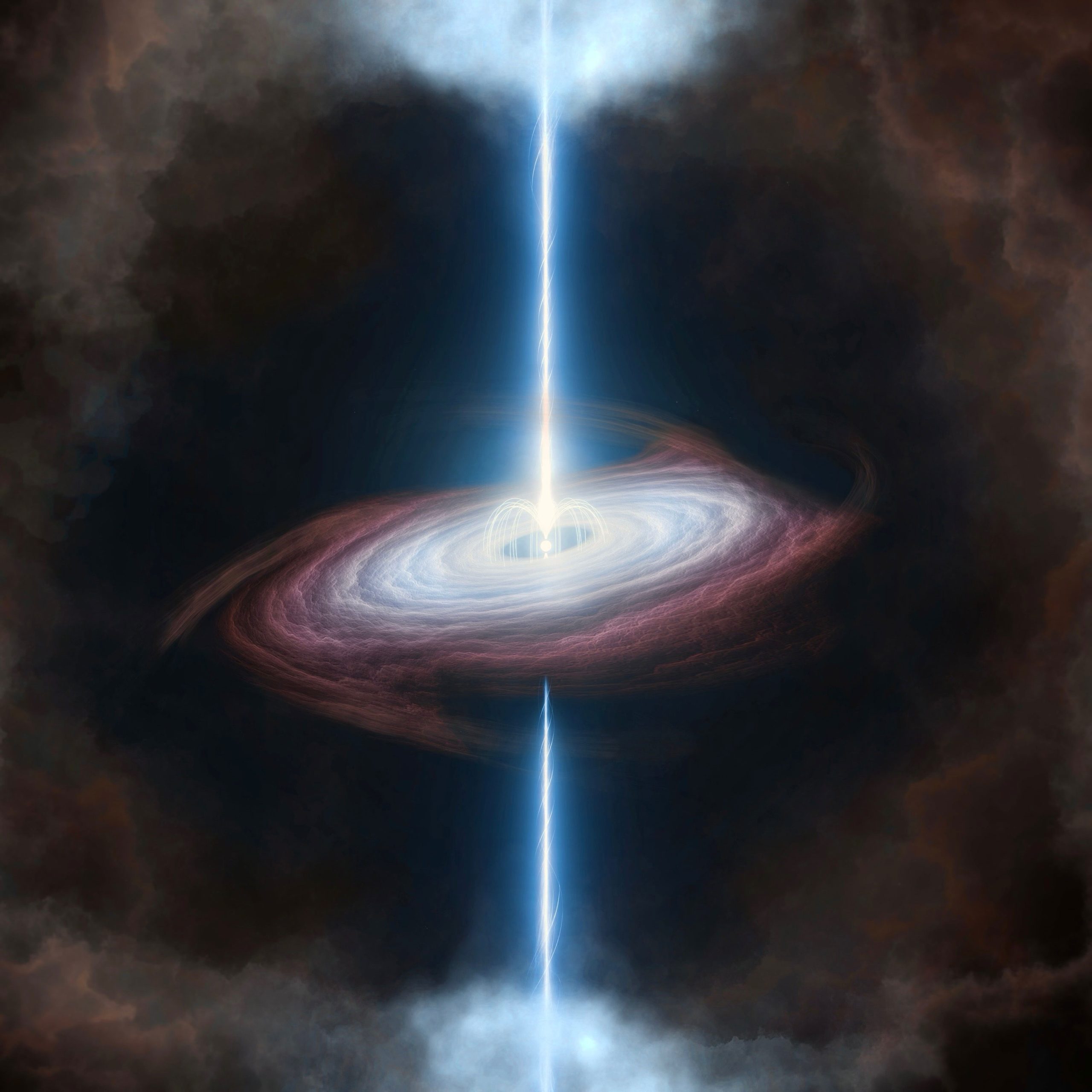
Astronomers have identified the first clear evidence of a magnetar forming during a superluminous supernova, offering new insight into some of the brightest explosions in the universe.
Astronomers have observed the birth of a magnetar for the first time and confirmed that this extreme object powers some of the brightest stellar explosions in the universe. A magnetar is a rapidly spinning neutron star with an extraordinarily strong magnetic field.
The discovery supports a theory first proposed by a UC Berkeley physicist 16 years ago. It also identifies a new behavior in exploding stars. Some supernovae display a “chirp” pattern in their light curves that arises from effects predicted by general relativity. A study describing this phenomenon was published in the journal Nature.
Superluminous supernovae can shine 10 times brighter or more than typical stellar explosions. Since their discovery in the early 2000s, these events have puzzled astronomers. Scientists suspected they came from the deaths of extremely massive stars, possibly around 25 times the mass of our sun. However, their brightness persists much longer than expected after a star’s iron core collapses and the outer layers are blasted into space.
The Magnetar-Powered Supernova Theory
In 2010, Dan Kasen, now a theoretical astrophysicist and physics professor at UC Berkeley, proposed that a newly formed magnetar could drive this extended glow. His idea, developed with Lars Bildsten and independently suggested by Stanford Woosley of UC Santa Cruz, describes what happens when a massive star reaches the end of its life.
During the collapse, much of the star’s material compresses into an extremely dense neutron star. This outcome is just short of forming a black hole. If the original star possessed a powerful magnetic field, the collapse could amplify it dramatically during magnetar formation. The result would be a magnetic field between 100 and 1,000 times stronger than those found in ordinary spinning neutron stars known as pulsars. Both pulsars and magnetars are only about 10 miles (16 kilometers) across, yet young ones can rotate more than 1,000 times per second.
As the magnetar spins, its intense magnetic field accelerates charged particles. These particles collide with debris expanding outward from the supernova, injecting energy and boosting the explosion’s brightness. Magnetars are also considered a possible source of fast radio bursts.
A New Supernova Reveals the Hidden Engine
Joseph Farah, a graduate student at UC Santa Barbara and Las Cumbres Observatory (LCO), analyzed observations from a supernova discovered in 2024 called SN 2024afav. Farah will join UC Berkeley this fall as a Miller Postdoctoral Fellow in Kasen’s research group.
By studying this event, Farah confirmed the connection between magnetars and Type I superluminous supernovae (SLSNe-I). In the Nature paper, he and his collaborators proposed that unusual bumps in the supernova’s light curve can be explained by general relativity. They describe this repeating pattern as a chirp, and their analysis shows that it directly points to the presence of a magnetar at the center of the explosion.
“What’s really exciting is that this is definitive evidence for a magnetar forming as the result of a superluminous supernova core collapse,” said Alex Filippenko, a UC Berkeley distinguished professor of astronomy who is a coauthor of the paper and one of Farah’s soon-to-be mentors. “The basis of Dan Kasen and Stan Woosley’s model is that all you need is the energy of the magnetar deep within and a good fraction of it will get absorbed, and that’ll explain why the thing is superluminous. What had not been demonstrated was that a magnetar did in fact form in the middle of the supernova, and that’s what Joseph’s paper shows.”
“For years the magnetar idea has felt almost like a theorist’s magic trick — hiding a powerful engine behind layers of supernova debris. It was a natural explanation for the extraordinary brightness of these explosions, but we couldn’t see it directly,” Kasen said. “The chirp in this supernova signal is like that engine pulling back the curtain and revealing that it’s really there.”
Distant discovery
After SN 2024afav was discovered in December 2024, Las Cumbres Observatory — a network of 27 telescopes around the world — tracked it and measured its brightness for more than 200 days. The exploding star was located about a billion light-years from Earth.
Farah, working with UCSB astronomer Andy Howell, noticed that after the brightness peaked about 50 days after the explosion, it didn’t gradually fade away like typical supernovae. Instead, its brightness slowly oscillated downward, with the period of the oscillations gradually shortening, producing a series of four bumps. He compared this to a sound gradually increasing in frequency, sounding much like a bird chirp.
Previous superluminous supernovae were known to have a couple of bumps in their decaying light curve, which some interpreted as the supernova shock colliding with layers of gas clumped around the star, briefly brightening it. But no one had observed as many as four.
A Relativistic “Chirp” in the Light Curve
According to Farah’s model, some material from the SN 2024afav explosion fell back toward the magnetar, forming a disk of matter called an accretion disk. Since material around the magnetar is unlikely to be symmetric, the accretion disk would not be symmetric about the spinning neutron star either, leading to a misalignment of the magnetar spin axis and the spin axis of the accretion disk.
Because general relativity states that a spinning mass drags space-time with it, the spinning magnetar would produce an effect known as Lense-Thirring precession — that is, it would make the misaligned disk wobble. A wobbling disk could periodically block and reflect light from the magnetar, turning the whole system into a strobing cosmic lighthouse. The time for this to repeat decreases with the radius of the disk, so as the disk slides inward toward the magnetar, it wobbles faster, causing the light to oscillate more rapidly as it fades, creating the “chirp” observed by telescopes on Earth.
“We tested several ideas, including purely Newtonian effects and precession driven by the magnetar’s magnetic fields, but only Lense-Thirring precession matched the timing perfectly,” Farah said. “It is the first time general relativity has been needed to describe the mechanics of a supernova.”
The astronomers also used observational data to estimate the neutron star’s spin period — 4.2 milliseconds — and magnetic field: about 300 trillion times that of Earth. Both are hallmarks of a magnetar.
“I think Joseph has found the smoking gun,” said Howell, a senior scientist at LCO and UCSB adjunct professor of physics. “He’s tied the bumps into the magnetar model and explained everything with the best-tested theory in astrophysics — general relativity. It is incredibly elegant.” Filippenko added, “To see a clear effect of Einstein’s general theory of relativity is always exciting, but seeing it for the first time in a supernova is especially rewarding.”
Filippenko cautioned that Farah’s conclusion does not mean that all superluminous supernovae are powered by magnetars. There’s also the alternative theory: that the shock wave from the exploding star hits material surrounding it, bumping its brightness up a bit. Moreover, Kasen has proposed that if the core collapse of a star results in a black hole, that could also power a brighter supernova and, if it had a misaligned accretion disk, produce bumps in the light curve.
“We don’t know what fraction of Type I superluminous supernovae might be powered by circumstellar material, but it’s definitely a smaller fraction than we previously thought, because this discovery clearly accounts for some of them,” Filippenko said.
Future Searches for “Chirping” Supernovae
Farah expects to find dozens more of these “chirping” supernovae as the Vera C. Rubin Observatory prepares to come online and begin the most comprehensive survey of the night sky to date.
“This is the most exciting thing I have ever had the privilege to be a part of. This is the science I dreamed of as a kid,” Farah said. “It’s the universe telling us out loud and in our face that we don’t fully understand it yet, and challenging us to explain it.”
Reference: “Lense–Thirring precessing magnetar engine drives a superluminous supernova” by Joseph R. Farah, Logan J. Prust, D. Andrew Howell, Yuan Qi Ni, Curtis McCully, Moira Andrews, Harsh Kumar, Daichi Hiramatsu, Sebastian Gomez, Kathryn Wynn, Alexei V. Filippenko, K. Azalee Bostroem, Edo Berger and Peter Blanchard, 11 March 2026, Nature.
DOI: 10.1038/s41586-026-10151-0
Howell, Logan Prust, now at the Flatiron Institute in New York, and Yuan Qi Ni of UCSB contributed equally to the work. Filippenko acknowledges financial support from Christopher R. Redlich and many other donors.
Never miss a breakthrough: Join the SciTechDaily newsletter.
Follow us on Google and Google News.
Source link
-

-

-

-
-